
The yellow oil-can symbol and a “check oil level” message are among the most common reasons a car, truck or tractor arrives at the workshop. Many modern engines no longer rely only on a dipstick: a sensor in the sump measures oil level, often oil temperature as well, and some even estimate oil condition. The ECU and instrument cluster use that information for warnings, service intervals and engine protection. This guide explains how the different oil level and condition sensors work, how the electronics interpret them and how to diagnose them without replacing parts blindly.
Why engines measure oil level electronically
Oil pressure only tells the ECU that the pump is delivering oil right now. By the time pressure drops because the sump is nearly empty, bearings may already be at risk. A level sensor gives earlier warning. It also enables features drivers now expect: an electronic dipstick in the dashboard menu, variable service intervals and, on diesels, detection of a rising level caused by fuel dilution. On trucks and agricultural machines with large sumps and long service intervals, a low-level warning before a cold start can save an engine.
Types of oil level and condition sensors
Float and reed switches
The simplest design is a float carrying a magnet that closes a reed contact when the level drops below a set point. It is on/off only, so it can warn of low oil but cannot show how much is missing. These switches are still common on commercial vehicles, tractors and older cars.
Thermal (heated-element) level sensors
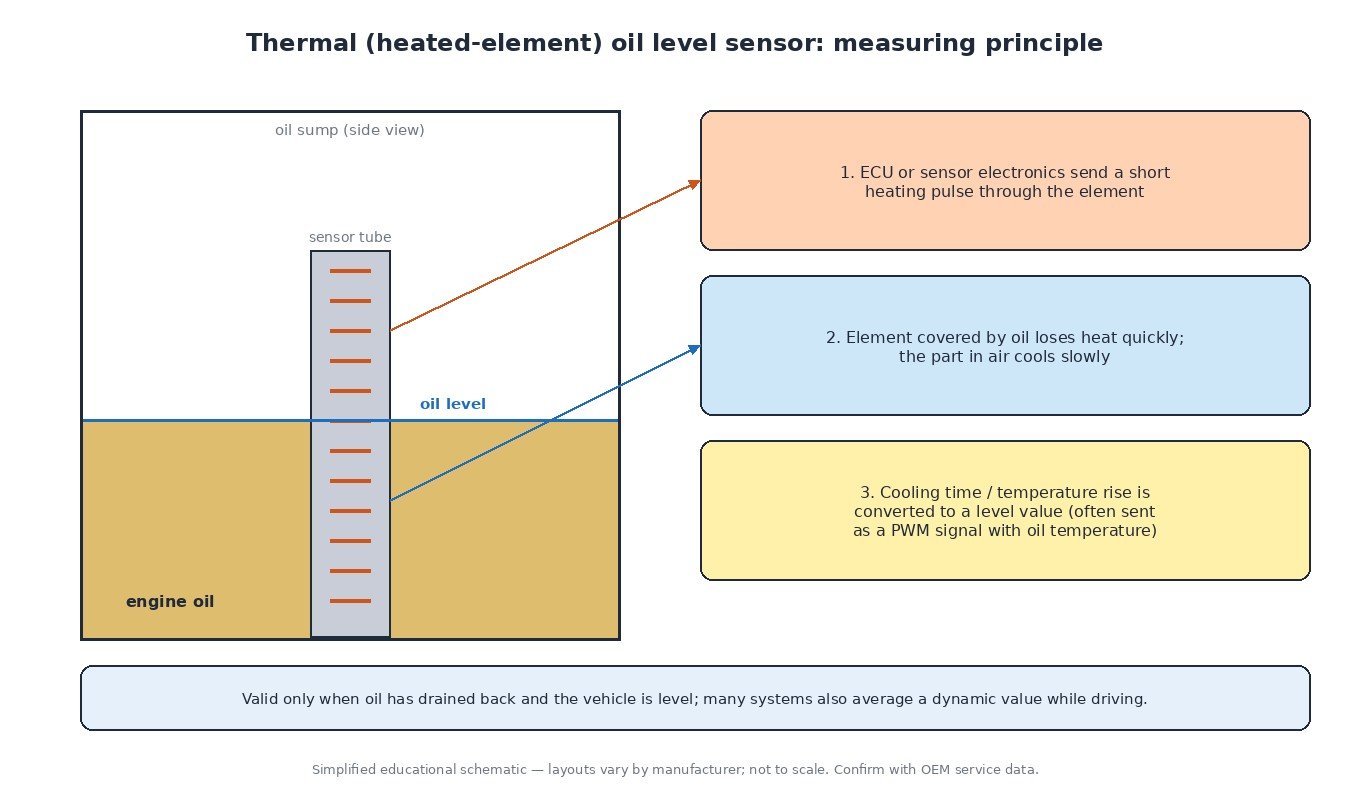
The most widespread passenger car design uses a heated element inside a tube that reaches up from the bottom of the sump. Electronics apply a short heating pulse, then measure how quickly the element cools. The part submerged in oil loses heat much faster than the part surrounded by air, so the cooling behaviour indicates how much of the element is covered. Many of these sensors also contain a temperature element and send both values as a pulse-width modulated (PWM) signal or over a LIN bus.
Ultrasonic level sensors
An ultrasonic sensor sits at the bottom of the sump and sends a sound pulse upwards. It measures the time until the echo returns from the oil surface; with the known speed of sound in oil, corrected for temperature, it calculates the oil height. This gives a continuous reading, but software must filter out sloshing, foaming and cornering forces.
Oil condition sensors
Some engines use a sensor that measures the oil’s electrical permittivity, typically with a capacitive element. Permittivity changes as oil oxidises, takes on soot, water or fuel, so the value helps the ECU estimate remaining oil life. It does not replace a level reading, and the exact interpretation is manufacturer-specific.
The oil temperature sensor
Oil temperature is usually measured with an NTC thermistor, in its own housing or combined with the level sensor. The ECU feeds it from a 5 V reference through a pull-up resistor: as oil warms, resistance and signal voltage fall. Oil temperature is used for oil life calculation, warm-up strategies, thermal management and protection against overheating under heavy load.

How the ECU and cluster use the data
- Static measurement. The most accurate value is taken with the engine off, the vehicle level and after enough time for oil to drain back into the sump. Many cars only show a level after the ignition has been on for a while with the engine stopped.
- Dynamic measurement. While driving, the system averages readings over time and only accepts them in stable conditions (steady speed, low lateral and longitudinal acceleration, warm oil).
- Warnings. Low level triggers a lamp or message; some systems also warn about overfill, which can cause foaming and crankcase pressure problems.
- Service interval. Oil temperature, condition data, fuel quantity burned and engine load feed flexible service calculations.
- Fuel dilution models. On diesels, post-injection during DPF regeneration can wash fuel into the oil. Some ECUs model the dilution and may request an oil change earlier; a level that slowly rises between services is a classic sign.
- Networks. On trucks, buses and agricultural machines, level and temperature are typically shared over J1939 as SPN 98 and SPN 175. Our J1939 guide explains how to read the FMI with them.
Common faults and what they look like
A sensor fault usually sets a circuit code and removes the level display, while a real low-level condition sets a “level too low” code with a plausible signal. Typical sensor problems are oil leaks at the sensor seal, corroded connectors at the bottom of the engine where water and road salt collect, harness damage from a careless undertray fitting and internal electronic failure. Readings taken on a slope or right after switching off are the most common cause of false complaints.
Step-by-step diagnosis
- Check the oil the old way. Park on level ground, wait the manufacturer’s drain-back time and use the dipstick or the specified procedure. Note the oil grade and whether it smells of fuel or looks milky.
- Read codes and freeze frame. Note whether the code is a circuit fault or a level fault and the conditions when it set.
- Live data. After a cold soak, oil temperature should be close to coolant and intake air temperature. Compare with the ECT sensor reading.
- Inspect the sensor area. Look for oil at the sensor seal, a damaged connector and chafed wiring along the sump.
- Test the circuit. Back-probe supply, ground and signal. Do a loaded voltage drop test on the ground and compare the PWM duty cycle or voltage with the manufacturer’s specification, not with a guessed value.
- After repair. Clear codes, perform any required service or level reset and confirm a stable reading over a full drive cycle.

If oil level is genuinely low, also check oil pressure behaviour; our oil pressure sensor guide covers the next line of defence.
Notes for tuners
Oil level and temperature protections should stay active in any performance calibration. Higher power means more heat in the oil, so oil temperature derates and warnings matter even more on tuned engines, track cars and machines working at full load all day. Always start from a healthy engine with correct oil level and a full original read.
Related fault codes (DTCs)
| Code | Meaning | Typical causes |
|---|---|---|
| P250A | Engine oil level sensor circuit | Failed level sensor, open or shorted wiring, corroded connector at the sump |
| P250B | Engine oil level sensor circuit range/performance | Implausible reading, oil overfilled or underfilled, contaminated or wrong sensor, measurement taken on a slope |
| P250C | Engine oil level sensor circuit low | Signal shorted to ground, missing supply, internal sensor fault |
| P250D | Engine oil level sensor circuit high | Signal open or shorted to voltage, broken ground, internal sensor fault |
| P250E | Engine oil level sensor circuit intermittent/erratic | Loose terminals, chafed harness near the sump, oil or water in the connector |
| P250F | Engine oil level too low | Genuinely low oil (consumption or leak), reading taken before drain-back, skewed sensor |
| P0195 | Engine oil temperature sensor circuit | Failed NTC sensor, open or shorted wiring |
| P0196 | Engine oil temperature sensor range/performance | Skewed sensor, value disagrees with coolant/intake temperature after a cold soak |
| P0197 | Engine oil temperature sensor low | Signal shorted to ground, failed sensor (reads very hot) |
| P0198 | Engine oil temperature sensor high | Open circuit, poor connection, failed sensor (reads very cold) |
| P0199 | Engine oil temperature sensor intermittent | Loose or corroded terminals, intermittent harness fault |
| P0524 | Engine oil pressure too low | Low oil level, wrong viscosity, worn pump or bearings; check level first |
| SPN 98 (J1939) | Engine oil level | Read with the FMI (e.g. 1 = data valid but below normal, 3/4 = voltage high/low) on trucks, buses and agricultural machines |
| SPN 175 (J1939) | Engine oil temperature 1 | Sensor or circuit fault, or a genuine overheating condition, depending on the FMI |
Generic SAE OBD-II codes plus the J1939 heavy-duty equivalents. Manufacturer-specific codes may also exist; always confirm with the service data for the vehicle.
Need a tuning file for a car, truck, tractor or motorcycle that keeps engine protection intact? Order professionally developed ECU files at ecufilemarket.com.