
Plug a scan tool into a modern truck, tractor, combine or construction machine and you will rarely see a simple five-character code like P0299. Instead you get something like SPN 110 FMI 0, OC 3, often from several control units at once. These are SAE J1939 diagnostic trouble codes. Once you understand how they are built, they are often more informative than passenger-car codes. This guide explains what SPN, FMI and OC mean, how the DM1 and DM2 messages work, and how to use that information to diagnose heavy-duty and agricultural vehicles faster.

Why heavy-duty vehicles use J1939 codes
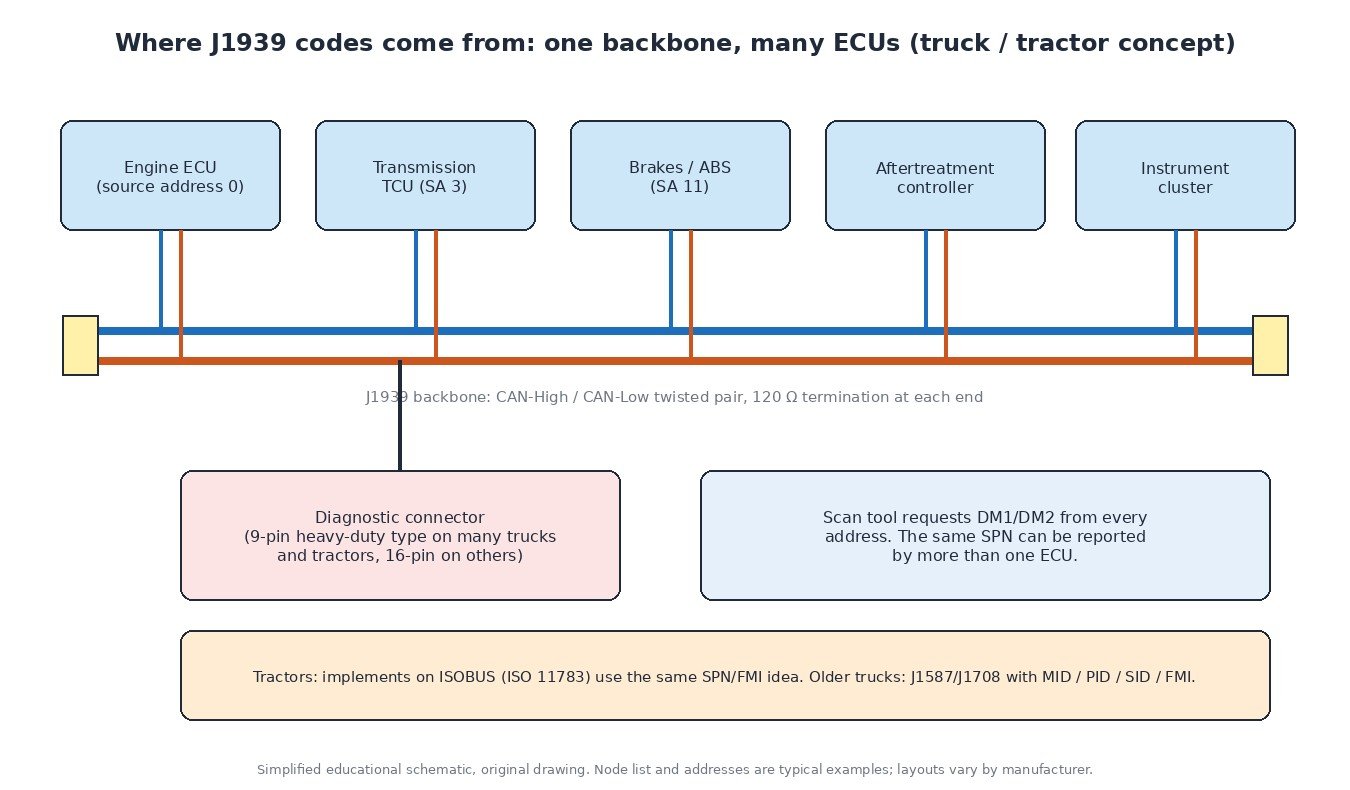
J1939 is the SAE standard family for communication and diagnostics on commercial vehicles. It runs on the same CAN physical layer described in our CAN bus guide: a twisted CAN-High/CAN-Low pair with a 120 Ω terminating resistor at each end of the backbone. Engine, transmission, brakes, aftertreatment, cab controllers and the instrument cluster all share that backbone. Each one has a source address (for example 0 is usually engine #1 and 3 is transmission #1).
Agricultural machines use the same idea. Tractor and implement networks based on ISOBUS (ISO 11783) are built on J1939 concepts, so tractors and many implements report faults with the same SPN/FMI structure. Older trucks may still use J1587/J1708, where faults appear as MID, PID or SID plus FMI.
Anatomy of a J1939 DTC
Each J1939 DTC is four bytes (32 bits) long and has four parts:
- SPN – Suspect Parameter Number (19 bits). This tells you what is affected: a sensor, an actuator, a calculated value or a network. SPN 110 is engine coolant temperature, SPN 100 is engine oil pressure, SPN 190 is engine speed and SPN 91 is accelerator pedal position 1.
- FMI – Failure Mode Identifier (5 bits, 0–31). This tells you how it failed: out of range, erratic, shorted high or low, open circuit, not responding, and so on.
- CM – Conversion Method (1 bit). Current ECUs use CM = 0. Some very old units used earlier layouts, so a generic tool can occasionally decode a strange SPN.
- OC – Occurrence Count (7 bits). This tells you how often the fault has gone from inactive to active. A high count on an intermittent fault strongly points to wiring or connectors.
The same SPN can appear with different FMIs. That is the whole point. SPN 110 FMI 0 means the coolant temperature reading is valid but above the normal range, so the engine really is overheating. SPN 110 FMI 4 means the sensor signal voltage is too low, which is an electrical fault, and the engine may be perfectly cool. Same component, completely different repair.
DM1, DM2 and the warning lamps
J1939 diagnostics are organised into numbered diagnostic messages (DM). The ones every technician should know are:
- DM1 – active DTCs. Each ECU with an active fault broadcasts DM1, typically once per second. When there is more than one fault, the message is sent in several CAN frames using the J1939 transport protocol.
- DM2 – previously active DTCs. Stored faults that are no longer present, read on request and useful for intermittent complaints.
- DM3 and DM11. These clear previously active and active DTCs respectively.
The first two bytes of DM1 carry the lamp status: malfunction indicator lamp (MIL), red stop lamp, amber warning lamp and protect lamp. A red stop lamp means stop safely as soon as possible. It is often linked to engine protection strategies such as torque derate or shutdown for low oil pressure or high coolant temperature, as described in our article on ECU limiters and derates.
The FMIs you will see most often
The FMI is the fastest way to decide whether you are chasing a real mechanical condition or an electrical fault:
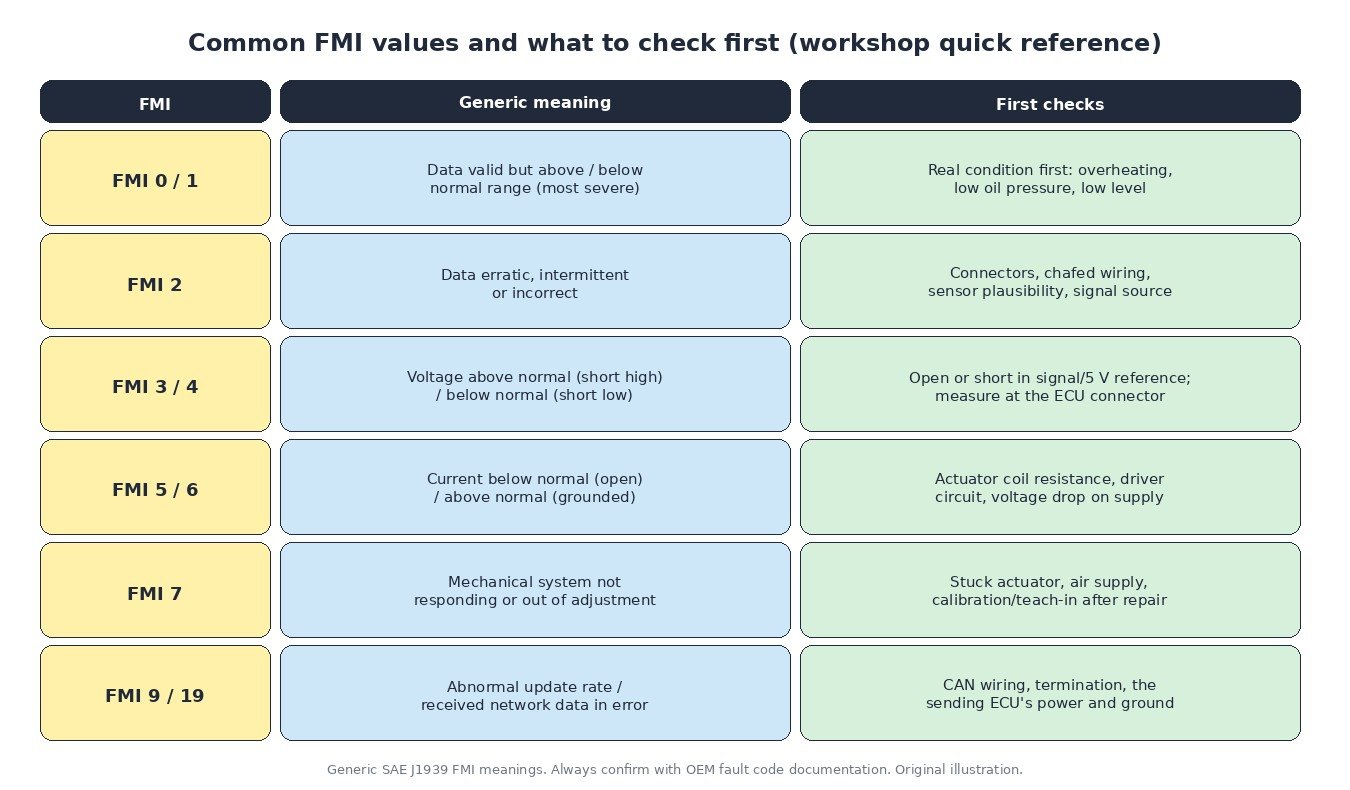
- FMI 0 / 1 – data valid but above / below the normal operating range (most severe). FMI 15–18 are the less severe versions. Confirm the real condition with an independent gauge before suspecting the sensor.
- FMI 2 – data erratic, intermittent or incorrect. Think loose pins, chafed harnesses or two sensors that disagree.
- FMI 3 / 4 – voltage above normal or shorted high / voltage below normal or shorted low.
- FMI 5 / 6 – current below normal or open circuit / current above normal or grounded circuit. Typical for solenoids, heaters and actuators.
- FMI 7 – mechanical system not responding or out of adjustment, for example a sticking actuator, low air supply or a missing teach-in after repair.
- FMI 9 / 19 – abnormal update rate / received network data in error. This often means the problem is not the reporting ECU but the network or the ECU that should be sending the data.
A practical diagnostic workflow
- Read every ECU, not just the engine. Note the source address of each code. A gearbox code may simply be reacting to an engine fault. Our truck AMT guide shows how closely engine and TCU work together.
- Separate DM1 from DM2. Active codes come first. Previously active codes with a high occurrence count are your intermittent leads.
- Read the FMI before touching parts. FMI 0/1 means verify the real condition. FMI 3–6 means electrical checks at the ECU connector. FMI 9/19 means look at the network.
- Check power and grounds under load. Low supply voltage on 24 V systems causes many false codes, so follow our voltage drop testing guide.
- Use live data and OEM documentation. Generic SPN/FMI meanings are standardised, but limits, OEM-specific SPNs and fault reactions are manufacturer specific.
- Clear and verify. After the repair, clear the codes and run the machine under the conditions that set the fault. Then confirm that DM1 stays empty.
Why this matters before ECU work
Before any calibration work on a truck or tractor, read and save the full fault list from all control units, along with a complete original read of the ECU. Existing faults such as low rail pressure (SPN 157), boost faults (SPN 102) or water in fuel (SPN 97, see our fuel filter and WIF guide) should be fixed first. A healthy, fault-free machine is the only sensible starting point for any file change, and the engine’s protection strategies should stay in place.
Related fault codes (DTCs)
| Code | Meaning | Typical causes |
|---|---|---|
| SPN 110 FMI 0 | Engine coolant temperature – data valid but above normal range (most severe) | Real overheating: low coolant, fan drive not engaging, thermostat, blocked radiator or charge-air cooler stack |
| SPN 110 FMI 3 / FMI 4 | Engine coolant temperature sensor – voltage above normal / below normal | Open circuit or short to battery (FMI 3), short to ground (FMI 4), damaged connector, failed sensor |
| SPN 111 FMI 1 | Engine coolant level – below normal (most severe) | Coolant leak, level sensor or wiring fault, air trapped after a repair |
| SPN 100 FMI 1 | Engine oil pressure – below normal (most severe) | Low oil level, wrong viscosity, worn pump or bearings, faulty sender – verify with a mechanical gauge |
| SPN 102 FMI 1 / FMI 18 | Intake manifold (boost) pressure – below normal | Charge-air leaks, turbocharger or VGT actuator problems, sensor or hose fault |
| SPN 157 FMI 1 / FMI 18 | Injector metering rail 1 (fuel rail) pressure – below normal | Blocked filters, air in fuel, weak feed pump, high-pressure pump or injector leakage |
| SPN 97 (FMI varies) | Water in fuel indicator | Water in the separator bowl, sensor or wiring fault |
| SPN 91 FMI 3 / FMI 4 | Accelerator pedal position 1 – voltage above / below normal | Pedal sensor, 5 V reference or signal wiring, connector corrosion |
| SPN 190 FMI 2 / FMI 8 | Engine speed – erratic / abnormal frequency | Crank speed sensor air gap, damaged tone wheel, wiring interference |
| SPN 168 FMI 4 | Battery potential (power input 1) – voltage below normal | Weak batteries, charging fault, voltage drop on supply cables or ECU grounds |
| SPN 639 (FMI varies) | J1939 network #1 (primary vehicle network) | CAN wiring damage, missing or extra termination, an ECU dragging the bus down |
Generic SAE J1939 meanings are shown. FMI usage, limits and OEM-specific SPNs vary by manufacturer, so always confirm with the manufacturer’s fault code documentation. For the passenger-car side of fault memory, see our guide to OBD readiness monitors and freeze frame.
Working on trucks, tractors or construction machines? Get professionally developed ECU files for heavy-duty, agricultural, car and bike applications at ecufilemarket.com.