
Engine oil does more than lubricate: it cools bearings, drives hydraulic cam phasers, feeds turbochargers and, on many modern engines, is pressure-controlled by the ECU. The oil pressure sensor (or switch) is the feedback device that lets the control unit know whether that system is healthy. This guide explains how oil is pumped and pressurized, how a switch differs from an analog transducer, how the ECU uses the signal for warnings and protection, and how to approach the common P0520–P0524 codes on cars, vans, trucks, agricultural machines and bikes.
How the lubrication circuit works
Oil sits in the pan (sump). A pickup tube with a strainer feeds the oil pump — usually a gear, rotor (trochoid) or vane design driven by the crankshaft or a chain. The pump raises pressure and pushes oil through the filter, often through an oil cooler, into the main galleries drilled in the block and head. From there, oil reaches the main and rod bearings, camshaft bearings, hydraulic tappets or phasers, and often a turbocharger feed. After lubricating each surface it drains back to the pan and the cycle repeats.
A pressure relief valve protects the system: when pump output exceeds what the engine needs (cold thick oil, high rpm), the valve opens and dumps excess oil back to the sump or pump inlet. Without that relief, seals and the filter bypass could be overstressed. Never invent numeric pressure targets — idle and high-load values differ widely by engine, oil grade and temperature. Always check OEM service data for the vehicle you are working on.
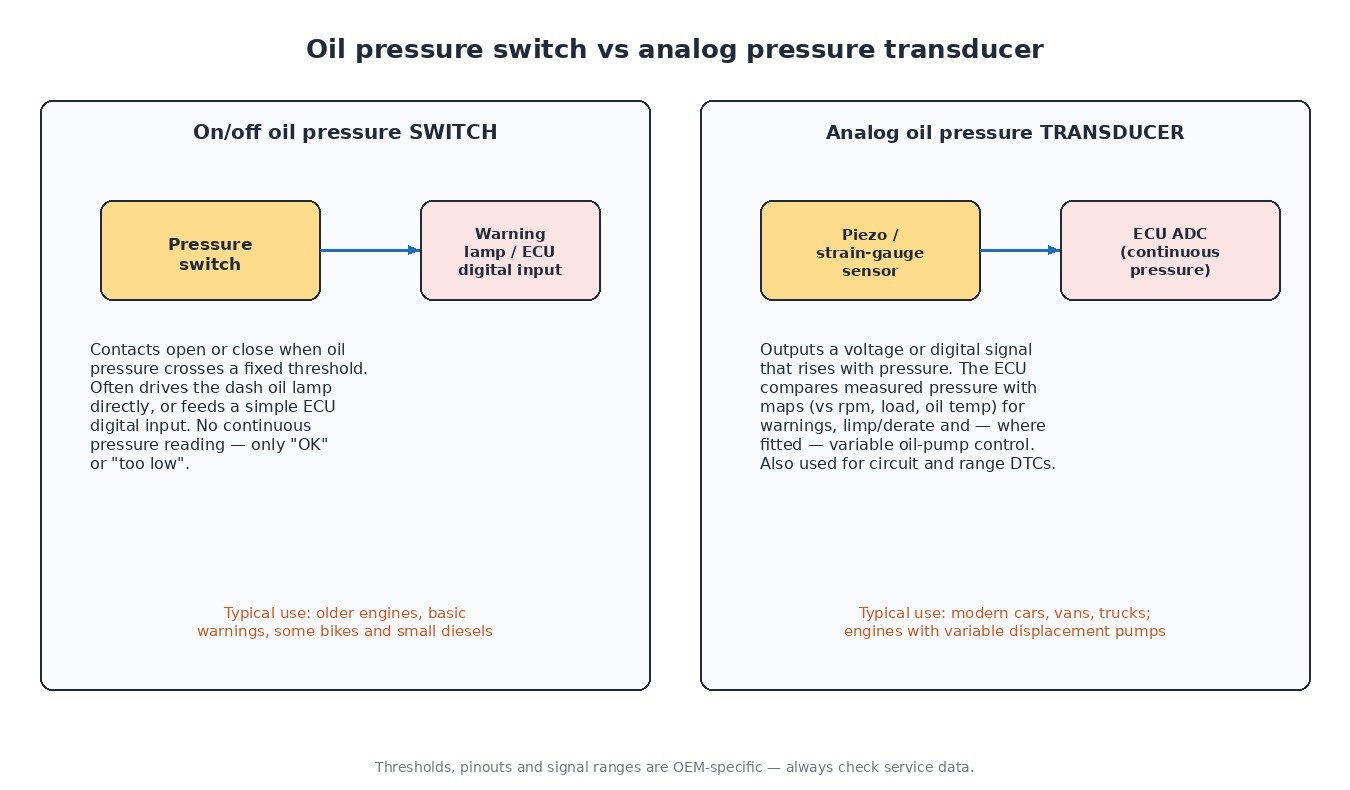
Sensor versus switch
Older and simpler engines often use an oil pressure switch: a mechanical contact that opens or closes when pressure crosses a fixed threshold. It typically drives the dashboard oil lamp directly, or feeds a digital ECU input. You only learn “pressure OK” or “pressure too low” — there is no continuous reading.
Most modern cars, vans and trucks use an analog oil pressure transducer (sensor). A piezoresistive or strain-gauge element converts pressure into a voltage (or a digital network message) that the ECU’s ADC reads continuously. That lets the control unit compare measured pressure against maps that depend on engine speed, load and often oil temperature. Circuit faults, range/performance problems and true low-pressure conditions can then be diagnosed separately.
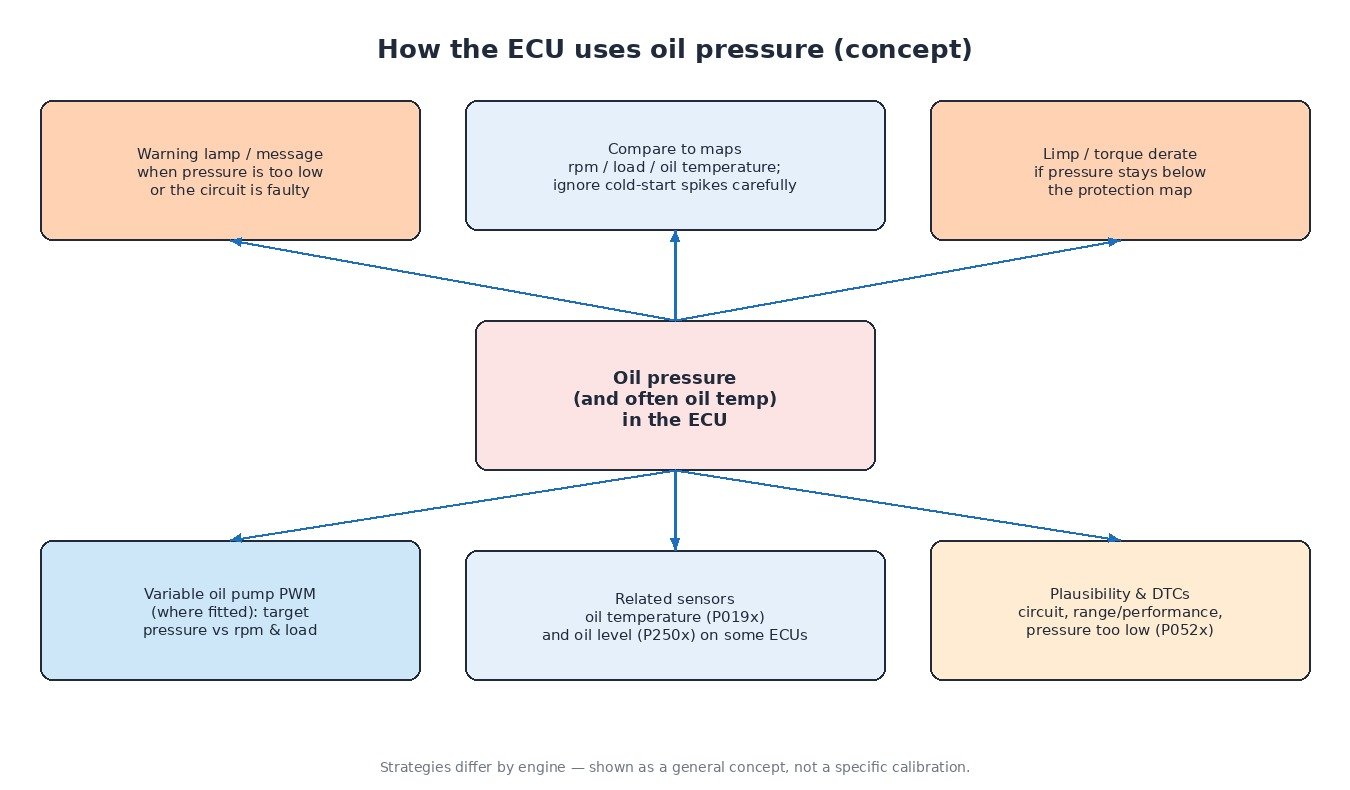
How the ECU uses oil pressure
- Warning lamp or message — if pressure is too low for the current operating point, or the circuit fails, the driver is alerted immediately.
- Limp / torque derate — many ECUs reduce fuel and torque when oil pressure stays below a protection threshold, to avoid bearing damage. Do not disable this to “fix” a remap.
- Variable oil pump control — engines with electrically controlled variable-displacement pumps use the sensor in closed loop. The ECU commands a target pressure via PWM or a similar driver and trims the pump to match rpm and load, saving parasitic losses when high pressure is not needed.
- Plausibility — cold thick oil produces higher pressure than hot thin oil at the same rpm; the ECU expects that relationship. An implausible reading sets range/performance codes.
Some ECUs also read oil temperature (related P0195–P0198 family) and oil level (P250A/P250B on some applications). Temperature affects viscosity and therefore pressure; level faults can precede pressure loss. Treat those as related, not interchangeable, diagnostics.
Diagnostics in practice
- Confirm the symptom. Is the lamp on at idle only, at all speeds, or only hot? Note freeze-frame rpm, load and oil/coolant temperature.
- Mechanical first when pressure is truly low. Check oil level and grade, listen for pump noise, inspect for internal leaks or a stuck relief valve. A mechanical gauge on the gallery is the reference — compare it with the scan-tool value before condemning the sensor.
- Circuit tests for P0520–P0523. Verify reference voltage, signal and ground. Opens and shorts drive the reading to the ends of the scale. Chafed harnesses near the block and oil-soaked connectors are common.
- Range/performance (P0521) and pressure too low (P0524). Compare sensor output with a known-good mechanical gauge across idle, mid-rpm and high load. If the gauge is healthy but the sensor is wrong, replace the sensor. If both are low, the problem is mechanical or the oil itself.
- Variable-pump systems. Command pump duty with a bidirectional tool where available, and confirm pressure follows. A stuck solenoid or seized pump vane set looks like a sensor fault until you measure real gallery pressure.
Cars, vans, trucks, agricultural machines and bikes
Passenger cars and light vans increasingly use analog sensors and variable pumps. Heavy trucks and Stage IV/V tractors often run higher gallery volumes and long feed lines to turbos and gearboxes; pressure loss under sustained high load is a workshop red flag. Agricultural machines spend hours at elevated rpm with warm oil, so derates from low oil pressure show up under PTO work. Motorcycles may still use a simple switch and a dash lamp; larger tourers and some sport engines add a sender for a gauge. In every case, OEM pressure specs and wiring diagrams beat generic “typical” numbers.
Related fault codes (DTCs)
Generic SAE J2012 codes. Thresholds and pinouts are manufacturer-specific — confirm with service data.
| Code | Meaning | Typical causes |
|---|---|---|
| P0520 | Engine Oil Pressure Sensor/Switch Circuit | Open/short in harness, failed sensor/switch, connector corrosion |
| P0521 | Engine Oil Pressure Sensor/Switch Range/Performance | Drifting sensor, wrong oil grade/level, relief valve issues, implausible vs rpm/temp |
| P0522 | Engine Oil Pressure Sensor/Switch Low | Signal shorted low, failed sensor, wiring to ground |
| P0523 | Engine Oil Pressure Sensor/Switch High | Open circuit, disconnected connector, signal shorted to voltage |
| P0524 | Engine Oil Pressure Too Low | Low oil level, worn pump, stuck relief open, internal leak, clogged pickup |
| P0195 | Engine Oil Temperature Sensor Circuit | Oil temp sensor or wiring fault |
| P0196 | Engine Oil Temperature Sensor Range/Performance | Drifting oil temp sensor, implausible vs ECT after soak |
| P0197 | Engine Oil Temperature Sensor Low | Signal low / short to ground |
| P0198 | Engine Oil Temperature Sensor High | Open circuit or signal high |
| P250A | Engine Oil Level Sensor Circuit | Oil level sensor or wiring fault |
| P250B | Engine Oil Level Sensor Circuit Range/Performance | Implausible level reading, contaminated sensor |
What it means for tuning
Raising torque raises bearing loads. A responsible calibration leaves oil-pressure monitoring, warning thresholds and any limp/derate strategy intact. On engines with variable oil pumps, do not “optimize” pump maps in a way that starves bearings at high load. Fix low oil pressure, wrong viscosity oil, or a faulty sensor before you remap. Logging gallery pressure (or the OEM PID) under sustained load after a tune is good practice — especially on turbo diesels that tow or work under PTO.
Want a file that respects oil-pressure protection and component limits? Order your tuning file from ECUFileMarket.