
On a modern diesel truck, tractor or combine, the fuel filters are not a routine service item you can stretch. Common-rail and other high-pressure injection systems work with extremely tight clearances, and a small amount of water or dirt can ruin a high-pressure pump and a full set of injectors. This guide explains how diesel fuel filtration and water-in-fuel (WIF) detection work, what the ECU does with the sensor signals, and how to diagnose the problems that start on the low-pressure side.
Why water and dirt destroy high-pressure systems
Diesel fuel is also the lubricant for the high-pressure pump plungers and the injector needles and valves. Water has almost no lubricating ability, so when it reaches these parts the metal surfaces scuff and wear quickly. Water also causes corrosion inside the pump and injectors while the machine stands, and it supports microbial growth (often called “diesel bug”) at the fuel/water boundary in the tank, which produces sludge that blocks filters.
Hard particles are just as dangerous. In a high-pressure system even very fine abrasive particles erode valve seats and nozzle holes, change injected quantities and cause leakage. The worst case is a failed pump that sends metal debris through the whole high-pressure side.
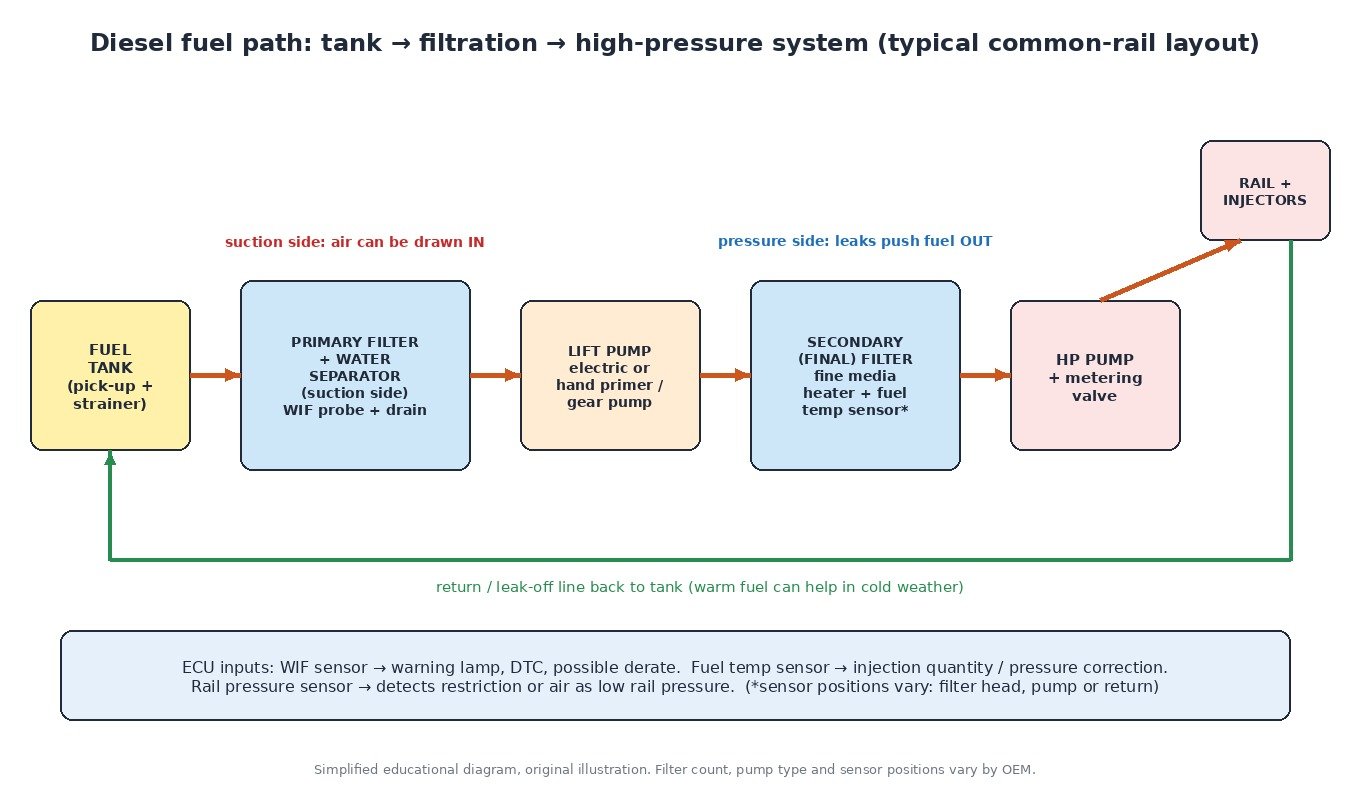
Primary vs secondary filters
Primary filter and fuel/water separator
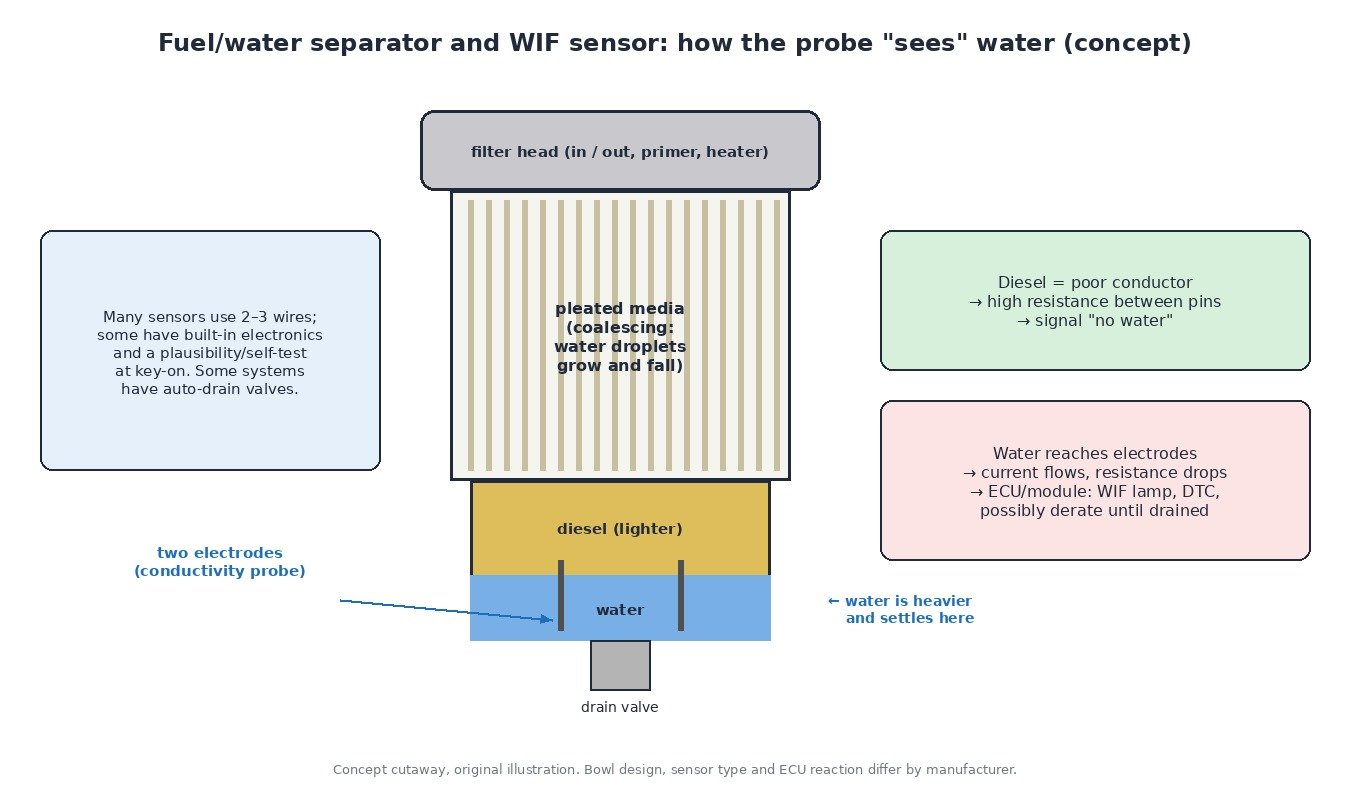
On most trucks and agricultural machines the first stage is a primary filter combined with a water separator, often on the suction side between the tank and the lift pump. Its media is coarser and is designed to make tiny water droplets merge (coalesce) into larger drops. Because water is heavier than diesel, these drops fall into a sump or clear bowl at the bottom, from where they are drained through a drain valve. Many housings also carry a hand primer, a heater and the WIF sensor.
Secondary (final) filter
The secondary filter has finer media and protects the high-pressure pump directly. It is usually on the pressure side after the lift pump. Cars and vans normally have a single filter cartridge that combines both jobs, with a water drain screw and, on many models, a WIF sensor and heater in the same housing.
How the WIF sensor works
Most WIF sensors are simple conductivity probes: two electrodes protrude into the bottom of the separator sump. Diesel is a very poor electrical conductor, so with clean fuel the resistance between the electrodes is high. When the water level rises to the electrodes, current can flow and the resistance drops. Some sensors are just two pins read by the ECU; others contain a small electronic circuit with a defined output and a self-test at key-on, during which the warning lamp may briefly light.
When water is detected, the ECU or instrument cluster turns on the water-in-fuel lamp and stores a fault such as P2269. Depending on the manufacturer and machine, the system may only warn the driver, or it may derate engine power after a time or if water keeps rising, to protect the injection system until the separator is drained. Some heavy-duty systems use automatic drain valves controlled by the ECU. Circuit faults are reported separately from a real water condition.
Fuel heaters, waxing and cloud point
Diesel contains paraffin that starts to form wax crystals as the temperature falls. The temperature where the fuel first turns hazy is the cloud point; below it, crystals collect on the filter media and can block flow completely. The fuel filter is usually the first place where waxing causes trouble, typically on a cold morning shortly after starting.
To prevent this, many filter housings contain an electric heater, commonly a PTC (positive temperature coefficient) element. Its resistance rises as it warms, so it limits its own current and temperature. Some heaters are switched by a thermostat or by the ECU, and many systems also route warm return fuel back to the filter or tank. Winter-grade fuel remains the main protection.
Fuel temperature sensor
Most common-rail engines have an NTC fuel temperature sensor in the filter head, the high-pressure pump or the return line. Fuel density and viscosity change with temperature, so the ECU uses this signal to correct injection quantity and rail pressure control, and on some engines it reduces power if fuel temperature gets too high to protect the pump and injectors. A faulty sensor (P0180–P0183) can cause incorrect fuelling or derate.
Priming, lift pumps and air ingress
After a filter change, the system has to be primed. Older and many agricultural machines use a hand primer pump on the filter head; most current trucks and cars use an electric lift pump that runs for a set time at key-on, or a priming routine via the diagnostic tool. Air in the system shows up as long cranking, rough running or stalling, and as rail pressure that cannot reach its target.
On the suction side the line is under slight vacuum, so a loose clamp, cracked hose, damaged O-ring or worn primer seal will draw air in without leaking any fuel. That makes suction-side air leaks hard to find by eye. A clear test hose before the high-pressure pump is one of the most useful tools in the workshop.
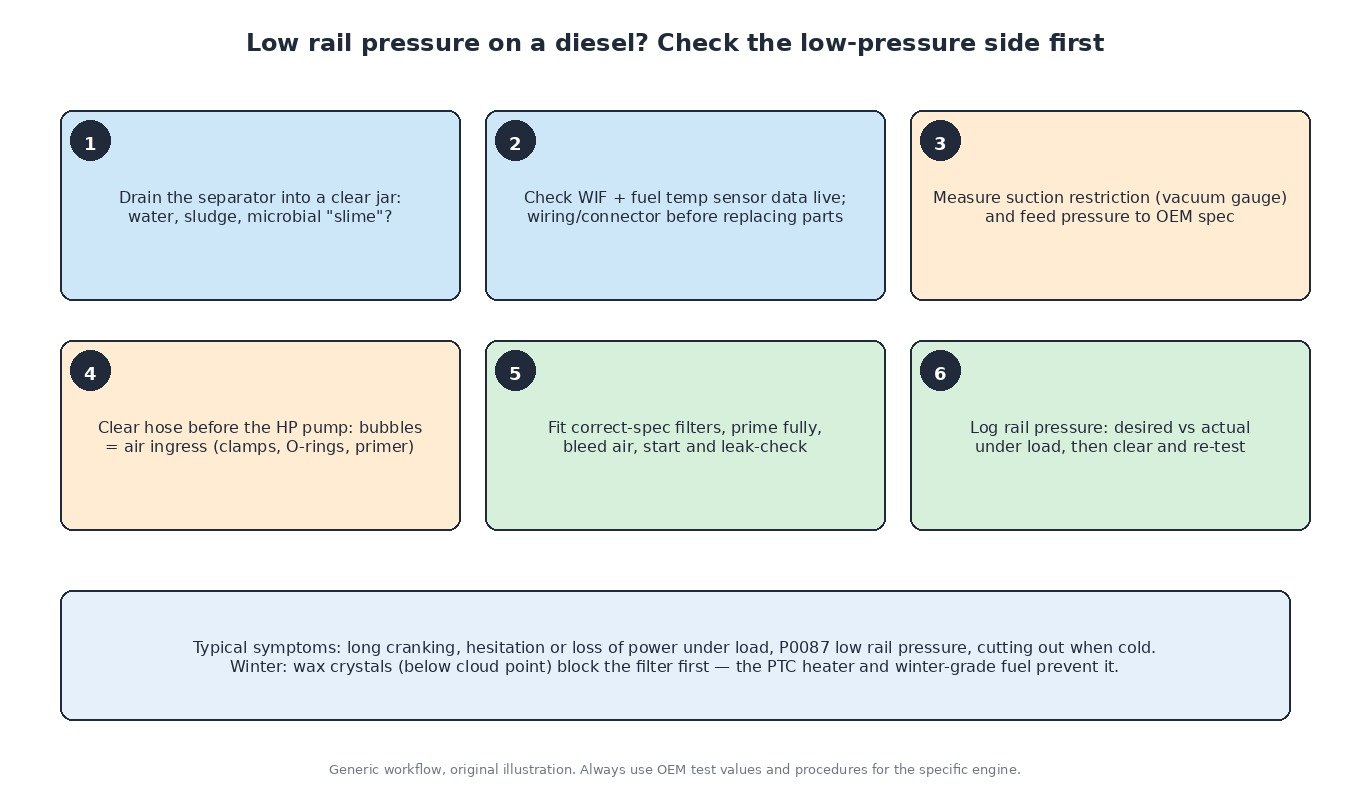
Service tips and diagnostics
- Drain water regularly, following the OEM interval and every time the WIF lamp lights. Collect the fluid in a clear jar and look for water, sludge or slime, which point to tank contamination.
- Use the correct filter. Media grade and water-separating ability vary a lot; a cheap cartridge that fits is not necessarily one that protects the injection system.
- Do not pre-fill the final filter with unfiltered fuel; prime with the primer or lift pump instead, so dirt is not delivered straight to the high-pressure pump.
- Measure restriction. A vacuum gauge on the suction side reveals a blocked filter, pinched line or tank pick-up strainer problem. Compare with OEM limits.
- Check feed pressure after the lift pump to specification, at idle and under load.
- Log rail pressure (desired vs actual) under load. Low actual pressure with P0087, especially when it gets worse at high load, often starts with restriction or air on the low-pressure side, before blaming the pump, metering valve or injectors.
- Check the WIF circuit with live data and a multimeter before replacing the sensor, and look for corroded connectors at the bottom of the filter where water and road salt collect.
For more background, see our guides to low-pressure fuel supply and lift pumps, common-rail pressure control and glow plugs and cold starting.
Before any remap, check filters, feed pressure and rail pressure: more power needs more fuel. WIF and fuel temperature protections should always stay active.
Related fault codes (DTCs)
These generic SAE codes are commonly seen around fuel filtration, water-in-fuel detection and low-pressure supply problems. Heavy-duty engines may also report J1939 SPN/FMI codes; always check the OEM description.
| Code | Meaning | Typical causes |
|---|---|---|
| P2269 | Water in Fuel Condition | Water collected in the separator sump, contaminated fuel or tank, separator not drained at service interval |
| P2264 | Water in Fuel Sensor Circuit | Open or shorted WIF sensor wiring, corroded connector, failed sensor |
| P2265 | Water in Fuel Sensor Circuit Range/Performance | Implausible sensor signal, contaminated or damaged probe, wrong sensor fitted |
| P2266 | Water in Fuel Sensor Circuit Low | Signal shorted to ground, water/moisture in connector, sensor fault |
| P2267 | Water in Fuel Sensor Circuit High | Open circuit, disconnected sensor, short to voltage |
| P2268 | Water in Fuel Sensor Circuit Intermittent | Loose or corroded terminals, chafed harness near the filter housing |
| P0180 | Fuel Temperature Sensor A Circuit | Wiring or connector fault, failed NTC sensor |
| P0181 | Fuel Temperature Sensor A Circuit Range/Performance | Implausible reading versus other temperature sensors, sensor drift |
| P0182 | Fuel Temperature Sensor A Circuit Low | Signal shorted to ground, failed sensor |
| P0183 | Fuel Temperature Sensor A Circuit High | Open circuit, disconnected sensor, poor ground |
| P0087 | Fuel Rail/System Pressure Too Low | Blocked or waxed filter, air ingress, weak lift pump, suction restriction, worn HP pump, metering valve or injector leak-off |
| P0093 | Fuel System Large Leak Detected | External high-pressure leak, pressure relief valve open, high injector leak-off, sensor fault |
Need a custom tuning file for your truck, tractor, van or car, built on your original read? Upload your file at ecufilemarket.com and our team will prepare it for you.