
A stretched timing chain rarely fails without warning. Long before it jumps a tooth, the engine control unit can usually see it: the camshaft signal slowly drifts late against the crankshaft signal. That is why codes such as P0016 or P0008 often appear on high-mileage chain-driven engines. This guide explains how a timing chain drive works, how the ECU measures cam-to-crank correlation, and how to diagnose these faults properly before replacing parts or touching a calibration.

How a timing chain drive works
The timing drive keeps the camshafts locked to the crankshaft at a fixed ratio: on a four-stroke engine the cams turn once for every two crank revolutions. Chain drives are popular because they are compact and designed to last much longer than a rubber belt. A typical system contains:
- Sprockets on the crankshaft and on each camshaft. With variable valve timing (VVT), the cam sprocket is part of a hydraulic or electric cam phaser.
- The chain itself, usually a roller or silent (inverted-tooth) chain.
- A tensioner, usually hydraulic and fed by engine oil, often with a spring and a ratchet. It pushes a pivoting guide against the slack side of the chain.
- Fixed guide rails with plastic wear faces that control chain whip on the tight side.
“Chain stretch” is not the steel plates getting longer. It is wear between the pins and bushes of every link. Each joint gains a tiny amount of play, and across the whole chain that adds up to a measurable increase in length. The tensioner takes up the slack until it runs out of travel. The cams then lag the crank more and more.
Why chains stretch
- Oil quality and service intervals. Soot from diesel combustion or fuel dilution makes the oil more abrasive, so very long oil change intervals speed up wear.
- Wrong oil grade or low oil level, which affects both lubrication and hydraulic tensioner pressure.
- Design weaknesses in particular engine families, such as undersized tensioners or guides that crack.
How the ECU measures cam-to-crank correlation
The crankshaft and camshaft position sensors give the ECU two signals. The crank wheel has many teeth and a reference gap, which gives the ECU fine angular resolution and top dead centre. Each cam trigger wheel has a few segments, which tell the ECU the engine phase and the actual cam position.
The ECU constantly measures where each cam edge appears relative to the crank teeth. When the phaser is in its parked (base) position, typically at idle or during a specific learn condition, the ECU can compare the measured cam position with the position it expects. It stores the difference as an adapted offset, often shown in scan tools as “cam/crank deviation” or “phase adaptation”.
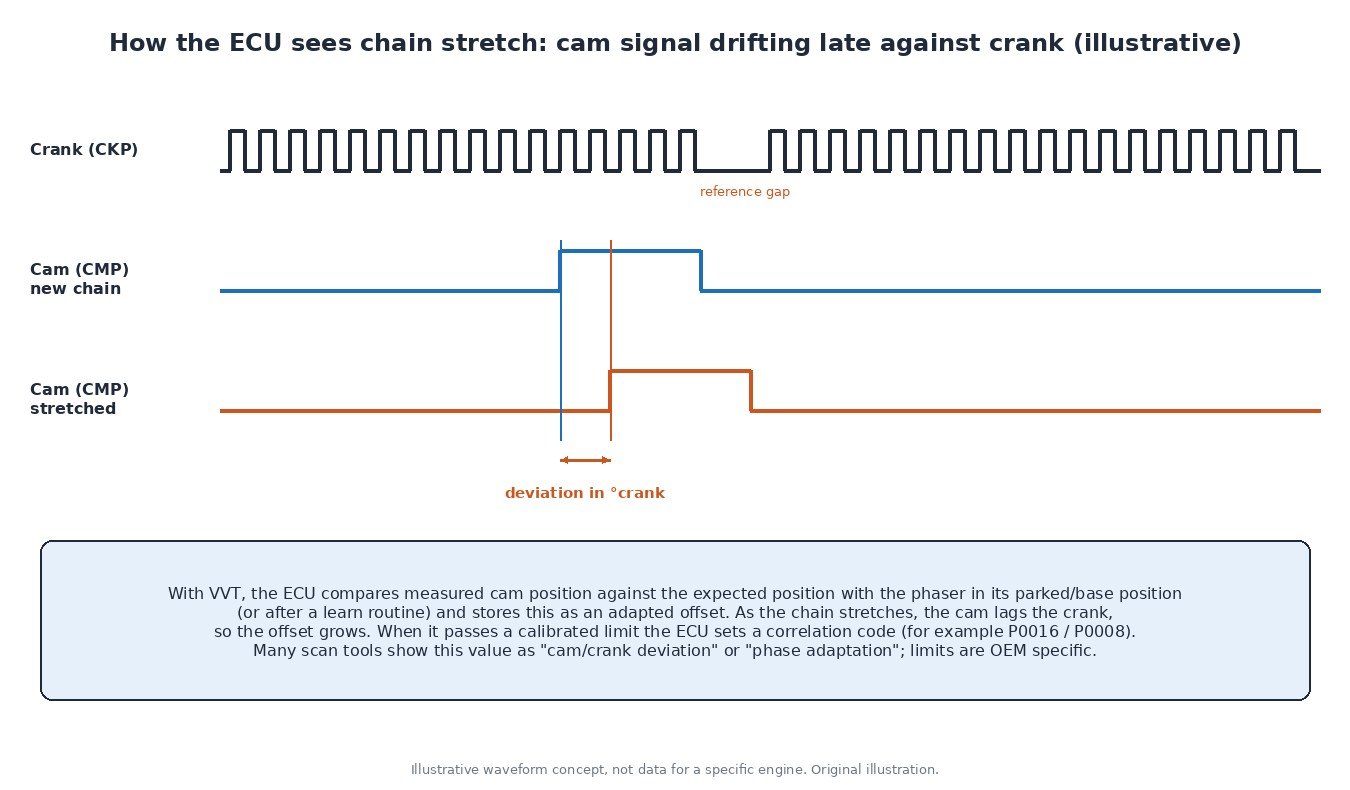
A new engine shows a small offset caused by manufacturing tolerances. As the chain stretches, the offset grows in the “late” direction, usually by a similar amount on both intake and exhaust cams of the same bank. When it passes a calibrated threshold, the ECU sets a correlation DTC and may restrict VVT operation. Thresholds and units are OEM specific, so compare against OEM data.
Chain stretch or something else?
Correlation codes do not automatically mean a chain is worn. The ECU only knows that two signals don’t line up as expected. Other common causes include:
- A cam phaser stuck away from its parked position, or a sticking oil control valve (OCV).
- Low oil pressure or the wrong oil viscosity affecting the phasers. See our guide to the oil pressure sensor and lubrication.
- A damaged trigger wheel, a loose reluctor ring or a wrong replacement sensor.
- Timing set one tooth off after a belt, chain or head job, or an adaptation that was not reset after repairs.
- Wiring faults that distort sensor edges.
One useful clue: if both cams on a bank show a similar late deviation, the chain or crank-side components are more likely than a single phaser. If only one cam is off, look at that phaser, OCV and sensor first.
Diagnostic procedure
- Read all codes and freeze frame data. Note whether VVT faults are stored too.
- Check oil level, grade and condition.
- Read the phase deviation or adaptation values for each camshaft with a capable scan tool and compare them to OEM limits.
- Listen at cold start. A rattle for a few seconds that fades as oil pressure builds suggests a tensioner or stretched chain.
- Scope CKP and CMP together. A dual-channel oscilloscope capture lets you compare the cam edge position against the crank reference gap with a known-good waveform.
- Confirm mechanically. Depending on the engine, that means locking tools, measuring tensioner extension through an inspection port, or checking chain wear as per the service manual.
- After repairs, reset or relearn the adaptation as required, then verify the new values.

Trucks, tractors and motorcycles
Many heavy truck and agricultural diesels use gear-driven timing trains, so chain stretch is not an issue there. Correlation faults on these engines more often point to sensors, wiring, tone wheels or incorrect timing after an overhaul.
Motorcycles commonly use a cam chain with a hydraulic or mechanical (spring and ratchet) tensioner. Many bikes have no cam phaser and log fewer correlation codes, so the noise and a check of tensioner extension are often the first clues.
Calibration and tuning notes
Correlation codes are a mechanical warning, not something to hide in software. Disabling the monitor in a calibration does not stop a chain from wearing. It only removes the early warning before possible valve-to-piston contact on interference engines. Before tuning a high-mileage engine, check the cam/crank deviation values and fix any timing drive problem first. Then make a full original read of the ECU so you always have a backup.
Related fault codes (DTCs)
| Code | Meaning | Typical causes |
|---|---|---|
| P0008 | Engine Position System Performance (Bank 1) | Stretched timing chain, worn tensioner/guides, timing set incorrectly (definition is OEM-dependent) |
| P0009 | Engine Position System Performance (Bank 2) | As P0008, on bank 2 |
| P0016 | Crankshaft Position – Camshaft Position Correlation (Bank 1 Sensor A) | Chain stretch, jumped tooth, stuck phaser/OCV, trigger wheel or sensor fault |
| P0017 | Crankshaft Position – Camshaft Position Correlation (Bank 1 Sensor B) | As P0016, on the second (usually exhaust) camshaft |
| P0018 / P0019 | Crankshaft Position – Camshaft Position Correlation (Bank 2 Sensor A / B) | As P0016/P0017, on bank 2 |
| P0011 | “A” Camshaft Position – Timing Over-Advanced or System Performance (Bank 1) | Sticking OCV or phaser, oil pressure/viscosity, timing drive wear |
| P0014 | “B” Camshaft Position – Timing Over-Advanced or System Performance (Bank 1) | As P0011, on the B camshaft |
| P0335 | Crankshaft Position Sensor “A” Circuit | Sensor, wiring, connector, damaged tone wheel, excessive air gap |
| P0340 | Camshaft Position Sensor “A” Circuit (Bank 1 or Single Sensor) | Sensor, wiring, connector, trigger wheel |
| P0300 | Random/Multiple Cylinder Misfire Detected | Large valve timing error after a jumped tooth, plus the usual ignition/fuel causes |
Generic meanings are shown. Manufacturer-specific definitions and limits vary, so always check OEM service information. For more engine diagnostics, see our compression and leak-down test guide.
Need a tuning file for a healthy engine? Get professionally developed ECU files for cars, trucks, tractors and bikes at ecufilemarket.com.