
Close the throttle on a car and the engine slows you down gently. Do the same on a sports motorcycle in a low gear at high rpm and the effect is much stronger: the engine has high compression and a light flywheel, while only one tyre carries the drive and the rear is getting lighter as weight moves forward under braking. If the engine braking torque is more than the rear tyre can transmit, the wheel can hop, chatter or step out on corner entry. Modern bikes manage this in two ways: mechanically with a slipper clutch, and electronically with engine brake control (EBC) in the ECU. This article explains both and what they mean for diagnostics and tuning.
Where engine braking comes from
When the rider closes the throttle, the throttle valves almost shut. The pistons still try to draw air through that small opening, so high manifold vacuum builds up and the engine has to work against it. These pumping losses, together with friction, create negative torque. Many ECUs also use overrun fuel cut-off, so the cylinders stop producing any positive torque at all. The result is a braking torque at the crankshaft that is multiplied by the gearbox and final drive, so it is strongest in low gears and at high rpm.
On a hard downshift the problem gets worse. If the rider releases the clutch before engine speed has risen to match road speed, the rear wheel has to spin the engine up suddenly. That short back-torque spike is what causes most rear wheel hop.
The slipper clutch: a mechanical limiter
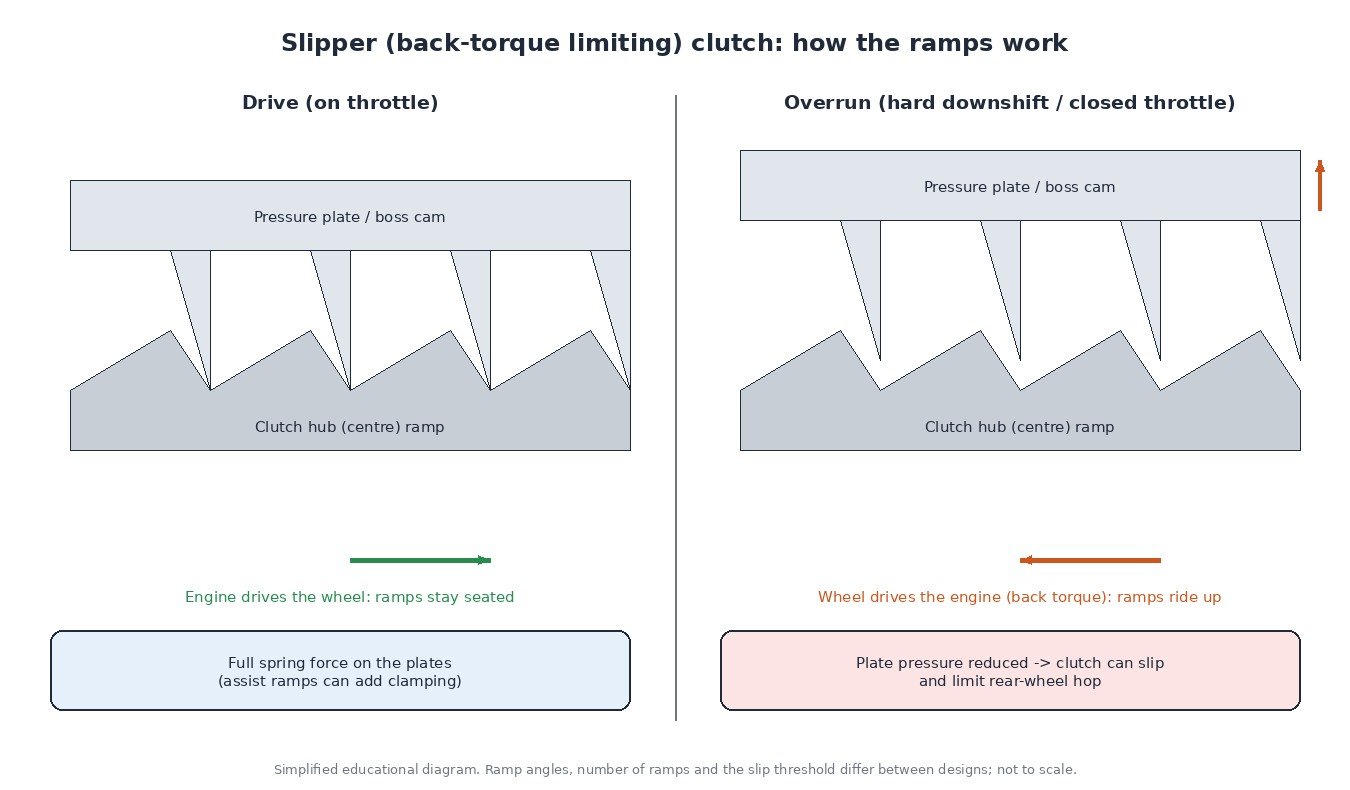
A slipper clutch, also called a back-torque limiting clutch, uses angled ramps (cams) between the clutch hub and the pressure plate or clutch boss. Under drive, the engine pushes the parts against each other along the ramps and the clutch springs clamp the plates as normal. Many designs add assist ramps that increase clamping under drive, which allows lighter springs and a lighter clutch lever.
When the rear wheel tries to drive the engine, torque flows the other way. The ramps then push the hub and pressure plate apart, reducing the spring force on the friction plates. The clutch slips just enough to cap the back torque, then re-engages when the force drops. It acts within milliseconds and does not need any electronics.
A slipper clutch is very good at absorbing short spikes from a downshift, but it is not designed to control steady engine braking during a long closed-throttle phase. That is where the ECU comes in.
Electronic engine brake control (EBC)
With a ride-by-wire throttle, the ECU decides the throttle valve opening, not the cable. That allows it to open the throttle slightly while the rider’s grip is fully closed. More air in the cylinders means lower manifold vacuum and smaller pumping losses, so engine braking is reduced. Some systems also keep or restore fuel and spark in some or all cylinders instead of cutting fuel completely, adding a small amount of positive torque. Some cable-throttle bikes reach a similar result with an electronically controlled air bypass, but the range of control is smaller.
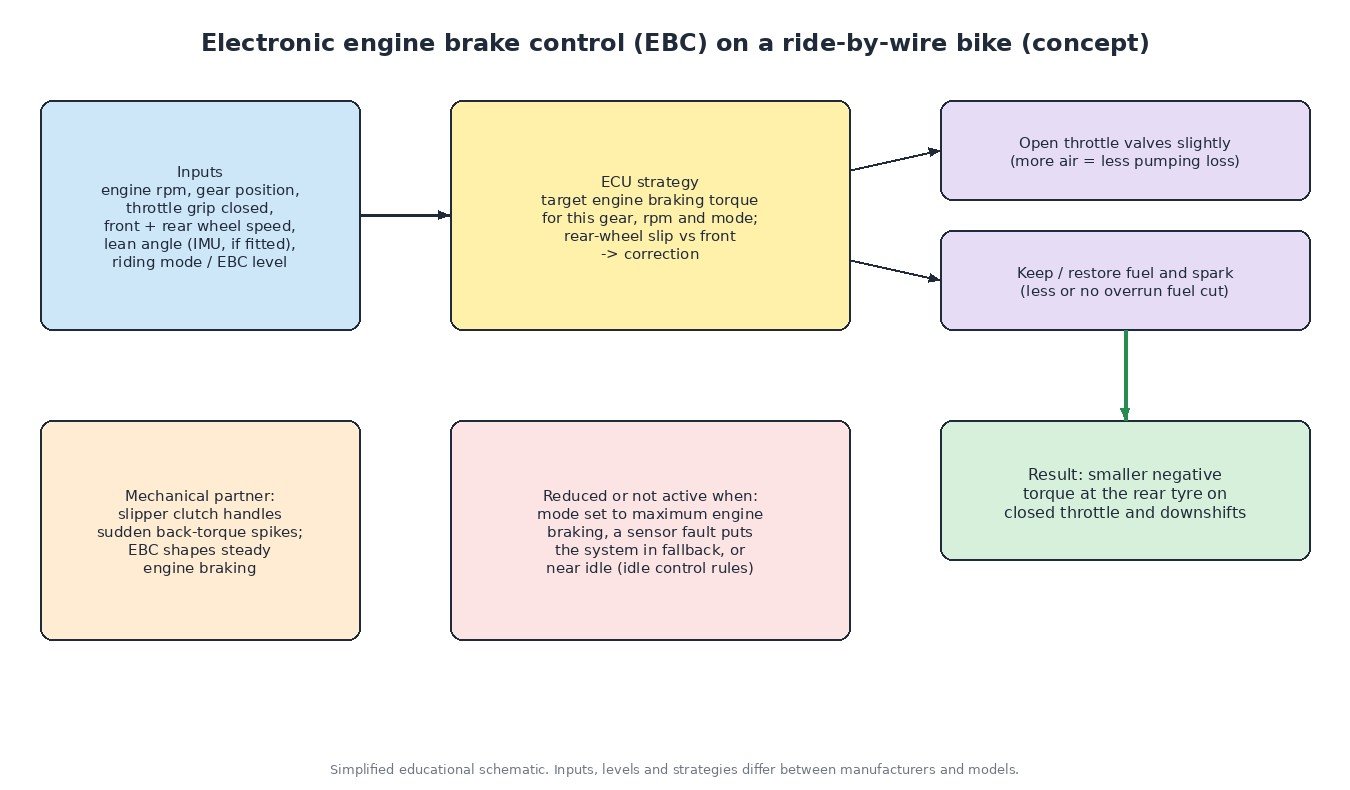
The ECU typically works from a target engine braking torque. Inputs used for that target can include:
- Engine speed and gear position, because engine braking at the wheel depends strongly on the gear.
- Throttle grip position, to confirm the rider really wants a closed throttle.
- Front and rear wheel speeds. If the rear wheel slows faster than the front, the rear tyre is slipping under engine braking and the ECU can open the throttle a little more.
- Lean angle and acceleration from an inertial measurement unit (IMU) on bikes that have one, because a leaned tyre has less grip available for braking forces.
- The riding mode or EBC level selected by the rider.
Most manufacturers offer several EBC levels, often linked to the riding modes. A higher level of intervention means less engine braking, which can feel calmer on track or in the wet. Experienced riders sometimes choose more engine braking because it helps slow the bike and settle the chassis. The system works closely with traction control and with the auto-blipper, which blips the throttle on clutchless downshifts to match engine speed before the gear engages.
Limits and fallback behaviour
EBC is a comfort and stability aid, not a replacement for rider technique. Near idle the idle speed control takes priority. If a sensor that EBC relies on fails, for example a wheel speed sensor or one of the throttle position tracks, the ECU usually reduces or disables the function and may enter a limp or fallback mode with limited throttle. That change can feel like stronger engine braking or a different throttle response, so a rider may report “the bike feels different off throttle” before noticing a warning light.
Diagnosing closed-throttle problems
Typical complaints are rear wheel hop on downshifts, surging or jerky engine braking, or engine speed hanging high when the throttle is closed. A logical order is:
- Read the ECU and ABS codes and note which riding mode and EBC level were selected.
- Check the throttle body and grip sensors. Ride-by-wire systems use two tracks per sensor and compare them; a correlation fault disables many functions.
- Confirm gear position and both wheel speed signals in live data. A wrong gear signal means the ECU uses the wrong target.
- Inspect the clutch: free play, cable or hydraulic release, slipper ramps, springs and plate wear. A clutch that slips or drags affects how back torque reaches the tyre.
- Look for intake air leaks, a sticking throttle or idle bypass problems if rpm hangs on a closed throttle.
- Check the software version and carry out any throttle body or grip relearn after cleaning or parts replacement.

What this means for tuning
Engine braking strategies live in the same ECU calibration as fuel, ignition and throttle maps. Changes to the throttle maps, idle targets or overrun fuel cut can alter how much engine braking the bike delivers and how smoothly EBC works. A careful motorcycle calibration leaves the EBC and traction functions working, keeps the closed-throttle behaviour predictable in every mode and is built from a full original read of the exact ECU software. Always keep a complete backup before any change.
Related fault codes (DTCs)
Motorcycle manufacturers often use their own fault code formats, but on bikes that report generic SAE codes these are the ones most often linked to engine braking and closed-throttle problems.
| Code | Meaning | Typical causes |
|---|---|---|
| P0120 | Throttle/pedal position sensor/switch “A” circuit | Throttle position sensor fault, wiring or connector problem, 5 V reference or ground issue |
| P0122 | Throttle/pedal position sensor/switch “A” circuit low | Open signal wire, short to ground, failed sensor, poor connector contact |
| P0123 | Throttle/pedal position sensor/switch “A” circuit high | Short to voltage, open ground, failed sensor |
| P0220 | Throttle/pedal position sensor/switch “B” circuit | Second sensor track fault, wiring or connector problem (often grip or throttle body sensor on ride-by-wire) |
| P2135 | Throttle/pedal position sensor/switch “A”/”B” voltage correlation | The two redundant tracks disagree: worn sensor, water in the connector, wiring resistance, poor ground |
| P0638 | Throttle actuator control range/performance (bank 1) | Sticking or dirty throttle body, motor or gear fault, actual position not following the commanded position |
| P2101 | Throttle actuator control motor circuit range/performance | Throttle motor wiring fault, failing motor, ECU driver problem, low supply voltage |
| P2119 | Throttle actuator control throttle body range/performance | Mechanical binding, carbon build-up, damaged return spring, throttle body fault |
| P0500 | Vehicle speed sensor “A” | Wheel or output speed sensor fault, damaged tone ring, wiring, implausible signal |
| P0335 | Crankshaft position sensor “A” circuit | Sensor fault, wiring or connector problem, damaged or dirty trigger wheel |
| P0914 | Gear shift position circuit | Gear position sensor fault, wiring or connector problem, sensor misalignment after engine work |
| P0507 | Idle air control system RPM higher than expected | Intake air leak, sticking throttle or idle bypass, throttle position not learned after cleaning |
Generic SAE J2012 code meanings shown. Exact wording and enable conditions vary by manufacturer; always check service data.
Need a motorcycle tuning file built on your original ECU read? Upload it to ECUFileMarket and get a file prepared for your exact hardware and software version.