
A car that cranks but will not start, or starts and dies after a second or two, often has nothing wrong with its fuel or ignition. Very often the engine immobiliser is doing exactly what it was designed to do: refusing to let the engine run because it did not recognise the key or the control unit. Knowing how it works saves hours of diagnosis.
What an immobiliser does
An immobiliser is an electronic anti-theft system. Its only job is to decide whether the engine is allowed to run. Unlike an alarm, it does not make noise; it simply blocks the functions the engine needs, typically fuel injection and ignition and, on many vehicles, the starter motor. Immobilisers have been standard on most European passenger cars since the late 1990s, and they are now common on vans, trucks, motorcycles and many tractors and other agricultural machines.
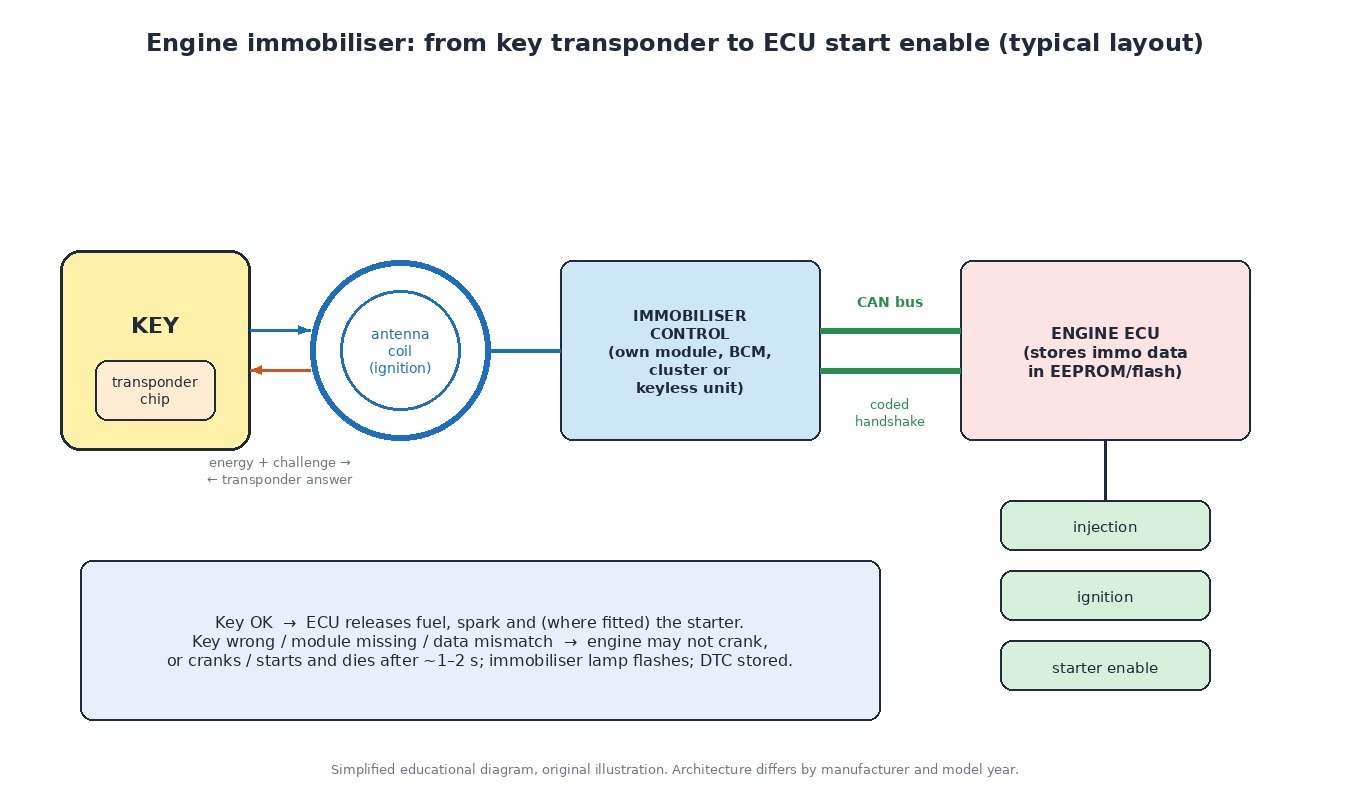
The main components
Key transponder
Inside the key head (or the keyless-entry fob) sits a small transponder chip. It has no battery for this function: it is powered by the electromagnetic field of the antenna coil when the key is close. Early systems used a fixed code, which the chip simply transmitted. Later generations use cryptographic transponders that calculate an answer from a secret value stored inside the chip.
Antenna coil
A coil around the ignition lock barrel or near the start button energises the transponder and reads its reply. Keyless systems use cabin antennas plus a backup reading spot for a flat fob battery.
Immobiliser control
The logic that checks the key may be a separate immobiliser module, or it may be integrated into the body control module (BCM), the instrument cluster or the keyless-entry unit. It stores the identities of the keys programmed to the vehicle.
Engine ECU
The engine control unit also stores immobiliser data, usually in its EEPROM or a protected area of flash memory. It will only enable injection and ignition after a successful exchange with the immobiliser control over the CAN bus or a dedicated serial line. On many trucks and agricultural machines the same principle applies, sometimes with a PIN keypad or coded key instead of, or in addition to, a transponder.
How the start authorisation works
When the ignition is switched on, two checks normally take place:
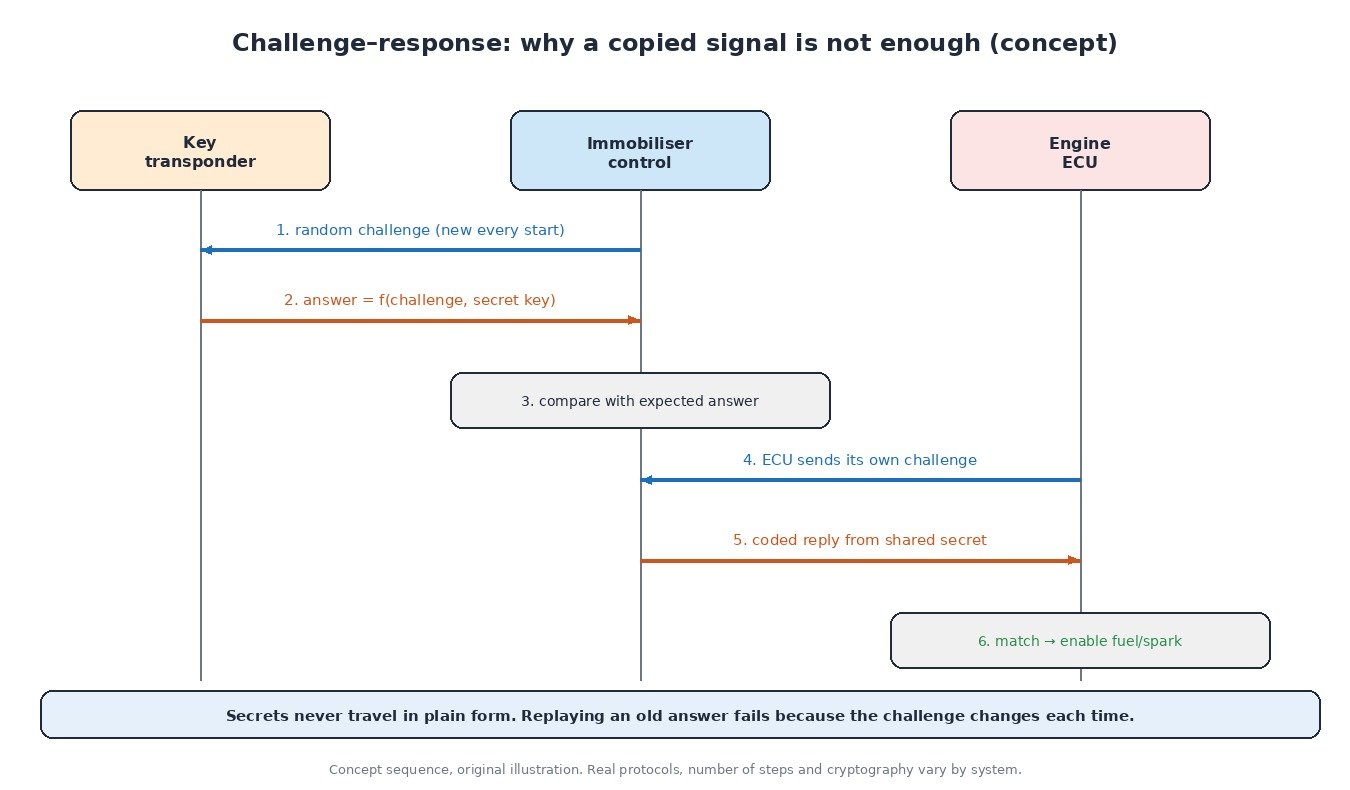
- Key check – the immobiliser control sends a challenge to the transponder through the antenna coil and checks the answer. With modern crypto transponders the challenge changes at every start, so recording and replaying an old answer does not work.
- Control unit check – the immobiliser control and the engine ECU authenticate each other with a coded exchange based on a shared secret that was written into both units when they were paired.
Only when both checks pass does the ECU release fuel and spark. If either fails, the warning lamp (often a key or car symbol) stays on or flashes, and a fault code is stored.
Typical symptoms of an immobiliser fault
- Engine cranks normally but never fires – the ECU is simply not driving injectors or coils.
- Engine starts and stalls after about one to two seconds.
- Starter does not engage at all on vehicles where the immobiliser also controls the starter relay.
- Immobiliser lamp flashing, “key not recognised” message, or communication codes with the immobiliser or ECU.
- Spare key works but the main key does not – usually a transponder or key problem, not the vehicle.
Diagnostic tips
- Try the spare key first. If it starts, the fault is in the first key (damaged transponder, cracked housing, chip missing after a key shell replacement).
- Remove other keys and tags from the key ring. A second transponder, a fuel card or a parking tag close to the coil can disturb the reading.
- Check battery voltage and grounds. Low voltage during cranking can reset modules mid-handshake. A voltage drop test on the ECU and immobiliser supplies quickly rules out wiring.
- Read codes in all modules, not just the engine ECU. The immobiliser result is often stored in the BCM, cluster or keyless unit.
- Check the network. If the ECU or immobiliser control is missing from the CAN bus, look at power, ground and CAN wiring before suspecting the units themselves.
- Ask about recent work. A replaced ECU, a repaired cluster, a new key shell or a reflash are all classic triggers.
Immobilisers, ECU replacement and tuning
Because the engine ECU holds its own immobiliser data, a used ECU taken from another vehicle will normally not start your engine: its data belongs to the donor vehicle. A new ECU must be paired, which on many recent vehicles is done only through dealer or approved diagnostic tools, often with an online connection and proof of ownership.
For chiptuning this has an important consequence. A tuning file changes the calibration – maps, limiters and the torque model – but the immobiliser and identity data must remain exactly as they were. That is why professional workflows always start with a complete backup of the original read, including EEPROM where the tool and reading method allow it. Writing a file taken from another car, overwriting the EEPROM, or letting the voltage drop during a write can all leave the vehicle unable to start.
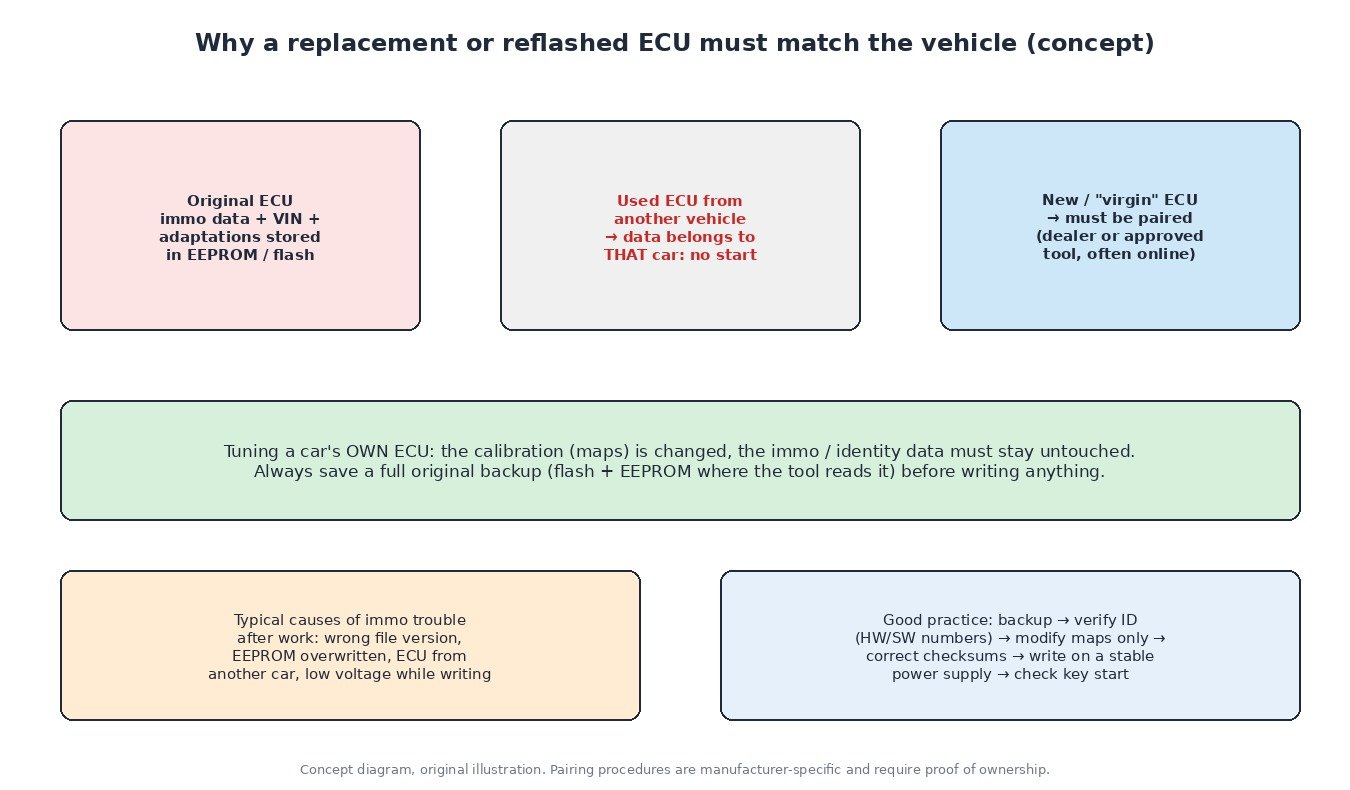
Before writing a modified file, the checksums must also be correct, otherwise the ECU may refuse to boot and report a memory checksum error. Note that on ecufilemarket.com checksum correction is offered as a paid extra, not included automatically, so make sure your tool corrects it or order the option.
Immobiliser systems exist to protect owners. Any pairing or key programming should be done only on vehicles you own or are authorised to work on, following the manufacturer’s procedure.
Related fault codes (DTCs)
These generic SAE codes are commonly seen around immobiliser and ECU identity problems. Always check the OEM description too.
| Code | Meaning | Typical causes |
|---|---|---|
| P0513 | Invalid Immobilizer Key | Key not programmed to the vehicle, damaged or missing transponder, weak antenna coil signal, interference from other keys or tags on the key ring |
| P0633 | Immobilizer Key Not Programmed – ECM/PCM | Replacement or used ECU not paired, immobiliser data lost or overwritten, incomplete key/ECU adaptation |
| P0630 | VIN Not Programmed or Incompatible – ECM/PCM | New or second-hand ECU without the correct VIN, interrupted programming, wrong software for the vehicle |
| U0167 | Lost Communication With Vehicle Immobilizer Control Module | Immobiliser module without power or ground, CAN wiring/connector fault, failed module |
| U0100 | Lost Communication With ECM/PCM “A” | ECU power/ground fault, CAN bus wiring fault, ECU not booting after an interrupted write |
| P0601 | Internal Control Module Memory Check Sum Error | Corrupted or modified flash without valid checksums, interrupted write, internal ECU fault |
| P0602 | Control Module Programming Error | Programming not completed, wrong or mismatched software, ECU not coded to the vehicle |
| P0562 | System Voltage Low | Weak battery during cranking or coding, poor ECU supply/ground, charging fault – low voltage can also cause immobiliser communication errors |
Need a custom tuning file for your car, truck, tractor or bike, built on your original read? Upload your file at ecufilemarket.com and our team will prepare it for you.