
A temperature gauge tells you how hot the coolant is. It does not tell you whether there is still enough coolant in the engine. That is the job of the coolant level sensor, a small part in the expansion or surge tank that heavy trucks, buses, tractors, combines and many cars rely on to catch coolant loss before the engine is damaged. This guide explains how coolant level sensors work, how the ECU reacts to low coolant, and how to diagnose a low coolant warning properly.
Why a temperature sensor alone is not enough
The engine coolant temperature (ECT) sensor measures the temperature of the liquid around its tip. As long as the tip is covered, the reading is good. When coolant is lost, the level can drop below the ECT sensor. The tip then sits in steam or air, which carries far less heat than liquid. The ECU may see a normal or even low temperature while parts of the cylinder head are overheating. That is why many engines add a separate level signal. Our guides to the cooling system and ECT sensor and the ECT sensor circuit cover the temperature side in detail.
Where the sensor is fitted
On most modern engines the level sensor sits in the expansion tank (also called the surge tank or degas bottle). This is the highest point of the cooling circuit, so coolant loss shows up there first. Heavy-duty trucks and tractors often fit it in the surge tank or in the radiator top tank. Some engines have more than one level sensor, or a sensor in a separate tank for a second cooling circuit.
The signal does not always go to the engine ECU. On many cars the instrument cluster or body control module reads the switch and shows the warning itself. In that case there is no engine fault code at all, and you need to read the cluster module. On trucks and agricultural machines the engine ECU often reads the sensor and shares the value on the J1939 network.
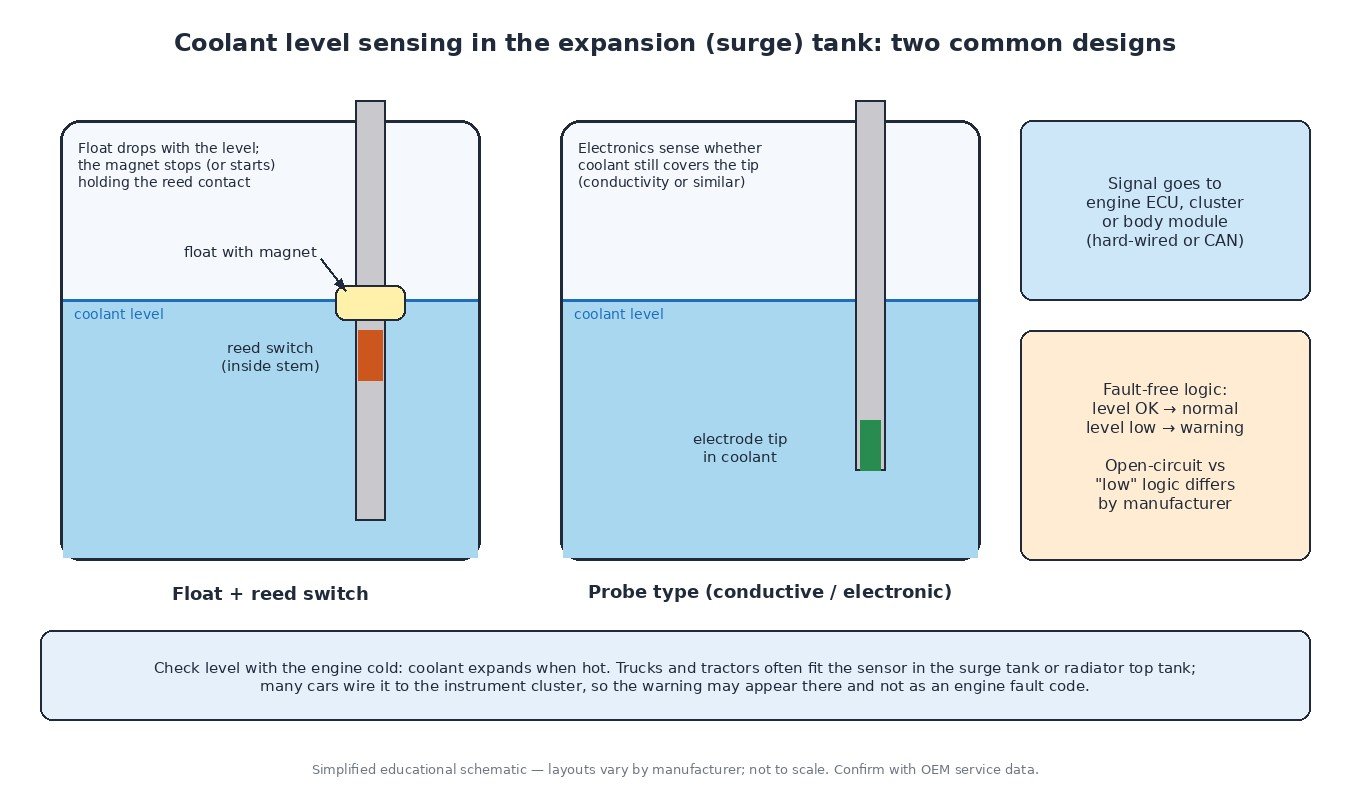
The two common sensor designs
Float with reed switch
A float carrying a small magnet slides on a stem. Inside the stem is a reed switch, a pair of thin contacts in a sealed glass tube that close when a magnetic field is near. When the level is normal, the float holds the magnet at the reed switch. When the level drops, the float falls and the switch changes state. Some designs open on low level, others close; the logic and any resistors in the circuit depend on the manufacturer.
Probe type
Many heavy-duty engines use a probe with an electrode at its tip. The sensor detects whether coolant still covers the tip, for example by measuring conductivity. Probe sensors have no moving parts, but deposits on the tip, oil in the coolant or the wrong coolant type can affect them. Some probe sensors have their own electronics with a supply, ground and signal wire.
How the ECU uses the signal
A tank on a tractor working across a slope, or a truck braking hard, sloshes coolant around. The ECU therefore does not react to a single reading. It filters the signal and only confirms low coolant after the condition has lasted for a calibrated time. Many systems also ignore the signal for a short time after start-up.
Once low coolant is confirmed, the response depends on the engine and how it is set up:
- Warning: a lamp or message on the dash and a stored fault code.
- Derate: many heavy-duty engines reduce torque or power to cut heat input, in the same way as for high coolant temperature.
- Shutdown: where engine protection is enabled, some engines shut down after a warning period. On many trucks and machines this behaviour is a configurable parameter set by the OEM or fleet.
The ECU usually looks at coolant level and coolant temperature together. Coolant temperature also feeds the fan control, explained in our guide to truck and tractor cooling fan drives, and the thermostat strategy on modern cars covered in engine thermal management.

J1939: how the level appears on trucks and machines
On J1939 networks engine coolant level is reported as SPN 111, usually as a percentage. Fault codes combine SPN 111 with an FMI that tells you whether the level itself is low (FMI 1, 17 or 18) or whether the sensor circuit is faulty (FMI 3 or 4). That difference matters: a level fault points you to the cooling system, a circuit fault points you to the sensor and wiring. Our guide to J1939 fault codes explains how to read SPN and FMI.
Diagnosing a low coolant warning
- Check the real level with the engine cold. Coolant expands when hot, so a hot reading is misleading. Never open a hot pressurised system.
- Read codes in all modules, including the cluster, and note the freeze frame. Check whether the code is a level fault or a circuit fault.
- Watch live data. On a float sensor, the status should change when the level crosses the switch point. On some sensors you can lift the float or tilt the sensor out of the tank to test it.
- Look for air. After a coolant change or repair, trapped air can work its way to the tank over the first heat cycles and lower the level. Bleed the system to the manufacturer procedure.
- Find where the coolant is going. Pressure-test the system and the cap. Check hoses, the water pump and radiator for external leaks. If the level drops with no visible leak, test for combustion gas in the coolant (head gasket) and check for internal leaks in the EGR cooler, oil cooler or heater circuit.
- Check the sensor and wiring. Look for a float stuck in sludge, a coated probe tip, corroded tank connectors and chafed wiring. Check supply, ground and signal, and do a voltage drop test under load.
- Confirm the repair. Refill with the correct coolant, bleed, warm up, let it cool and re-check the level. Clear codes and confirm the signal in live data.

Related fault codes (DTCs)
| Code | Meaning | Typical causes |
|---|---|---|
| P2556 | Engine coolant level sensor/switch circuit | Failed sensor or switch, corroded connector at the tank, open or intermittent wiring, missing supply or ground |
| P2557 | Engine coolant level sensor/switch range/performance | Float sticking in sludge or oil-contaminated coolant, coated probe tip, signal that does not match other plausibility checks, wrong sensor fitted |
| P2558 | Engine coolant level sensor/switch circuit low | Signal shorted to ground, sensor fault, chafed harness near the tank |
| P2559 | Engine coolant level sensor/switch circuit high | Signal open or shorted to voltage, broken ground, disconnected sensor |
| P2560 | Engine coolant level low | Real coolant loss (external leak, head gasket, EGR or oil cooler leak, faulty cap), air trapped after a coolant change, level checked hot, sensor stuck reading low |
| P0217 | Engine coolant over temperature condition | Low coolant, thermostat stuck closed, fan or fan drive fault, blocked radiator or charge-air cooler stack, failed water pump |
| SPN 111 FMI 1 | Engine coolant level: data valid but below normal operating range, most severe level | Coolant well below the sensor, major leak, overflow from combustion gas pressure; often triggers engine protection |
| SPN 111 FMI 17 / 18 | Engine coolant level: below normal, least / moderately severe level | Level slowly dropping, small leak, air pocket working out of the system |
| SPN 111 FMI 3 / 4 | Engine coolant level sensor: voltage above normal or shorted high / below normal or shorted low | Open circuit, short to supply or ground, connector corrosion, internal sensor fault |
P-codes are generic SAE OBD-II definitions; SPN/FMI codes follow SAE J1939. Manufacturers often use their own codes as well, especially for cluster-read sensors, so confirm with the service information for the vehicle or machine.
A note for tuning
A remap does not change how much coolant an engine holds, but more power means more heat into the cooling system. A good calibration keeps the coolant level and coolant temperature protections working, including any derate and shutdown logic. Fix coolant loss and level sensor faults before tuning, and log coolant temperature under sustained load afterwards, especially on trucks and tractors that work at high load for hours.
Need a reliable tuning file for your truck, tractor or car? Order it from the file service at ecufilemarket.com.