
Most multi-cylinder sport and touring motorcycles do not breathe through a single throttle. Each cylinder has its own throttle body and butterfly, and all of them are linked so they open together. When those butterflies are not opening by exactly the same amount, the engine idles roughly, vibrates and feels snatchy at low speed, even though every sensor and the ECU are working correctly. Throttle body synchronisation (often called “balancing the throttle bodies” or a “carb sync” on older bikes) is the adjustment that fixes this. This article explains why it matters, how it is measured, how it interacts with the ECU and how to approach it in the workshop.
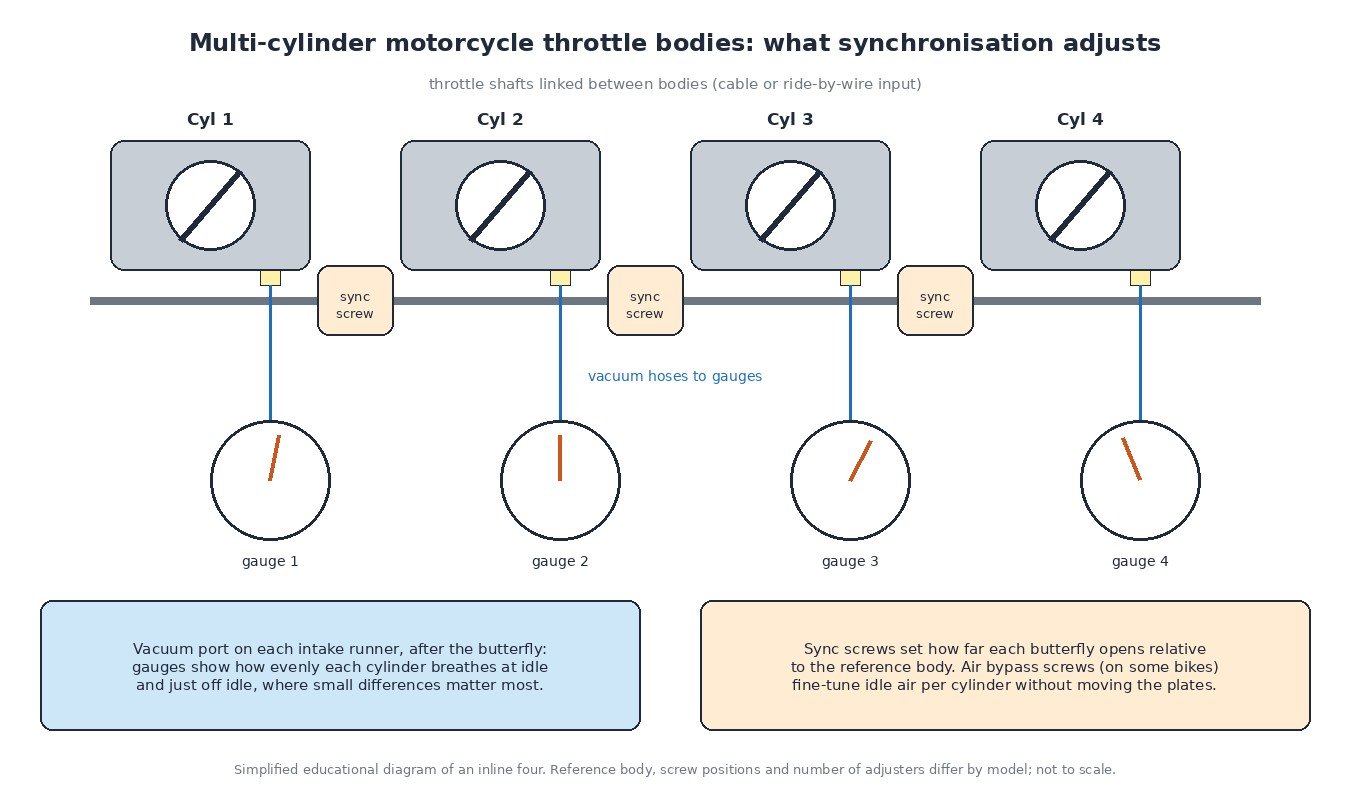
Individual throttle bodies: why balance is needed
An inline four typically has four throttle bodies mounted side by side, each feeding one intake port. Twins and triples follow the same principle with fewer bodies. The butterflies sit on short shafts joined by linkages, and between neighbouring bodies there is usually a spring-loaded synchronising screw. Turning that screw changes how far one butterfly opens relative to its neighbour. Usually one throttle body acts as the reference and has no adjuster; the others are set to match it.
Individual throttle bodies give a sharp throttle response and good cylinder filling at high rpm, but they also mean there are several separate air paths. Manufacturing tolerances, wear in the linkage, carbon deposits on the plates and previous adjustments all cause small differences between them over time.
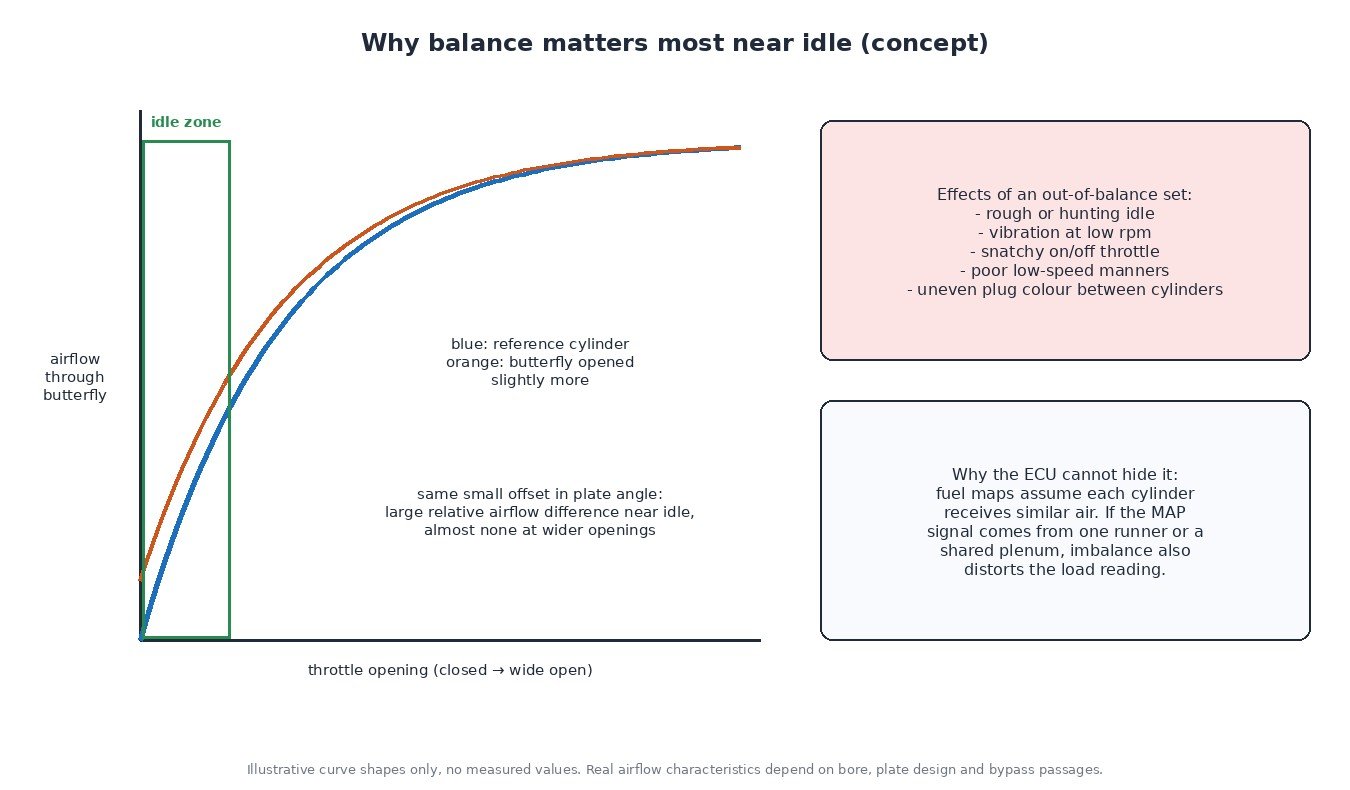
Why small differences matter most near idle
At idle the butterflies are almost closed. The gap around each plate is tiny, so a very small difference in plate angle produces a large relative difference in airflow between cylinders. One cylinder may be pulling noticeably more air than another, and because the injectors deliver roughly the same fuel to each cylinder at idle, the mixture and torque contribution differ between cylinders. The result is a lumpy idle, vibration through the bars and pegs, and an uneven pick-up when the throttle is just cracked open.
Once the throttle is opened further, the plate is no longer the main restriction and the same mechanical offset makes very little difference. That is why an out-of-balance bike can feel fine at full throttle but unpleasant in town traffic.
How synchronisation is measured
Each intake runner has a small vacuum port between the butterfly and the cylinder head, normally closed with a rubber cap or a screw. During synchronisation a gauge is connected to every port at the same time. The traditional tools are dial vacuum gauges or liquid column manometers; modern electronic sync tools show all cylinders on one screen with averaging, which makes small differences easier to read. Dampers or restrictors in the hoses smooth out the pulsing vacuum so the readings are stable.
The aim is not a particular vacuum value but equal readings across all cylinders, within the difference allowed in the service manual. Some models also have air bypass screws on each body. These meter a small amount of idle air around the butterfly and are used to fine-tune the idle balance without moving the plates themselves.
What the ECU sees, and why it cannot correct it
On a fuel-injected motorcycle the ECU calculates fuel from throttle position, engine speed and, on many models, manifold pressure. The basics are covered in our guide to how motorcycle fuel injection works (alpha-N vs speed density). The fuel maps assume that every cylinder receives a similar amount of air for a given throttle angle. If they do not, the ECU has no way to see it, because it usually measures throttle position on one shaft and, where fitted, pressure from one runner or from a small collector joining several runners.
That has two consequences. First, the per-cylinder mixture difference stays, regardless of how good the fuel map is. Second, on bikes that use a MAP sensor fed from one cylinder, a badly unbalanced set can make that signal unrepresentative of the engine as a whole, so the load reading and fuelling at light throttle become less accurate.
Idle control is affected too. Many bikes hold idle with an idle air valve or, on ride-by-wire models, by moving the throttle plates. A poorly balanced set forces that control to work at the edge of its range, which can cause hunting idle or idle speed codes. Our article on motorcycle idle speed control explains that system in more detail.
Ride-by-wire motorcycles
With ride-by-wire, the twist grip sends a signal to the ECU and an electric motor moves the throttle shaft. The bodies are still linked mechanically on most designs, and many still have synchronising and bypass screws, so a vacuum balance check remains relevant. Some engines use more than one throttle actuator, and certain models require a diagnostic tool procedure or throttle learn after any work on the throttle bodies. The procedure is model-specific, so always follow the service data rather than assuming the cable-bike method applies.
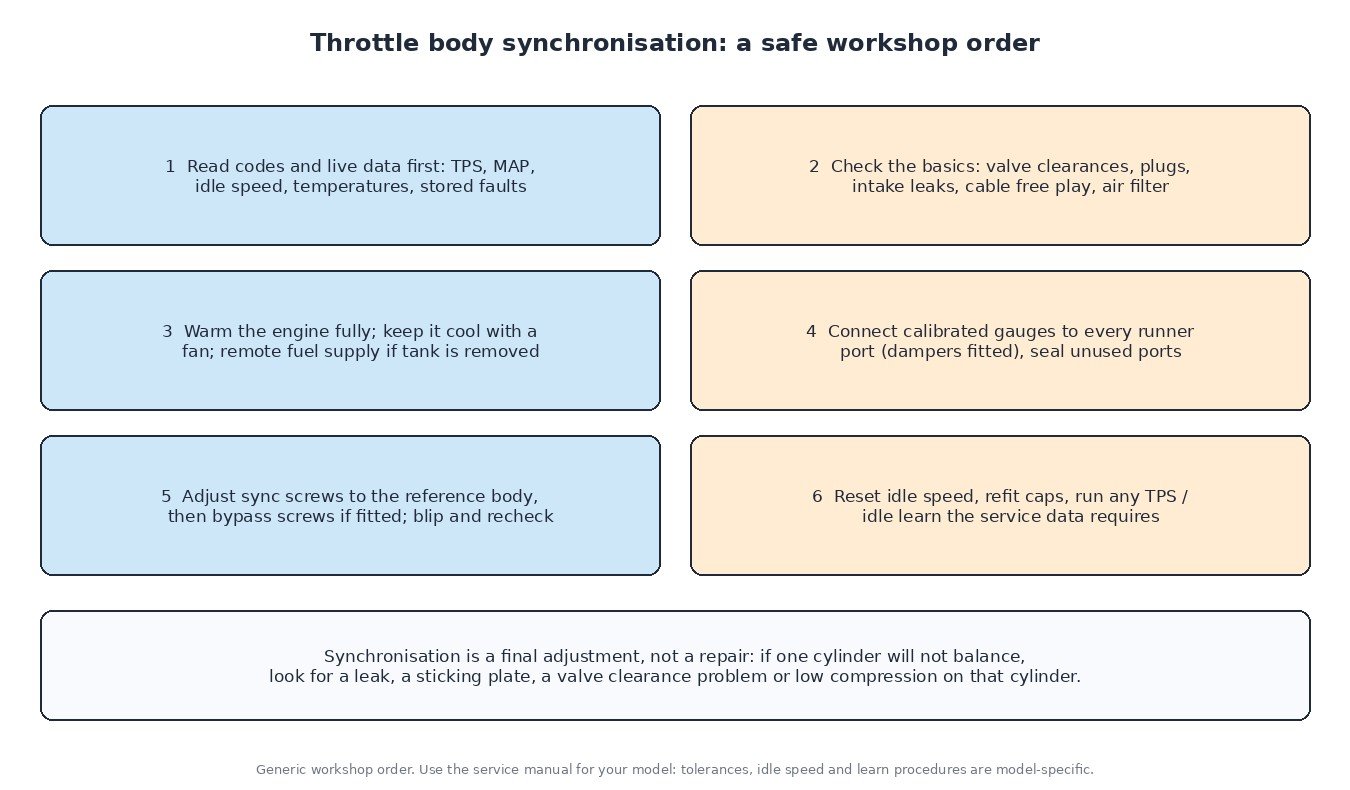
A safe workshop order
Synchronisation is the last step after the engine is in good mechanical condition, not a cure for other faults:
- Codes and live data first. Read stored faults and check throttle position, manifold pressure, idle speed and temperatures for plausibility.
- Basics. Valve clearances, spark plugs, intake boots, vacuum caps, air filter and throttle cable free play. A cylinder with a tight valve or poor compression will never balance properly.
- Full operating temperature. Use a fan to keep the engine cool while it idles. If the fuel tank must be lifted or removed, use a safe remote fuel supply.
- Connect gauges to every runner port, with dampers fitted, and make sure every connection is airtight.
- Adjust the synchronising screws to match the reference body, then any bypass screws. Blip the throttle a few times and recheck, because linkages can settle.
- Finish. Reset idle speed to specification, refit all caps and run any throttle position reset or idle learn that the service data requires. Clear codes and road test.
If one cylinder refuses to come into line, stop adjusting and look for the cause on that cylinder: a cracked intake boot, a loose vacuum cap, a sticking or carboned plate, a valve clearance problem or low compression.
Why it matters before tuning
A remapped fuel or ignition calibration assumes a healthy engine. Unbalanced throttle bodies, intake leaks or a TPS that was never reset after an idle screw adjustment will show up as poor low-speed running that no map change can fix properly. Checking synchronisation, valve clearances and stored codes before a dyno session or file change saves time and gives a clean baseline for comparing before and after.
Related fault codes (DTCs)
Many motorcycles still use manufacturer-specific codes or blink codes, while newer Euro 5 models report generic OBD codes. The generic SAE codes below are the ones most often linked to throttle body balance, idle and intake air problems.
| Code | Meaning | Typical causes |
|---|---|---|
| P0505 | Idle air control system | Idle air/stepper valve or ride-by-wire idle control unable to hold target idle; throttle bodies out of balance, intake leak, dirty bypass passages |
| P0506 | Idle air control system RPM lower than expected | Air passages or plates carboned up, bypass screws closed too far, idle control at its limit after poor synchronisation |
| P0507 | Idle air control system RPM higher than expected | Intake or vacuum port leak (cap left off after sync), idle stop or bypass screws opened too far, sticking throttle cable or plate |
| P0121 | Throttle/pedal position sensor/switch “A” circuit range/performance | TPS out of its expected range after the idle stop screw was moved, missing TPS reset/learn, worn sensor track, loose mounting |
| P0122 | Throttle/pedal position sensor/switch “A” circuit low | Open or short to ground in the signal circuit, missing 5 V reference, damaged connector after throttle body work |
| P0123 | Throttle/pedal position sensor/switch “A” circuit high | Signal shorted to reference voltage, open ground circuit, faulty sensor |
| P0106 | Manifold absolute pressure/barometric pressure circuit range/performance | Split, kinked or disconnected MAP hose, vacuum port leak, strong cylinder imbalance where the sensor reads one runner |
| P0171 | System too lean (bank 1) | Air leaks at runner boots, vacuum ports or gauge adaptors left loose; low fuel pressure; on bikes with oxygen sensors and closed-loop control |
| P0300 | Random/multiple cylinder misfire detected | Severe imbalance at idle, ignition or plug faults, low compression or valve clearance problems on one cylinder |
Generic SAE J2012 / ISO 15031-6 code meanings shown. Code support and descriptions vary by manufacturer; always confirm with service data for your model.
Planning a tune for your motorcycle, car or truck? Upload your original ECU read to ECUFileMarket and get a file prepared for your exact hardware and software version.