
Every injection system, from a port-injected scooter to a common-rail tractor, depends on something less glamorous: the low-pressure side that brings fuel from the tank to the engine. If that supply falls short, the high-pressure pump runs short of fuel, the ECU sees low pressure or a lean mixture, and the engine loses power, often only under full load. Here is how low-pressure fuel supply works, how the ECU controls and monitors it, and why it matters before and after any calibration work.

What the low-pressure side does
The low-pressure system has three jobs. It has to deliver enough fuel for the highest demand the engine will ever see, keep that fuel clean and free of water and air, and hold a stable pressure so that injection (or the high-pressure pump feeding the injectors) behaves the way the calibration expects. On port-injected petrol engines this pressure goes straight to the injectors. On direct injection petrol engines and common-rail diesels it feeds the inlet of the high-pressure pump.
Return-type and returnless petrol systems
Older petrol systems used an in-tank electric pump that ran at full speed whenever the engine was running. A mechanical pressure regulator on the rail held a set pressure, often referenced to manifold vacuum, and sent excess fuel back to the tank through a return line. It is simple and robust, but it circulates hot fuel back into the tank and wastes pump energy.
Returnless systems moved the regulator into the tank module, so only one feed line runs to the engine. The next step was the demand-controlled system: the pump runs at variable speed, controlled by PWM from a pump control module or directly from the ECU, and a low-pressure sensor closes the loop. The ECU only asks for as much flow as the engine needs, which cuts electrical load and fuel heating.
How the ECU controls a demand-controlled pump
The ECU calculates a target low pressure from operating conditions such as load, engine speed, fuel temperature and, on direct injection, the high-pressure pump’s demand. It compares the target with the sensor reading and adjusts the pump duty cycle. A pilot (feed-forward) value gets the pump close to the right speed, and a closed-loop correction trims the rest.
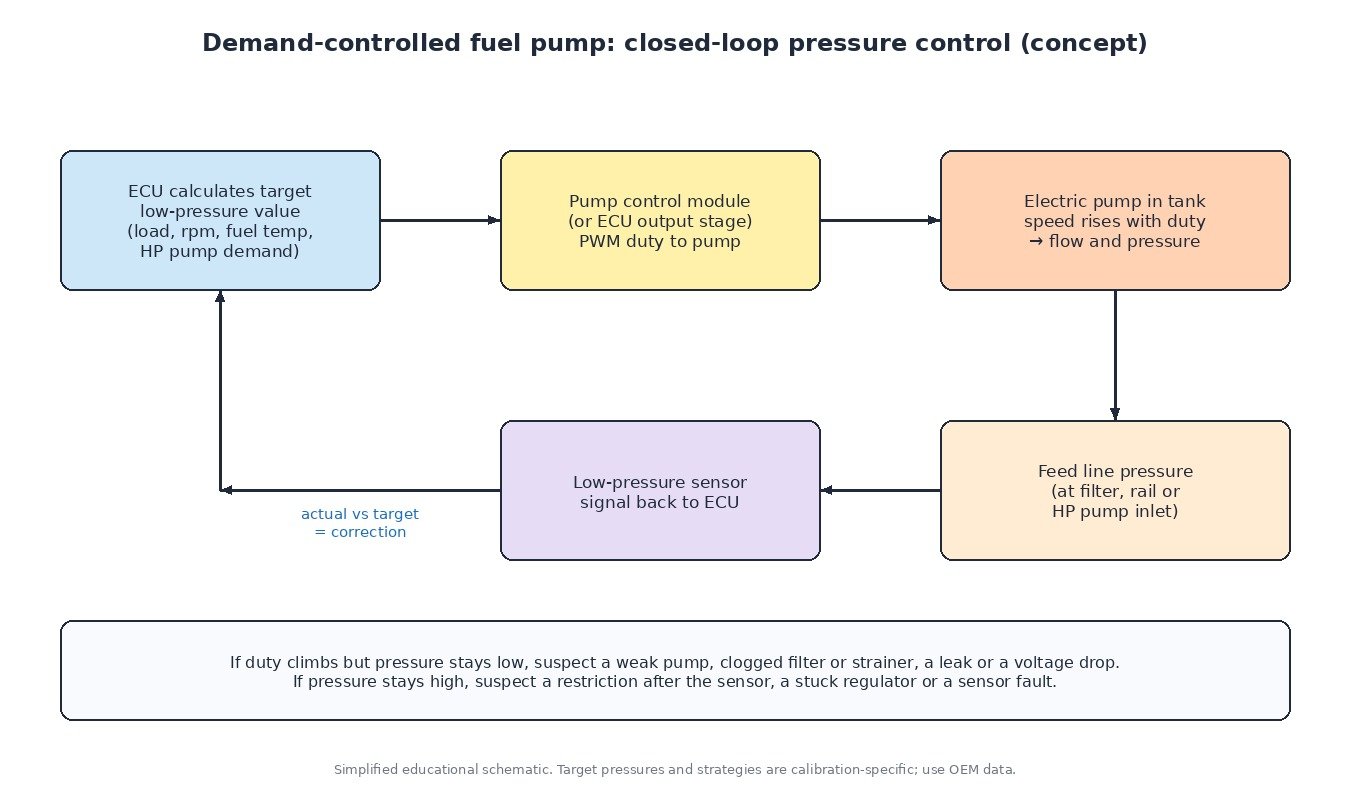
This loop is also a useful diagnostic window. If live data shows the duty cycle climbing towards its maximum while pressure still sits below target, the pump is working hard against a restriction, a leak or its own wear. Many ECUs use exactly that logic to set flow or performance codes.
Diesel low-pressure supply
Diesel systems add two concerns: air and water. Depending on the design, fuel reaches the high-pressure pump through an electric lift pump in or near the tank, a mechanical gear feed pump driven by the high-pressure pump, or both. Any air leak on a suction line lets the pump draw air instead of fuel, which shows up as rough starting, lost rail pressure under load and P0087.
The filter normally includes a water separator, and many have a water-in-fuel (WIF) sensor that warns the driver before water reaches the high-pressure pump and injectors, where it can cause serious damage. Diesel systems also return leak-off fuel from the injectors and pump back to the tank, and fuel heaters or thermostatic valves keep filters from waxing in cold weather.
Differences across vehicle types
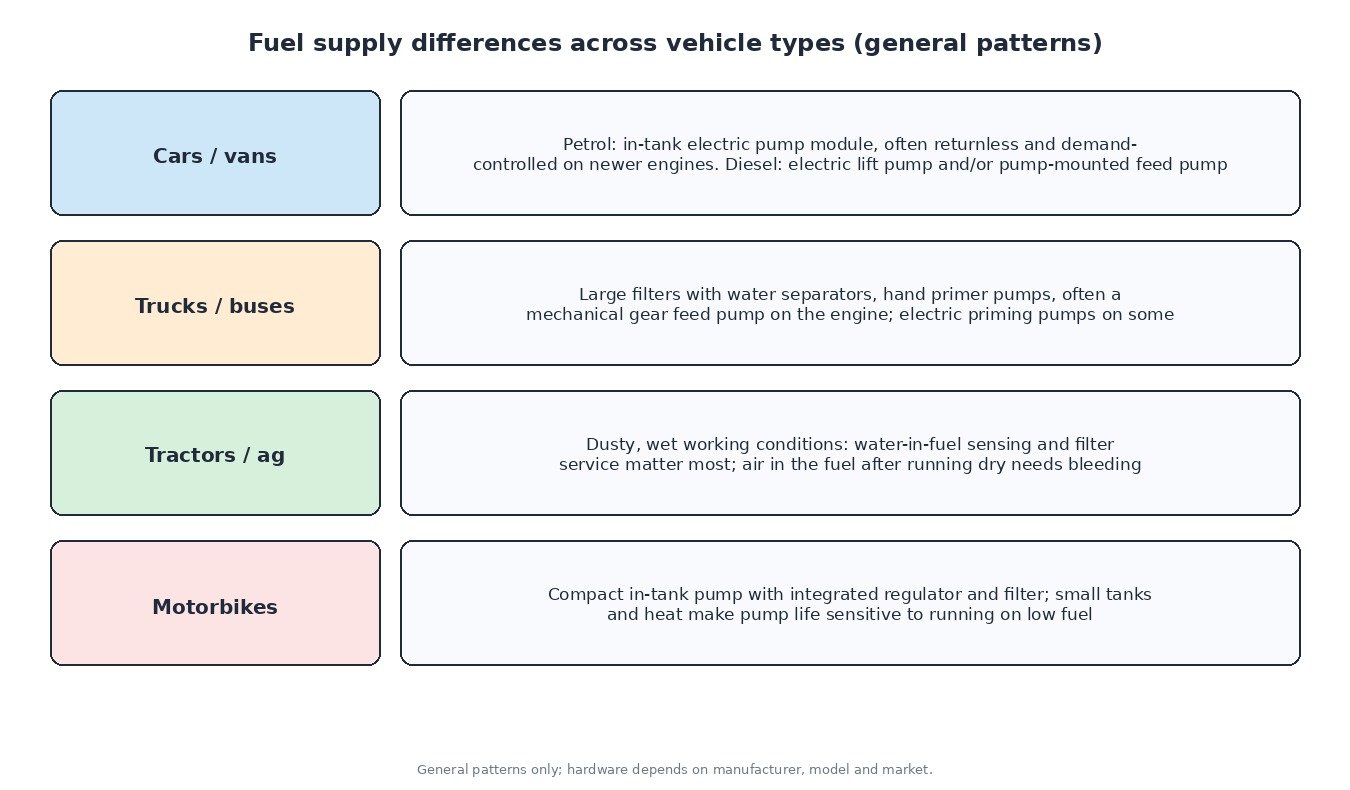
Cars and vans use in-tank modules, increasingly demand-controlled on petrol engines. Trucks and buses add large separators, hand primers and engine-driven feed pumps. Tractors face water and dust, so WIF warnings and filter service matter most, and motorbikes pack everything into a small module that dislikes running on low fuel.
Diagnostic tips
- Measure, don’t guess. Compare sensor readings with a mechanical gauge, and check pressure, flow and duty cycle under load, not only at idle.
- Check voltage at the pump. A voltage drop across a tired connector, relay or ground can starve a healthy pump. Measure it with the pump running.
- Look at the strainer and filter. A blocked tank strainer or overdue filter causes exactly the same symptoms as a weak pump.
- On diesels, look for air. A clear test line on the suction side shows bubbles quickly. Check filter seals and quick connectors.
- Drain water and find its source. A WIF warning after one fill-up points to the fuel, not the sensor.
Why it matters for ECU calibration
More power means more fuel. A calibration that raises injected quantity or boost assumes the low-pressure system can keep up at the new peak demand, with enough margin for hot fuel and a low tank. Before tuning, log the low-pressure value and pump duty at full load. If the supply is already near its limit on the original calibration, fix or upgrade the hardware first, and keep the ECU’s fuel pressure and lean protection active in the file.
Related fault codes (DTCs)
Generic OBD-II codes (SAE J2012) linked to the low-pressure fuel supply. Exact wording and where each code applies can vary by manufacturer, and many makers also store their own codes, so read them with a suitable diagnostic tool.
| Code | Meaning | Typical causes |
|---|---|---|
| P0087 | Fuel Rail/System Pressure – Too Low | Weak or failing lift pump, clogged filter or tank strainer, air leak on a diesel suction line, low supply voltage to the pump; on direct injection also high-pressure side faults |
| P0088 | Fuel Rail/System Pressure – Too High | Stuck regulator, kinked or blocked return line, pressure sensor fault |
| P0089 | Fuel Pressure Regulator 1 Performance | Regulator sticking or slow to respond, contamination, wiring fault |
| P0090 | Fuel Pressure Regulator 1 Control Circuit | Open or shorted regulator circuit, connector corrosion |
| P0148 | Fuel Delivery Error | Delivery cannot meet demand: pump, filter, restriction or supply voltage problem |
| P0171 / P0174 | System Too Lean (Bank 1 / Bank 2) | Low fuel pressure or flow under load, alongside the usual vacuum leak and air metering causes |
| P0180–P0183 | Fuel Temperature Sensor “A” Circuit / Range/Performance / Low / High | Sensor or wiring fault, connector damage, plausibility mismatch with other temperatures after a cold soak |
| P0190–P0193 | Fuel Rail Pressure Sensor “A” Circuit / Range/Performance / Low / High | Sensor, 5 V reference or ground fault, wiring damage; check the actual pressure with a gauge before replacing parts |
| P0230 | Fuel Pump Primary Circuit | Pump relay or its control circuit, fuse, wiring or ECU output fault |
| P0231 / P0232 | Fuel Pump Secondary Circuit Low / High | Open or shorted feed to the pump, bad ground, failed pump motor, relay contacts |
| P0460–P0463 | Fuel Level Sensor “A” Circuit / Range/Performance / Low / High | Sender in the tank module, float or wiring fault; can matter when the ECU limits functions at low fuel |
| P0627–P0629 | Fuel Pump “A” Control Circuit/Open / Low / High | Control line between ECU and pump control module open or shorted, module fault |
| P2264 | Water in Fuel Sensor Circuit | WIF sensor or wiring fault on the filter housing |
| P2269 | Water in Fuel Condition | Water collected in the filter or separator; drain it and check the fuel source |
| P2635 | Fuel Pump “A” Low Flow/Performance | Worn pump, restricted strainer or filter, voltage drop in the pump supply, wrong pump fitted |
Closing
The low-pressure side rarely gets attention until it fails. Check pressure, flow, voltage, filters, air and water first, and the high-pressure system and ECU can do their job.
Need an engineered ECU file for a car, van, truck, tractor or bike? Upload your original read at ECUFileMarket.