
Press the accelerator sharply in second gear on an older diesel and the car can lurch forward, rock back and forth a couple of times, then settle. Lift off suddenly and the same thing happens in reverse. Drivers call it shunt, kangarooing or bucking. Modern engine ECUs work hard to hide it with a group of functions usually described as driveability filters, with anti-jerk control (also called active surge damping) at the centre. This article explains why the driveline jerks, how the ECU shapes and damps torque, and what that means for diagnosis and remapping on cars, vans, trucks and tractors.
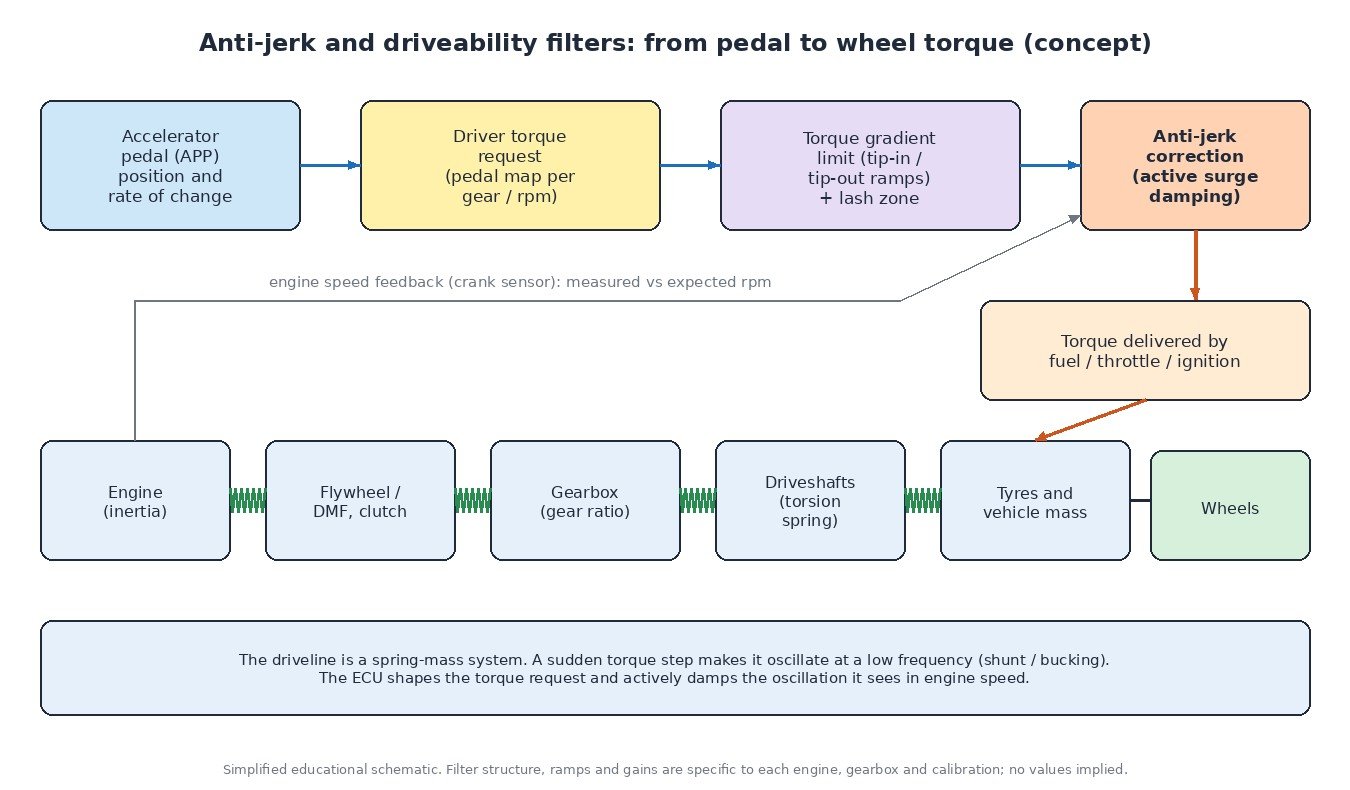
Why the driveline shunts
Between the crankshaft and the road there is a chain of parts: flywheel or dual-mass flywheel, clutch or torque converter, gearbox, propshaft, differential, driveshafts and tyres. None of them is perfectly stiff. Driveshafts twist slightly under load, tyres deflect and engine mounts let the engine rock. Engineers model this as a spring-mass system: the engine inertia on one side, the vehicle mass on the other, and a torsional spring in between.
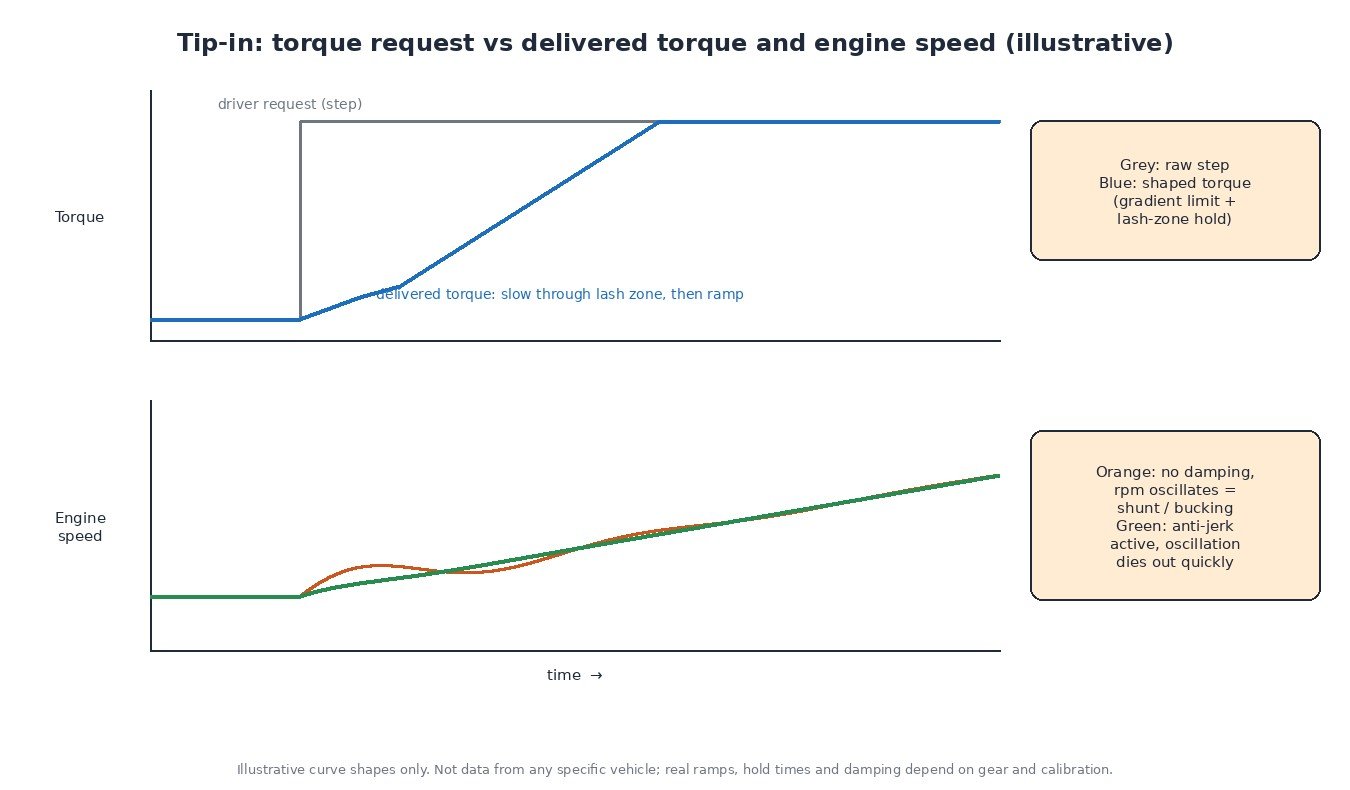
Any spring-mass system has a natural frequency. If torque rises as a sudden step, the spring winds up, overshoots and swings back, so the vehicle accelerates in pulses at a low frequency of a few hertz. The effect is strongest in low gears, where the gear ratio multiplies torque and the driveline is relatively soft, and at low engine speed, where a turbo diesel can produce a lot of torque very quickly.
A second effect is lash, the free play in gear teeth, splines and joints. When the driver switches from coasting to pulling, the gear flanks have to move across that play before they carry load again. If torque is already high when the flanks meet, the result is a clunk followed by oscillation.
Driveability filters before the anti-jerk stage
In a torque-based engine management system (see our ECU torque model guide) the pedal is not connected directly to fuel or throttle. The pedal position sensor becomes a driver torque request through a pedal map, often different for each gear. Before that request reaches the injectors or throttle, the ECU shapes it:
- Tip-in gradient limit: the rate at which torque may rise after a sudden pedal input is limited, often with separate values per gear, engine speed and temperature.
- Lash zone handling: when torque passes from negative (engine braking) to positive, the ECU slows it down around zero so the gear flanks close gently, then lets torque build.
- Tip-out ramp: on a sudden lift the torque is ramped down rather than cut, which avoids a hard change from drive to overrun. Petrol engines may combine this with a dashpot-type slow throttle closing and ignition retard, which also helps emissions.
- Gear and clutch logic: the filters depend on knowing whether the driveline is closed and in which gear. The ECU calculates the gear from engine speed and vehicle speed and uses the clutch pedal switch or TCU messages.
How active anti-jerk control works
Shaping the request reduces the excitation, but some oscillation still appears, for example on rough roads or during gear changes. Active anti-jerk control deals with that. The ECU compares the measured engine speed from the crankshaft sensor with the speed it would expect from a smooth driveline, often calculated from vehicle speed and gear ratio or from a reference model. The difference is an oscillation signal. A controller then adds a small correction torque in opposition to it: slightly less torque when the engine speeds up in a swing, slightly more when it slows down.
Because a diesel can change injected quantity from one combustion to the next, it can apply this correction very quickly through fuel. A petrol engine uses fast ignition timing changes for quick corrections, while the throttle handles the slower part of the request. Hybrid systems can also use the electric motor, which responds even faster.
The same principle appears on heavy vehicles. Trucks with automated manual gearboxes and tractors with powershift transmissions coordinate engine torque with the transmission during shifts so the driveline is unloaded before a gear is released and loaded again smoothly afterwards. The details sit partly in the engine ECU and partly in the TCU, linked over CAN or J1939.
Symptoms when something is wrong
- Shunt or bucking on tip-in in low gears, especially after a clutch or flywheel replacement.
- Clunk when changing from overrun to drive, pointing to wear in mounts, joints or the differential.
- Surging at constant pedal, which may be a misfire, pedal signal noise or a sensor fault rather than the filters.
- A soft, delayed response that feels like lag, sometimes caused by substitute values after a fault, for example a missing speed or gear signal.
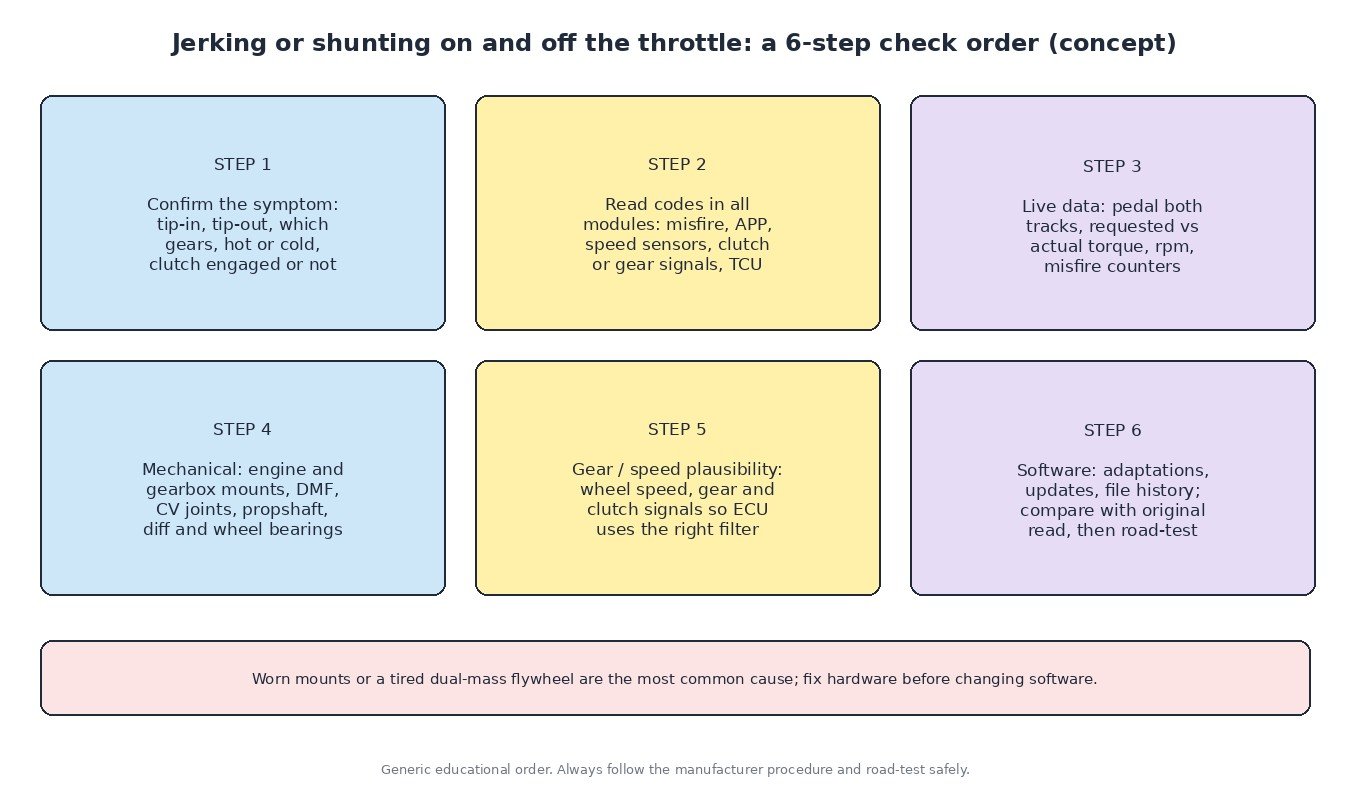
Diagnosis: a practical order
- Define the symptom: tip-in or tip-out, which gears, hot or cold, with the clutch engaged or slipping.
- Read codes in all modules, not just the engine ECU. Misfire, pedal, speed sensor, clutch switch and TCU faults all affect driveability.
- Check live data: both pedal tracks, requested and actual torque, engine speed and misfire counters during the event.
- Inspect the hardware: engine and gearbox mounts, dual-mass flywheel free play and rock, CV joints, propshaft couplings and differential lash. Worn mounts are the most common cause.
- Verify plausibility of wheel speed, gear and clutch signals so the ECU uses the right filter set.
- Review the software: adaptation values, available updates and the file history. If the ECU was reprogrammed, compare with the original read and road-test again.
Anti-jerk control and remapping
Torque gradient limits and lash-zone settings are a big part of how a car feels. A calibration that raises torque without considering them can make shunt worse, especially on a worn driveline. Removing the ramps completely to make the engine feel sharper often has the same effect and loads the dual-mass flywheel, clutch and joints harder. A sensible file keeps the driveability functions working and matched to the new torque, and it is checked on the road in the low gears where problems show first. Mechanical faults should be fixed before any software change, and a full original read should always be kept so the stock file can be restored.
Related fault codes (DTCs)
| Code | Meaning | Typical causes |
|---|---|---|
| P0300 | Random/Multiple Cylinder Misfire Detected | Ignition coils or plugs, injector faults, lean mixture, low compression; a misfire under load feels like a jerk |
| P0335 | Crankshaft Position Sensor “A” Circuit | Sensor, wiring or connector fault, damaged trigger wheel; engine speed signal is also the anti-jerk feedback |
| P0500 | Vehicle Speed Sensor “A” | Wheel or output speed sensor fault, wiring, missing CAN speed message; can upset gear detection |
| P0700 | Transmission Control System (MIL Request) | A fault stored in the TCU; read the transmission module for the actual code |
| P0830 | Clutch Pedal Switch “A” Circuit | Misadjusted or failed clutch switch, wiring; the ECU may misjudge whether the driveline is closed |
| P2122 | Throttle/Pedal Position Sensor/Switch “D” Circuit Low | Pedal sensor track 1 wiring open or short to ground, connector, failed pedal module |
| P2127 | Throttle/Pedal Position Sensor/Switch “E” Circuit Low | Pedal sensor track 2 wiring or connector fault, failed pedal module |
| P2138 | Throttle/Pedal Position Sensor/Switch “D”/”E” Voltage Correlation | Worn pedal tracks, poor grounds or reference, connector corrosion; can cause hesitation and surging |
| U0101 | Lost Communication With TCM | CAN wiring, TCU power or ground, failed module; without gear information the ECU uses substitute values |
Note: these are SAE J2012 generic definitions. There is no generic code for driveline shunt itself; anti-jerk is a normal control function. Manufacturer-specific codes and live-data names vary, so check the OEM service data.
Need an original or modified ECU file for your car, van, truck or tractor, matched to your exact hardware and software version? Order it from the file service at ECUFileMarket.