
Every modern common-rail diesel injector leaves the factory with a short code engraved or printed on its body. Depending on the system it may be called an IMA code, a QR code, a trim code or a C2I/C3I-type classification code, but the purpose is the same: it tells the engine ECU exactly how that individual injector behaves. When an injector is replaced and the code is not entered, the engine may still start and run, yet idle quality, smoke, noise and long-term reliability can all suffer. This article explains what the code contains, how the ECU uses it and how to code injectors correctly on cars, vans, trucks and tractors.

Why no two injectors are exactly alike
A common-rail injector meters fuel by opening for a precisely controlled energising time at a given rail pressure. Even with tight manufacturing, tiny differences in nozzle holes, needle lift, control valve clearances and spring forces mean two injectors of the same part number do not deliver exactly the same quantity for the same command. The difference is not constant either: one injector may be slightly rich at full load but close to nominal at idle, while another behaves the other way round.
For this reason each injector is measured on a test bench at the end of production at several test points, typically combinations of rail pressure and energising time that represent pilot injection, idle, part load and full load. The deviation from the nominal injector characteristic at each point is converted into the correction code.
What the correction code represents
The code is not a part number and not a serial number. It is compressed calibration data: per-injector correction values for the measured test points, encoded into a short alphanumeric string. Some systems use a simpler classification (the injector is sorted into a flow class), while newer systems carry more detailed data covering several points of the characteristic. Many code formats also contain an internal check so the ECU or diagnostic tool can reject an obviously mistyped entry, but a code from a different injector of the same type will often still be accepted, which is why careful matching matters.
How the ECU uses the code
The ECU first calculates the fuel quantity it wants for each injection event from its torque and fuelling maps. It then converts that quantity into an energising time using the nominal injector characteristic for the current rail pressure. The stored correction data is applied at this stage, cylinder by cylinder: the ECU interpolates between the bench test points and lengthens or shortens the energising time so that each injector delivers the requested quantity across the pressure and quantity range. The result is even torque from every cylinder and accurate pilot injections.
Coding after injector replacement
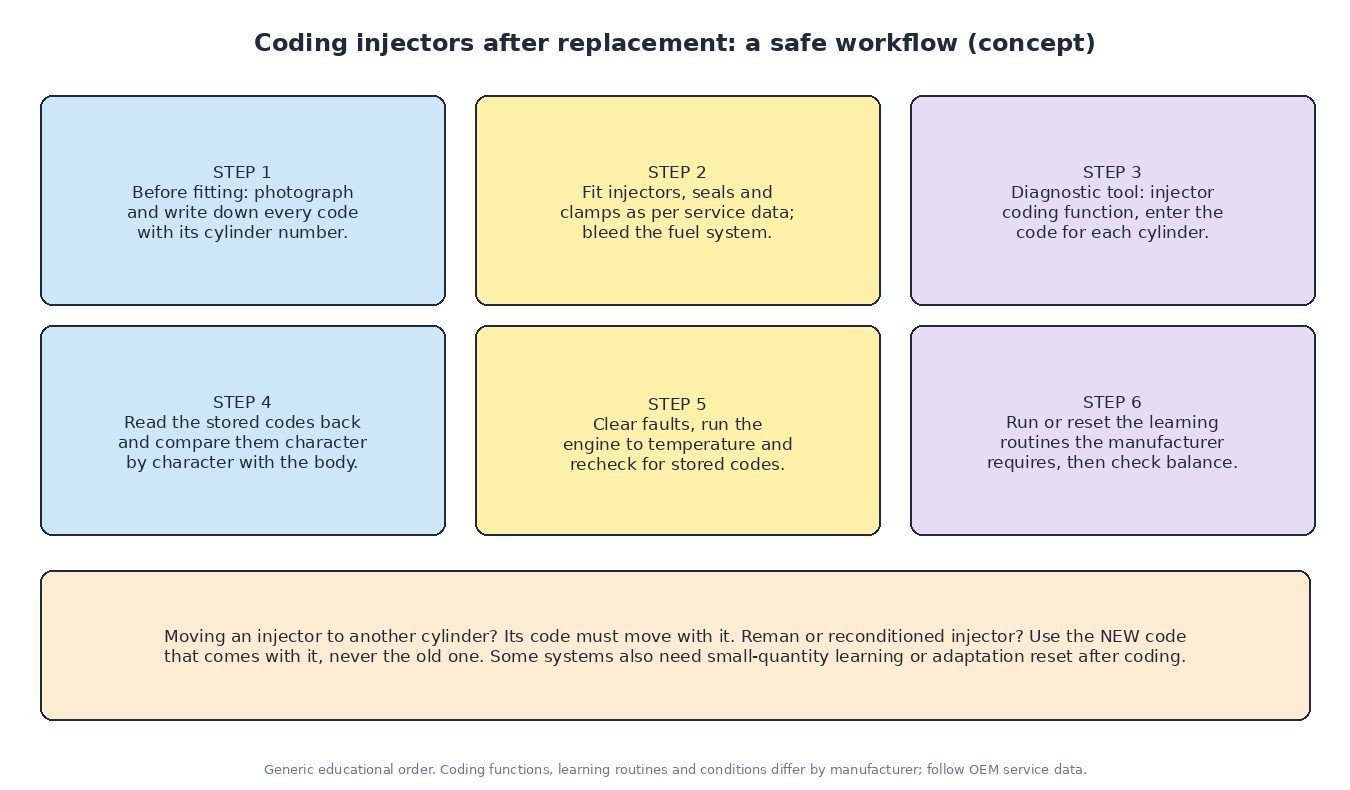
Coding is done with a diagnostic tool that supports the engine’s injector coding or injector replacement function. The usual workflow is:
- Before fitting, photograph each injector’s code and note which cylinder it is going into.
- Fit the injectors with new seals and clamps as per service data and bleed the fuel system.
- Select the coding function, choose the cylinder and enter the code exactly as printed.
- Read the stored codes back and compare them character by character with the injector bodies.
- Clear fault memory, run the engine up to temperature and check again for stored codes.
- Carry out any learning or adaptation reset the manufacturer specifies.
What happens if injectors are not coded
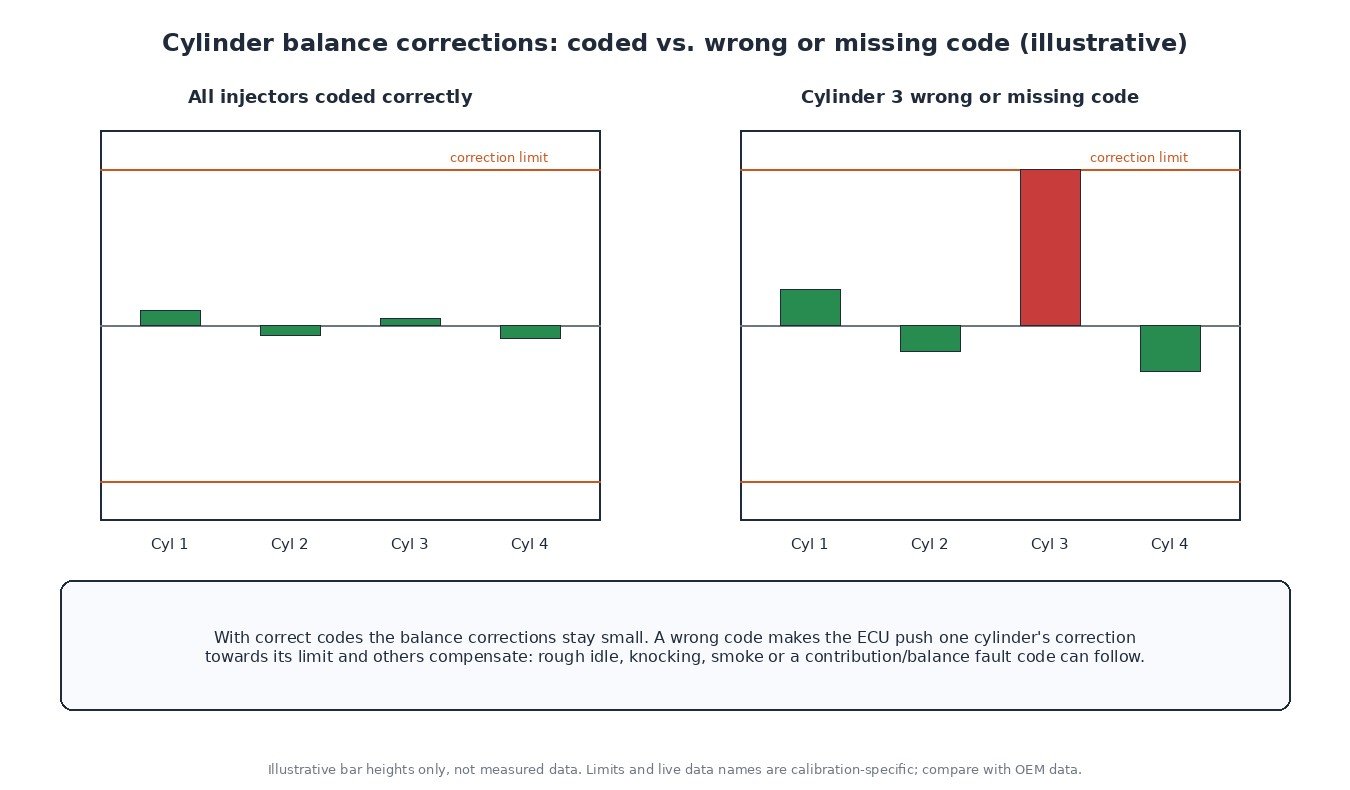
If the ECU still holds the old injector’s code, or a code for the wrong cylinder, it corrects the new injector with someone else’s data. Typical consequences are uneven running and a rough or “hunting” idle, increased combustion noise from incorrect pilot quantities, visible smoke under load, hard starting and a slight loss of power. The ECU’s running corrections try to hide the error, so the smooth-running or cylinder balance values for one or more cylinders move towards their limits. Once a limit is reached the engine can no longer compensate and fault codes for cylinder contribution/balance, misfire or injector data may be stored. On many newer systems the ECU detects missing or incompatible injector data directly.
Cylinder balance and small-quantity learning
Injector coding is the starting point; the running adaptations build on top of it. Cylinder balance (also called smooth-running control or idle quantity balancing) watches crankshaft speed fluctuations at idle and low load and trims each cylinder’s quantity so that every cylinder contributes equally. Small-quantity learning (zero fuel calibration or injector quantity adaptation on some systems) fires tiny test injections on overrun and measures the effect on engine speed, so pilot quantities stay accurate as the injector ages.
These functions correct drift and wear, but they work within a limited range. They are not designed to absorb a completely wrong code. That is why live data showing one cylinder’s balance value pinned near its limit straight after an injector job is a strong hint to check the coding first. Depending on the system, the learned values may need to be reset after coding so that old adaptations for the previous injector are not carried over.
Practical tips
- Record the code before fitting. Once installed, the code may be hidden under covers, pipes or the head itself.
- Reman injectors get new codes. A reconditioned injector is re-tested after repair and receives a new code. Never reuse the code from the old core.
- Check the entry against the engraving. Characters such as 0/O, 1/I and 8/B are easy to confuse; reading the stored codes back catches typing errors.
- Swapping injectors between cylinders needs re-coding. The ECU stores codes per cylinder position, not per injector. Moving injectors for a fault test without moving their codes gives misleading results.
- Replacing the ECU? The injector codes are stored in the ECU’s data, so a replacement unit must receive the codes of the injectors fitted to the engine.
Trucks and tractors
Heavy-duty engines with common-rail injectors, electronic unit injectors or unit pumps also use injector or pump calibration codes, and coding is normally done with the engine manufacturer’s diagnostic software or a capable multi-brand tool. On J1939 networks, injector problems are reported per cylinder (SPN 651 to 656 for cylinders 1 to 6), with the FMI describing the failure type. Tractors and agricultural machines follow the same principle: after an injector or pump change, enter the codes, verify them and check the cylinder balance at idle before returning the machine to work.
Notes for cars and vans
On passenger car and light van diesels, coding is often found under a menu such as “injector replacement”, “injector coding” or “IMA/QR code entry”. Always check whether the system also expects a learning routine to be run afterwards. For a deeper look at injector types and back-leak testing, see our article on how diesel injectors work.
Related fault codes (DTCs)
| Code | Meaning | Typical causes |
|---|---|---|
| P268A | Fuel Injector Calibration Not Learned/Programmed | Injector correction codes not entered after injector or ECU replacement, coding session interrupted, invalid or missing calibration data in the ECU |
| P268C | Cylinder 1 Injector Data Incompatible | Wrong or mistyped correction code stored for cylinder 1, old code left after fitting a new or reman injector, injector type not matching the engine |
| P268D | Cylinder 2 Injector Data Incompatible | Wrong or mistyped correction code stored for cylinder 2, old code left after replacement, incorrect injector type |
| P268E | Cylinder 3 Injector Data Incompatible | Wrong or mistyped correction code stored for cylinder 3, old code left after replacement, incorrect injector type |
| P268F | Cylinder 4 Injector Data Incompatible | Wrong or mistyped correction code stored for cylinder 4, old code left after replacement, incorrect injector type |
| P0263 | Cylinder 1 Contribution/Balance | Wrong or swapped injector code, worn or leaking injector, low compression on cylinder 1 |
| P0266 | Cylinder 2 Contribution/Balance | Wrong or swapped injector code, worn or leaking injector, low compression on cylinder 2 |
| P0269 | Cylinder 3 Contribution/Balance | Wrong or swapped injector code, worn or leaking injector, low compression on cylinder 3 |
| P0272 | Cylinder 4 Contribution/Balance | Wrong or swapped injector code, worn or leaking injector, low compression on cylinder 4 |
| P0201–P0204 | Injector Circuit/Open – Cylinder 1 to 4 | Connector not refitted after replacement, damaged wiring, open injector coil, ECU driver fault |
| P0300 | Random/Multiple Cylinder Misfire Detected | Uneven fuelling from wrong codes, faulty injectors, low compression, air in the fuel after replacement |
| P0611 | Fuel Injector Control Module Performance | Internal injector driver/control module fault, supply or ground problems, shorted injector wiring |
| SPN 651–656 (various FMI) | J1939: Engine Injector Cylinder #1 to #6 | Trucks and tractors: injector circuit faults, injector not responding as expected, calibration or trim data issues; the FMI shows the failure type |
Note: generic SAE and J1939 descriptions are shown. Manufacturers may use their own codes for injector coding faults; always check the vehicle’s service data.
Need an original or modified ECU file for your car, van, truck or tractor, matched to your exact hardware and software version? Order it from the file service at ECUFileMarket.