
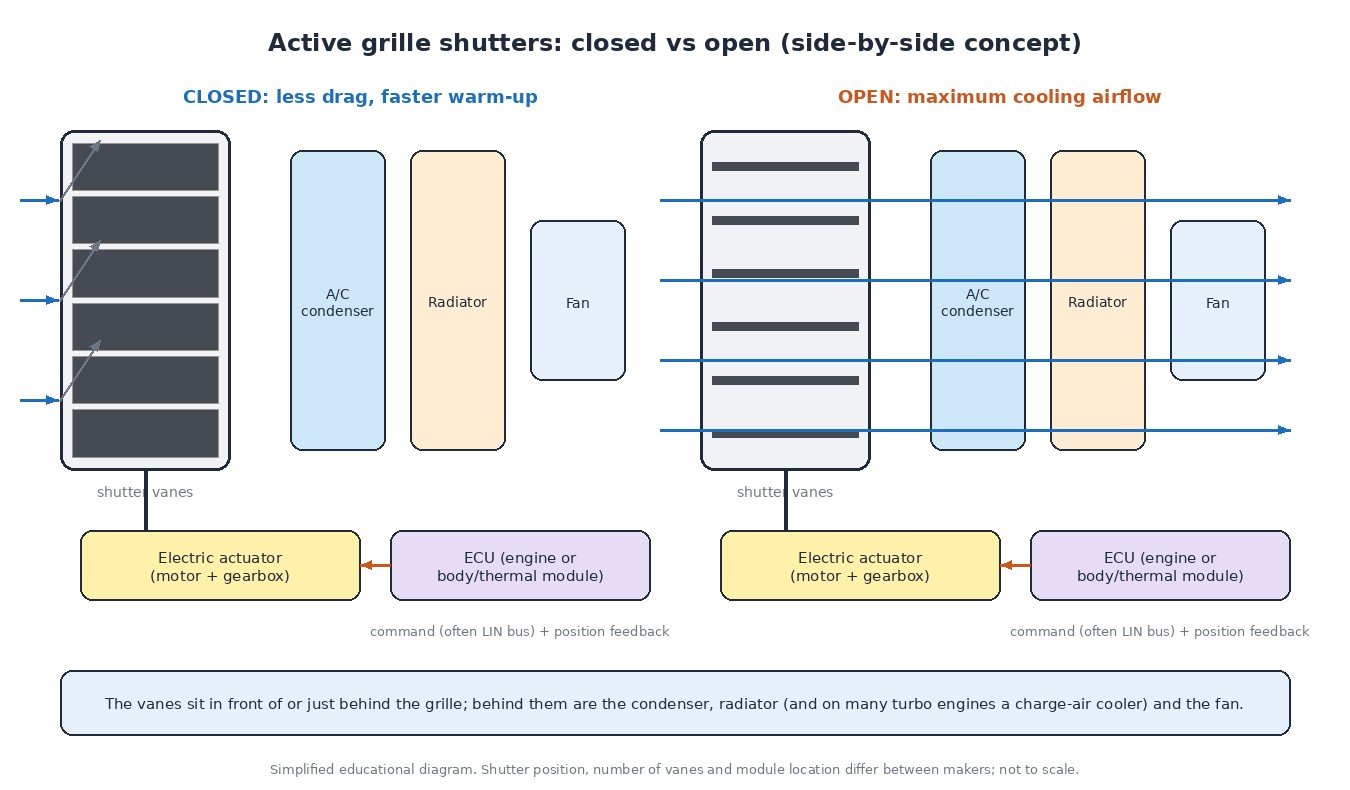
Look closely at the front of many modern cars, vans and pickups and you may see a row of black vanes behind the grille or in the lower bumper opening. These are active grille shutters. They open and close under ECU control to balance two goals that pull in opposite directions: letting enough air through the radiator to cool the engine, and blocking air when it is not needed to cut aerodynamic drag and help the engine warm up. This article explains how the system is built, how the ECU decides where to put the vanes, what goes wrong and how to diagnose it.
Why a car needs shutters at all
A grille opening is sized for the worst case: a fully loaded vehicle towing up a long hill on a hot day with the air conditioning on. Most of the time the engine needs far less cooling air than that. Air that flows through the radiator and engine bay creates drag, and in cold weather it also takes heat away from an engine that is trying to reach operating temperature.
Closing the grille when cooling demand is low brings three benefits. Drag is lower at road speed, which helps fuel consumption and, on electric and hybrid vehicles, range. The engine warms up faster, so friction and cold-start emissions drop sooner. And the engine bay stays warmer, which helps cabin heating in winter. When the engine, the A/C or the charge-air cooler needs air, the shutters open.
How the system is built
The hardware is simple. A plastic frame holds a set of horizontal or vertical vanes linked together so they rotate as one. A small electric actuator, basically a motor with a reduction gearbox, turns the linkage. Some vehicles have one shutter assembly, others have separate upper and lower units.
On many current vehicles the actuator is a “smart” unit on a LIN bus. The controlling module sends a target position as a digital message and the actuator replies with its actual position and any fault it has detected, such as a blocked motor or over-temperature. Other designs use a direct driver output or a PWM signal. The controlling module can be the engine ECU or a body or thermal management module, which then shares information with the engine ECU over CAN bus.
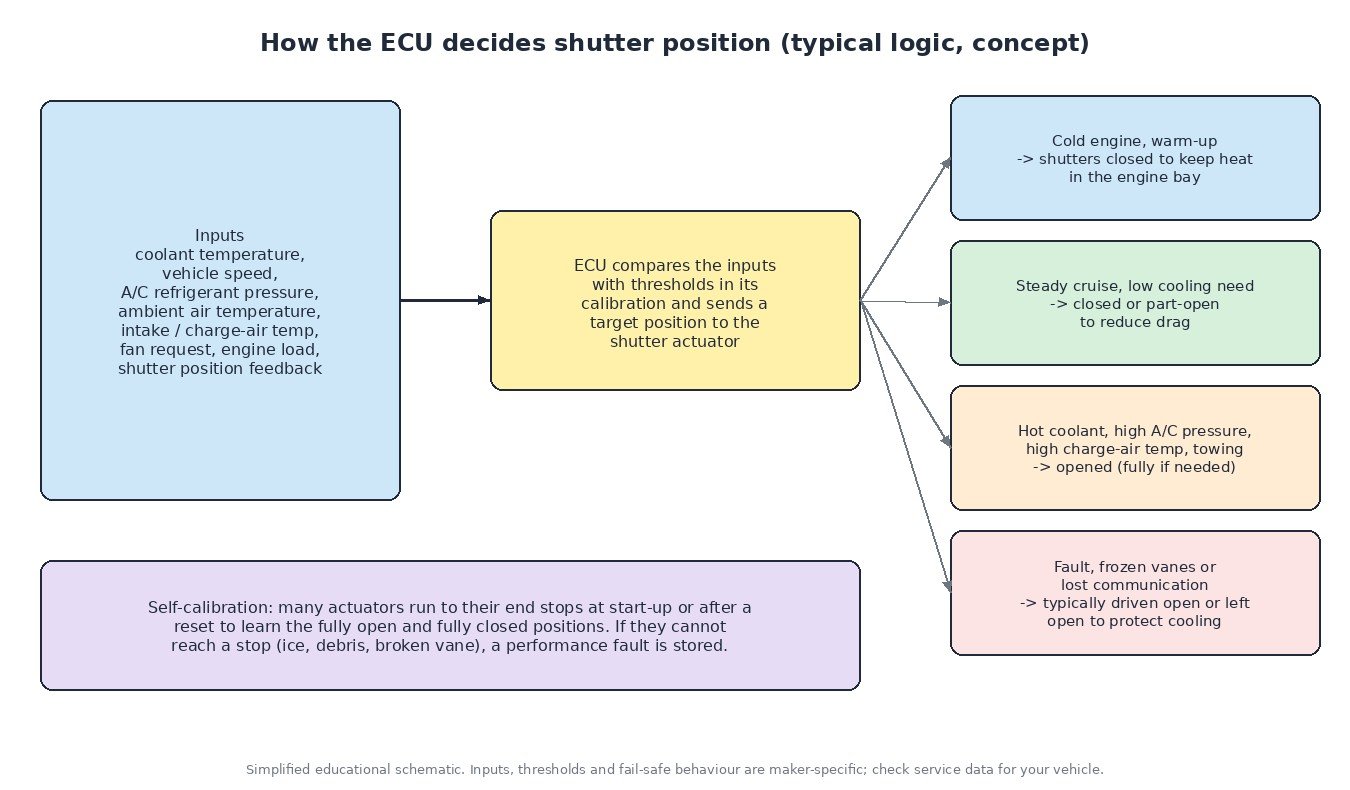
Because the actuator has no absolute position sensor on many designs, it learns its range by driving to the fully open and fully closed end stops. This self-calibration often runs at start-up or after power has been disconnected. If a vane cannot reach a stop, the actuator reports it and the ECU can store a performance fault.
The idea is not limited to cars. Some heavy trucks and buses have used radiator shutters for winter operation, and newer trucks may use active shutters for aerodynamics as well. The control principle is the same.
How the ECU decides the shutter position
The controller looks at several signals and picks a target position from rules and tables in its calibration:
- Coolant temperature: while the engine is cold the shutters usually stay closed. As temperature rises towards the upper limit of the normal range they open progressively. Coolant management works together with the map-controlled thermostat and electric coolant pump on engines that have them.
- Vehicle speed: at higher speed more ram air is available, so a partly open shutter may be enough. At very low speed or standstill the cooling fan does most of the work.
- A/C refrigerant pressure: the condenser sits in front of the radiator. High refrigerant pressure is a strong reason to open, which links shutter control with A/C compressor control.
- Charge-air and intake temperature: on turbo engines the charge-air cooler also needs airflow. Rising intake temperatures can open the shutters.
- Ambient temperature and load: towing, climbing or high engine load increase heat rejection and favour open shutters.
Exact thresholds are maker-specific and not published as general values, so treat any specific number you see online with caution.
Fail-safe behaviour
Cooling always takes priority over drag. If the controller detects a fault, loses communication with the actuator or sees an implausible position, systems are typically designed to drive the shutters open or leave them open so the engine cannot overheat because of a stuck vane. Some actuators can also detect ice: if the motor stalls before reaching its target, it stops, reports the obstruction and tries again later. A shutter that is mechanically stuck closed is the dangerous case, which is why coolant temperature and the fan still protect the engine independently.
Common symptoms
- Engine warning lamp or a message about the grille shutter or cooling system.
- Clicking or buzzing from the front of the car at start-up as the actuator tries to calibrate.
- Coolant temperature rising in slow traffic or when towing, with the fan running hard.
- Slow warm-up and poor cabin heat in winter if the shutters stay open.
- Faults appearing after a minor front-end impact, a bumper replacement or a frosty night.
Diagnosis step by step
- Read codes in all modules. The shutter may be managed by the engine ECU or a body module. Note any lost-communication U-codes, which point towards the LIN or supply side.
- Inspect the vanes. Look for ice, snow, stones, leaves, broken vanes or a bent frame. Check that the linkage is connected after bumper work.
- Use an actuator test. Many scan tools can command the shutters open and closed. Watch whether they move fully and smoothly and listen for a slipping or grinding gearbox.
- Check the wiring. Confirm supply voltage and ground at the actuator under load, then check the LIN or signal wire. A scope shows whether LIN messages are present.
- Compare commanded and actual position in live data. After replacing the actuator or the frame, run the relearn or calibration routine if the maker specifies one.
- Do not forget the cooling basics. Coolant level, fan operation, thermostat function and A/C pressures can all set codes or symptoms that look like a shutter fault.

What this means for ECU tuning
Shutter logic lives in the engine or thermal management calibration. A performance file adds power, and more power means more heat to reject through the radiator and the charge-air cooler. A responsible tune keeps the original coolant and intake temperature protections active and does not disable the shutter control or its diagnostics. If a tuned vehicle runs hot or pulls back power on a long climb, check that the shutters actually open before blaming the file. Every file should be built from a full original read of the ECU, and the original should be kept as a backup.
Related fault codes (DTCs)
Many makers use their own codes for shutter actuators and LIN communication. The table lists generic SAE codes often seen together with grille shutter and cooling-airflow problems.
| Code | Meaning | Typical causes |
|---|---|---|
| P059F | Active grille air shutter “A” performance | Vanes frozen or blocked by debris, broken vane or linkage, actuator fault, failed end-stop calibration, damage after a front-end repair |
| P0217 | Engine coolant over temperature condition | Shutters stuck closed, low coolant, cooling fan not working, thermostat stuck closed, blocked radiator, water pump fault |
| P0128 | Coolant thermostat (coolant temperature below thermostat regulating temperature) | Thermostat stuck open (most common), ECT sensor reading low, shutters stuck open in cold weather can add to slow warm-up |
| P0116 | Engine coolant temperature sensor 1 circuit range/performance | ECT sensor drifting, poor connection, implausible temperature compared with other sensors |
| P0117 | Engine coolant temperature sensor 1 circuit low | Sensor or signal wire shorted to ground, failed sensor |
| P0118 | Engine coolant temperature sensor 1 circuit high | Open circuit, unplugged or corroded connector, failed sensor |
| P0480 | Cooling fan 1 control circuit | Fan relay or fan control module fault, wiring, fuse, failed fan motor |
| P0530 | A/C refrigerant pressure sensor “A” circuit | Pressure sensor fault, wiring or connector problem, 5 V reference issue |
| P0562 | System voltage low | Weak battery, charging fault, poor supply or ground connections affecting actuators and modules |
Generic SAE J2012 meanings shown. Exact wording, manufacturer-specific codes and which module stores them vary; always check service data.
Planning a tune for your car, van or truck? Upload your original ECU read to ECUFileMarket and get a file prepared for your exact hardware and software version.