
The turbocharger is one of the hardest-working parts of a modern engine. It spins at very high speeds, sits right next to hot exhaust gas and lives on a thin film of engine oil. When it fails, it is rarely just bad luck: in most cases something upstream or downstream killed it. This guide explains how a turbocharger is built, why turbos fail, how to diagnose low boost, smoke and noise in a logical order, and what it all means for ECU calibration on cars, vans, trucks and tractors.
How a turbocharger works
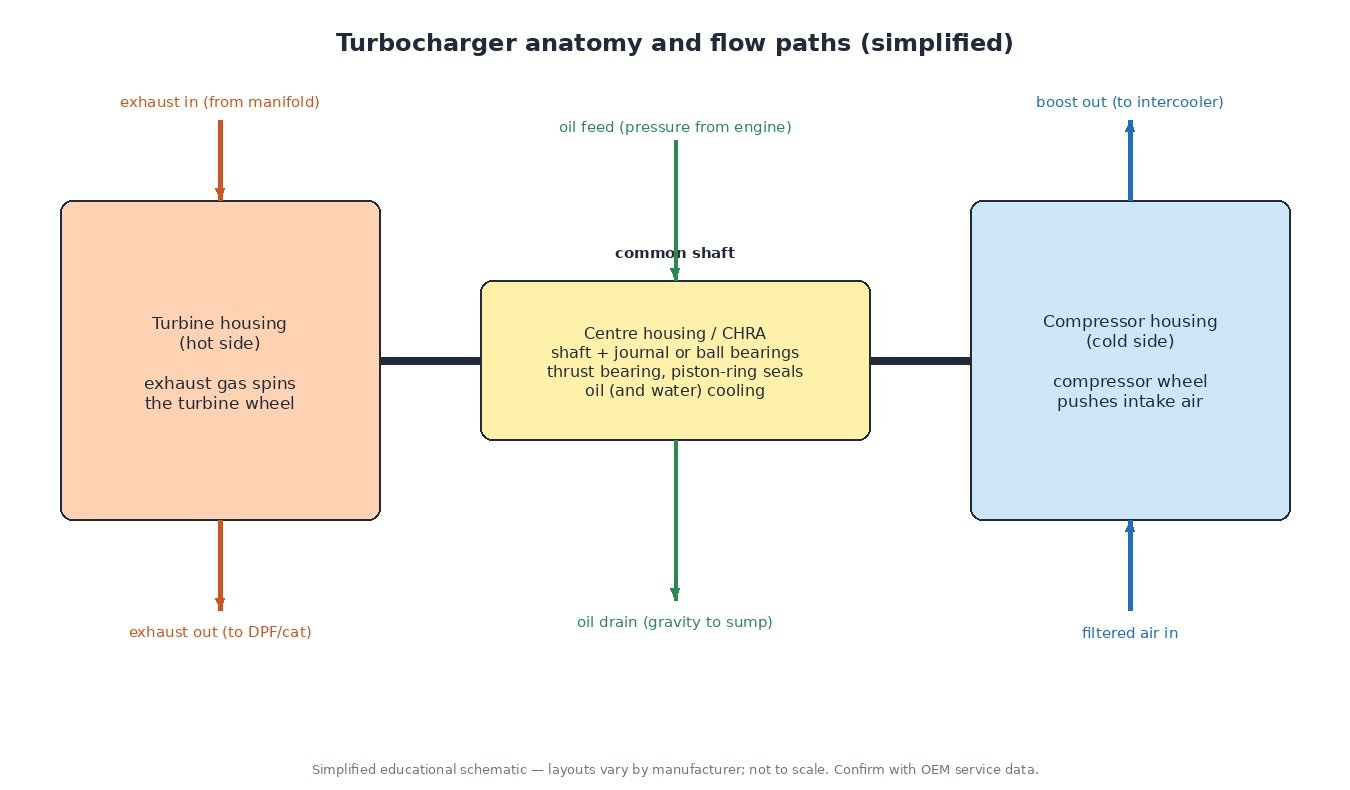
A turbocharger is an exhaust-driven air pump. Exhaust gas leaving the engine flows through the turbine housing and spins the turbine wheel. The turbine wheel is fixed to a shaft, and on the other end of that shaft sits the compressor wheel. The compressor draws in filtered air and pushes it, under pressure, through the intercooler into the intake manifold. More air in the cylinders allows more fuel to be burned, which is why a small turbocharged engine can make the power of a much larger naturally aspirated one.
How much boost the turbo makes is controlled by limiting the energy that reaches the turbine. Fixed-geometry turbos do this with a wastegate that lets some exhaust bypass the turbine. Most modern diesels use a variable geometry turbine (VGT/VNT) with movable vanes. In both cases the ECU compares requested boost with the boost sensor reading and moves the actuator in a closed loop.
The centre housing: where turbos live or die
Between the hot and cold sides sits the centre housing rotating assembly (CHRA). It contains:
- Bearings – most turbos use floating journal bearings that run on an oil film; some use ball-bearing cartridges.
- A thrust bearing – takes the axial load that pushes the shaft towards one side.
- Piston-ring type seals – dynamic seals at each end. They are not rubber lip seals and depend on correct pressure balance to keep oil inside.
- Oil passages and, on many petrol engines, water cooling – to carry heat away from the bearings, especially after the engine is switched off.
Oil enters at the top under engine oil pressure and must drain freely by gravity back to the sump. Anything that disturbs that supply or that drain shortens the turbo’s life quickly.
Why turbochargers fail
Turbo specialists repeat one message: a turbo is usually the victim, not the cause. The most common root causes are:
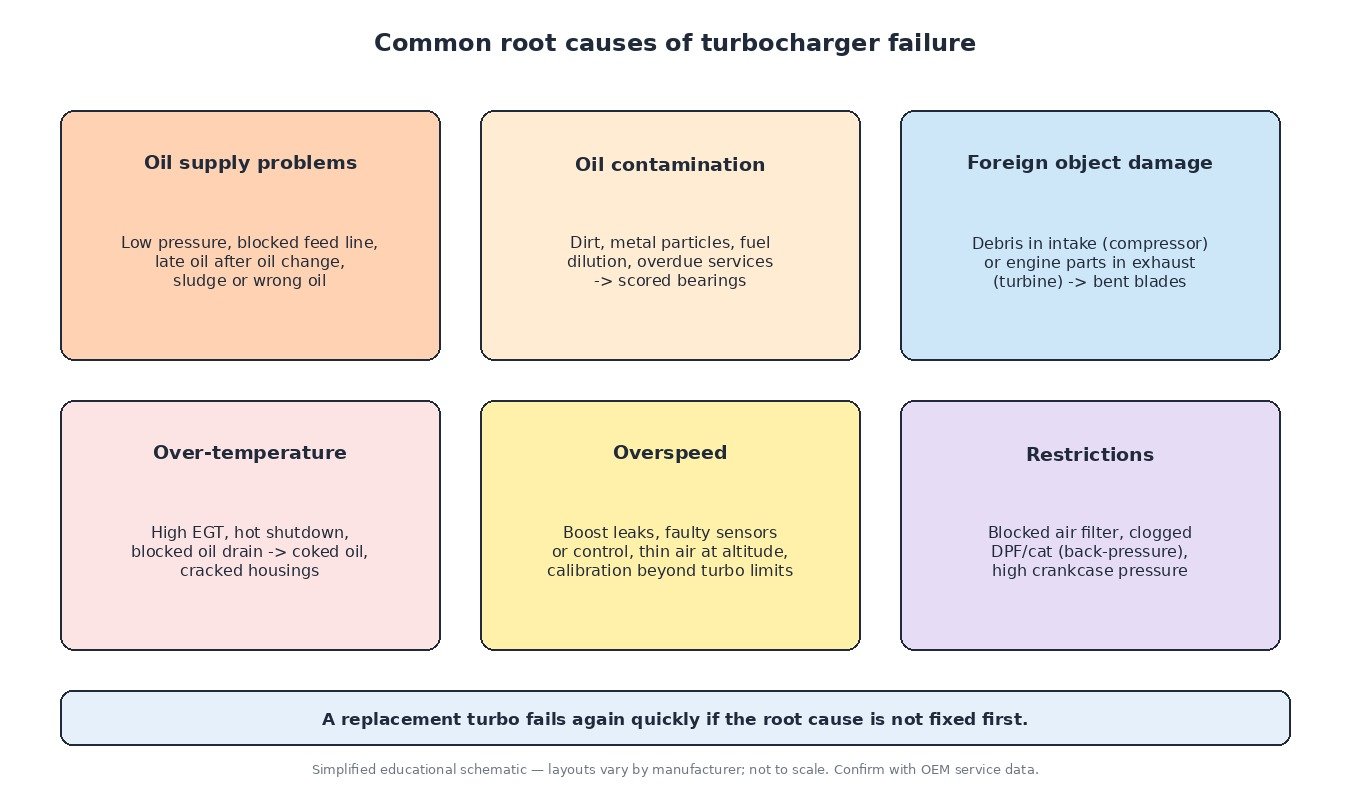
- Oil starvation – low oil level, a blocked or kinked feed pipe, a blocked banjo filter, sludged oil or cranking a new turbo without priming it. Damage happens in seconds.
- Contaminated oil – dirt, metal or coolant in the oil scores the bearings and the shaft. Overdue oil changes and the wrong oil specification play a big part.
- Foreign object damage – a loose clamp, a piece of air filter or debris left in the intake damages the compressor blades; broken engine parts damage the turbine.
- Heat – very high exhaust temperatures and hot shutdowns cook the oil in the centre housing into carbon, which blocks passages and wears bearings.
- Overspeed – boost leaks make the turbo spin faster to reach the requested pressure; altitude and aggressive calibrations can do the same.
- Restrictions – a blocked air filter, a clogged DPF or catalyst raising back-pressure, or high crankcase pressure that stops the oil draining and pushes oil past the seals.
Symptoms and what they really mean
- Low power and P0299 underboost – often a boost leak, a sticking VGT or wastegate, or a control fault rather than a bad turbo.
- Blue smoke or oil in the intercooler – can be worn turbo seals, but also a blocked oil drain, high crankcase pressure or a restricted air intake. A small oil film in the pipes is normal on many engines.
- Whistling or siren noise – boost leaks, damaged compressor blades or worn bearings letting the wheel touch the housing.
- Overboost, P0234 – vanes or wastegate stuck in the boosting position, often from soot build-up or a seized actuator.
A logical diagnostic order
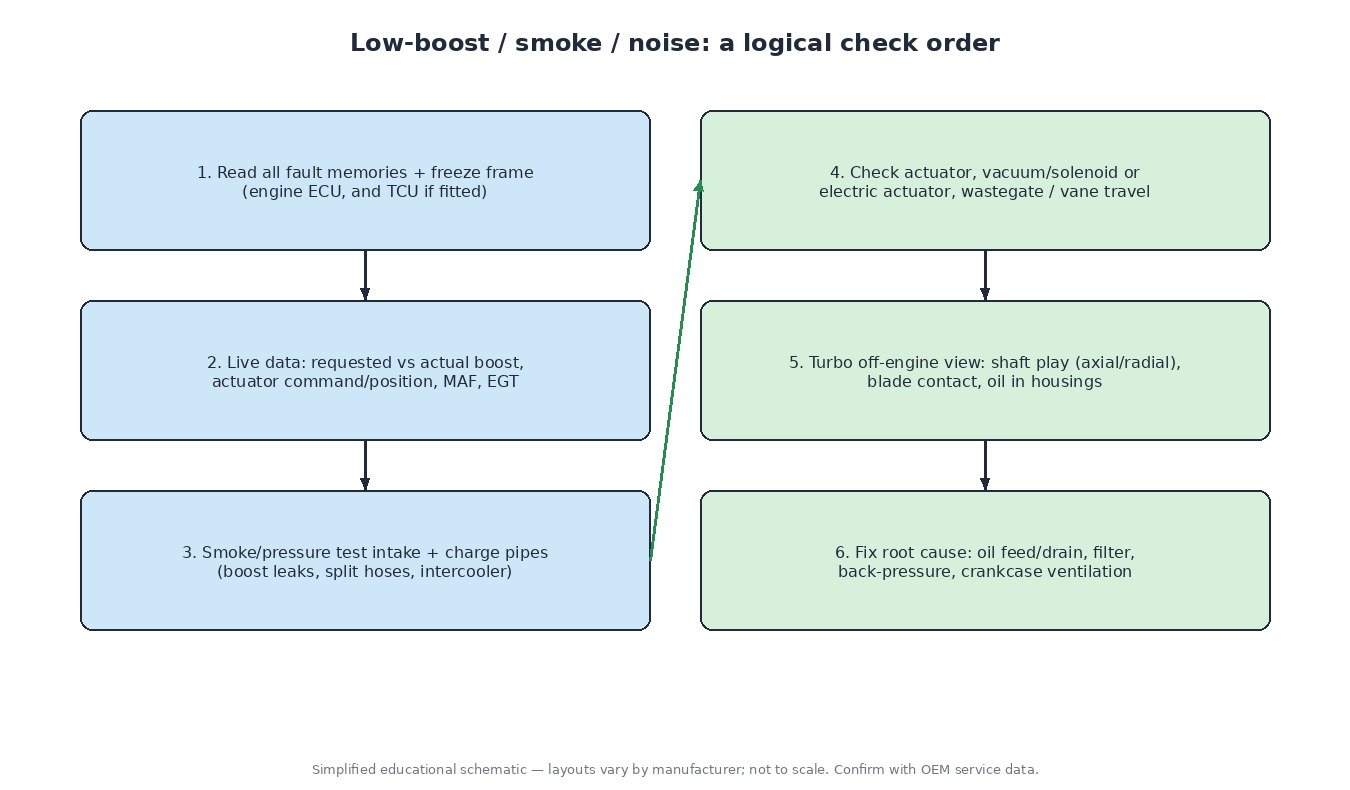
- Read all fault memories and the freeze-frame data before clearing anything.
- Check live data on a road test: requested versus actual boost, actuator command and position feedback, MAF, and EGT where available. A big gap between requested and actual boost with the actuator fully commanded points to a leak or mechanical problem.
- Smoke or pressure test the intake and charge-air system. Split hoses and leaking intercoolers are cheap fixes that are often missed.
- Test the actuator: vacuum supply and solenoid on pneumatic systems, or the electric actuator’s travel and relearn procedure. Many “dead turbos” are just sticking vanes.
- Inspect the turbo: feel for shaft play and any contact between the wheels and housings, and look for blade damage. Some radial play is normal on journal-bearing turbos; compare with the manufacturer’s limits.
- Fix the root cause before fitting a new or reconditioned unit: replace the oil feed pipe and banjo filters, check the oil drain and crankcase ventilation, change the oil and filter, and fix any exhaust restriction.
Trucks, tractors and bikes
Heavy-duty diesels in trucks and agricultural machines work under high load for long periods, so turbo life depends heavily on oil quality, air filter maintenance and letting the engine idle briefly after hard work before shutdown. Some truck engines use twin-stage turbo systems and electric VGT actuators that need calibration after replacement. Factory turbocharged motorcycles are rare, but the same principles apply to them and to aftermarket turbo kits.
What it means for ECU calibration
The ECU protects the turbo through boost limits, smoke and torque limits, EGT protection and, on some engines, models of turbo speed. A responsible calibration keeps boost and exhaust temperature inside what the turbo hardware can handle, keeps those protection functions working and never hides a mechanical problem. Before any remap, make sure the engine has no boost leaks or actuator faults, and always keep the original read of the ECU as a backup. The emissions system (DPF, EGR, SCR) should stay fully working.
Related fault codes (DTCs)
| Code | Meaning | Typical causes |
|---|---|---|
| P0299 | Turbocharger/Supercharger “A” Underboost Condition | Boost leak (split hose, loose clamp, leaking intercooler), sticking VGT vanes or wastegate stuck open, faulty actuator or control solenoid, worn or damaged turbo, blocked air filter, restricted exhaust/DPF |
| P0234 | Turbocharger/Supercharger “A” Overboost Condition | Wastegate stuck closed or VGT vanes stuck in the closed position, seized actuator linkage, faulty boost control solenoid or vacuum routing, implausible boost sensor signal |
| P0236 | Turbocharger/Supercharger Boost Sensor “A” Circuit Range/Performance | Sensor reading implausible versus barometric pressure or model, blocked or oily sensor port, leaking hose to sensor, faulty sensor |
| P0237 | Turbocharger/Supercharger Boost Sensor “A” Circuit Low | Open signal circuit, short to ground, missing 5 V reference, faulty sensor |
| P0238 | Turbocharger/Supercharger Boost Sensor “A” Circuit High | Signal shorted to reference voltage, open ground, faulty sensor |
| P0243 | Turbocharger/Supercharger Wastegate Solenoid “A” | Open or shorted solenoid coil, damaged wiring or connector, ECU driver fault |
| P0244 | Turbocharger/Supercharger Wastegate Solenoid “A” Range/Performance | Sticking solenoid, cracked or wrongly routed vacuum hoses, wastegate not responding to the command |
| P0245 | Turbocharger/Supercharger Wastegate Solenoid “A” Low | Short to ground in the control circuit, faulty solenoid |
| P0246 | Turbocharger/Supercharger Wastegate Solenoid “A” High | Short to voltage in the control circuit, faulty solenoid |
| P0045 | Turbocharger/Supercharger Boost Control “A” Circuit/Open | Open circuit to the boost control solenoid or electric actuator, unplugged connector, faulty actuator |
| P0046 | Turbocharger/Supercharger Boost Control “A” Circuit Range/Performance | Actuator not reaching the commanded position, sticking vanes or wastegate, weak vacuum supply |
| P0047 | Turbocharger/Supercharger Boost Control “A” Circuit Low | Short to ground in the boost control circuit |
| P0048 | Turbocharger/Supercharger Boost Control “A” Circuit High | Short to voltage in the boost control circuit |
| P0033 | Turbocharger/Supercharger Bypass Valve “A” Control Circuit | Open or shorted wiring to the diverter/recirculation valve, faulty valve |
| P0034 | Turbocharger/Supercharger Bypass Valve “A” Control Circuit Low | Short to ground, faulty valve coil |
| P0035 | Turbocharger/Supercharger Bypass Valve “A” Control Circuit High | Short to voltage, faulty valve coil |
| P2261 | Turbocharger/Supercharger Bypass Valve “A” Mechanical | Torn diaphragm, valve stuck open or closed, leaking recirculation valve on petrol turbo engines |
| P2563 | Turbocharger Boost Control Position Sensor “A” Circuit Range/Performance | VGT actuator position sensor implausible, sticking vanes, worn actuator, actuator needs relearn after replacement |
| P0101 | Mass or Volume Air Flow Sensor “A” Circuit Range/Performance | Often set alongside turbo faults: unmetered air leak, dirty or faulty MAF, airflow not matching the model because of low boost |
Code wording follows SAE J2012 generic definitions. Manufacturers often add their own codes for VGT actuators and turbo speed, so always check the OEM description for the vehicle.
Summary
A turbocharger is simple in concept but needs clean oil, free drainage, clean air and a healthy control system. Most failures have a root cause outside the turbo itself, so diagnose leaks, actuators, oil supply and restrictions before you replace it.
Need a professional calibration file for your car, truck, tractor or bike? Upload your original read to the ECUFileMarket file service and get a tested file from our tuning team.