
Every spark-ignition engine, from a small-capacity motorcycle to a turbocharged hatchback or a natural-gas truck engine, makes its best torque with the ignition timing advanced right up to the edge of knock. Go past that edge and the combustion turns violent, pistons and ring lands suffer, and the engine can be damaged in seconds under heavy load. The knock sensor and the ECU’s knock control strategy are what let the engine live close to that edge safely. This article explains what knock is, how the sensor detects it, how the ECU reacts, and what it means for diagnostics and tuning.
What engine knock actually is
In normal combustion the spark plug ignites the mixture and a flame front travels smoothly across the chamber. Knock (also called detonation) happens when the unburned mixture ahead of that flame front, the so-called end gas, is compressed and heated so much that it ignites on its own before the flame arrives. Several pockets of mixture then burn almost instantly, producing sharp pressure waves that bounce around the chamber. Those pressure oscillations ring through the block at a characteristic frequency, and in heavy cases you can hear them as pinging or rattling under load.
Knock is made more likely by anything that raises end-gas temperature or pressure: high boost, high intake air temperature, high compression, too much ignition advance, lean mixtures, hot combustion chambers, carbon deposits and low-octane fuel.
It is worth separating knock from pre-ignition. Pre-ignition is when the mixture lights before the spark, from a hot spot or, in modern downsized direct-injection turbo engines, from oil and fuel droplets (often called low-speed pre-ignition, LSPI). Retarding the spark cannot stop pre-ignition, so engines handle it with separate strategies, but the knock sensor still often picks up the resulting heavy pressure spikes.
How a knock sensor works
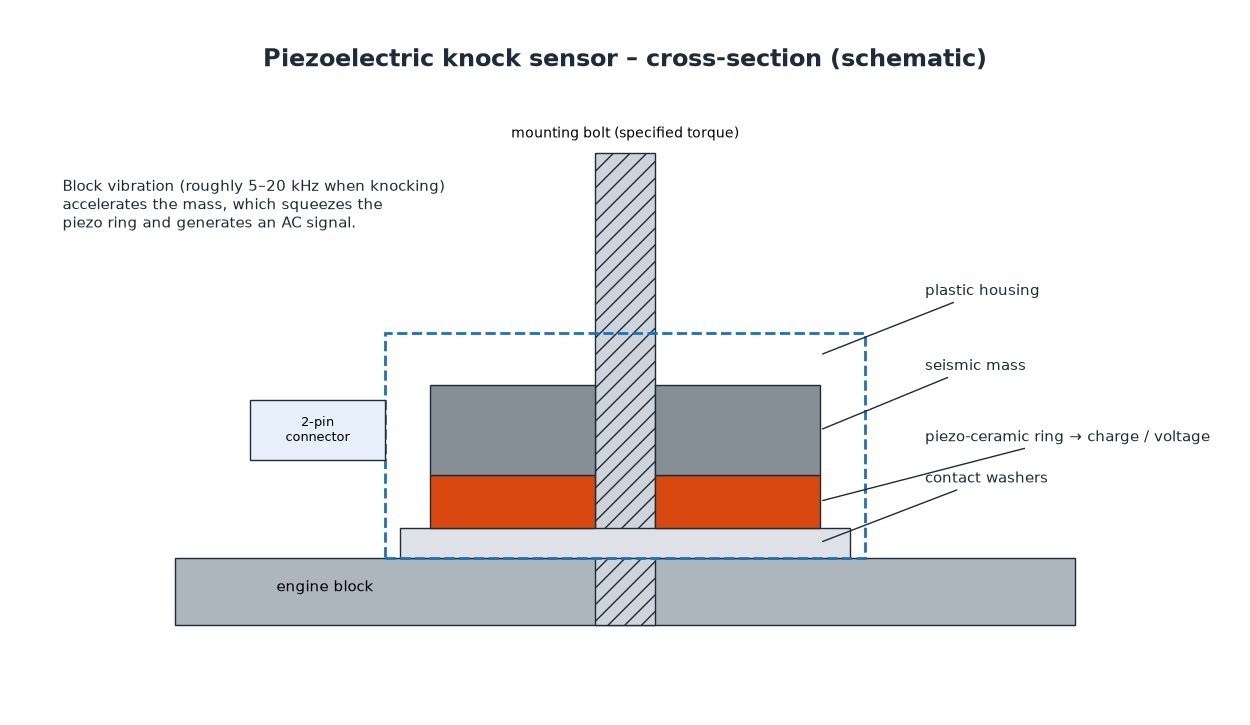
A modern knock sensor is a piezoelectric accelerometer bolted to the engine block or cylinder head. Inside is a ring of piezo ceramic clamped between a seismic mass and the sensor body. When the block vibrates, the mass presses on the ceramic and it generates a small voltage proportional to the acceleration. There is no need for an external supply, so most sensors have just two signal wires, sometimes with a shield.
Older designs were resonant types tuned to one expected knock frequency. Most current engines use broadband sensors with a fairly flat response across a wide frequency range, and leave the filtering to the ECU. This lets the same sensor work on different engines, because the knock frequency depends mainly on bore diameter: larger bores ring at lower frequencies.
Mounting matters a lot. The sensor must sit flat on a clean machined face and be tightened to the manufacturer’s torque, because the clamping force decides how well vibration is transmitted. A sensor that is over-tightened, loose or sitting on a washer or paint can under-read or over-read.
How the ECU turns vibration into a knock decision
An engine is a noisy machine: valves closing, injectors clicking, the timing chain and piston slap all show up in the sensor signal. The ECU separates real knock from that background in several steps:
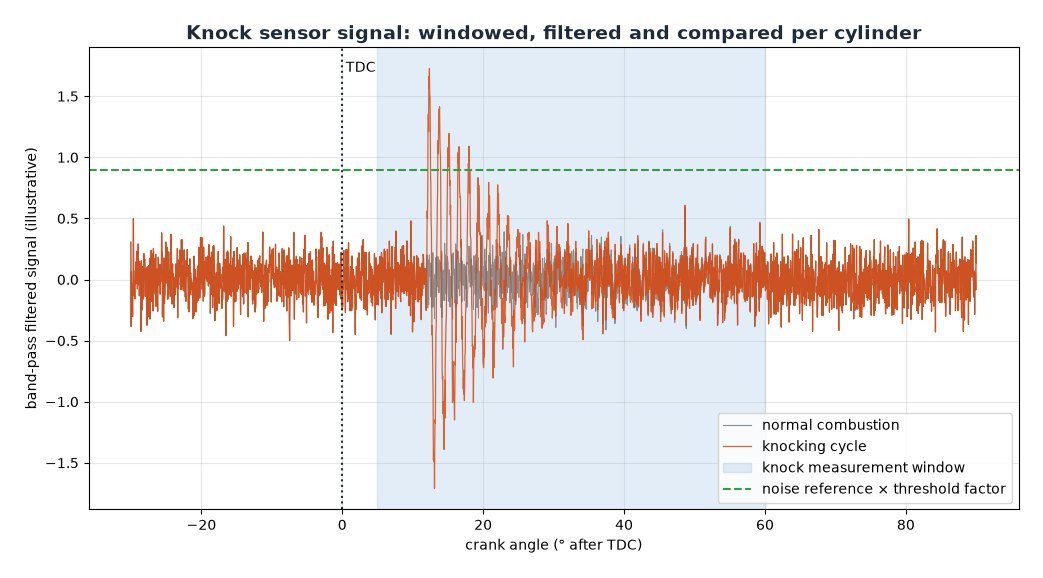
- Crank-angle window: the ECU only looks at the signal during a short window after top dead centre of the cylinder that is firing, when knock can physically occur. It uses the crank and cam sensors to know which cylinder that is.
- Band-pass filtering: the signal is filtered around the expected knock frequency for that engine.
- Integration: the filtered signal is rectified and integrated to give one intensity value per combustion event.
- Reference comparison: that value is compared with a learned background-noise level for the same cylinder at the same speed and load. If it exceeds the reference by a calibrated threshold factor, the event is counted as knock.
Because the reference is learned per cylinder, the system can detect knock even though cylinders closer to the sensor naturally produce a stronger signal.
How the ECU reacts
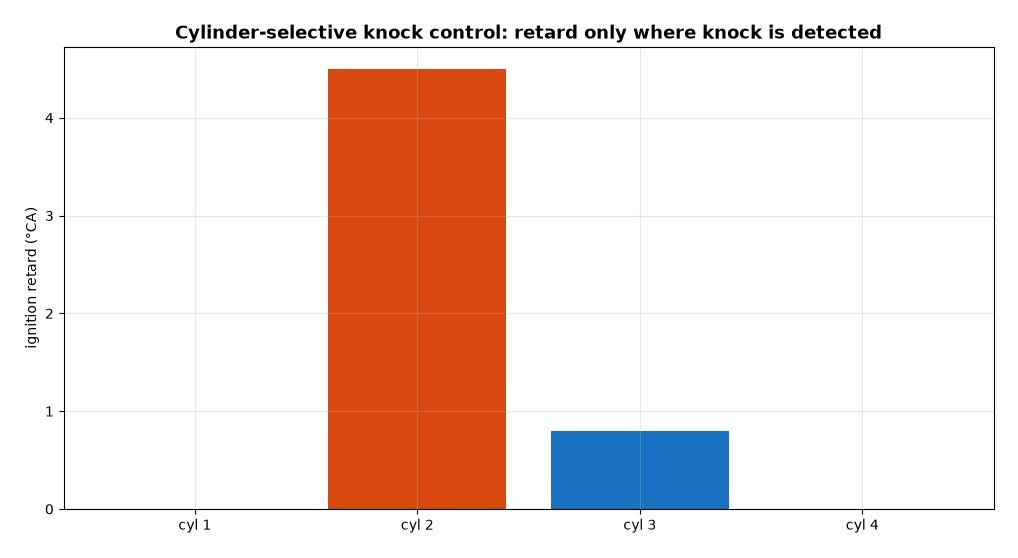
Knock control is usually cylinder-selective. When one cylinder knocks, the ECU retards the ignition on that cylinder only, by a calibrated step. If it knocks again, it retards further, up to a maximum limit. When the cylinder stays clean, timing is advanced back slowly in small steps toward the base map. The result is a sawtooth pattern of ignition retard that keeps each cylinder close to its knock limit.
Many ECUs also learn a long-term correction, so if the engine keeps needing retard (for example on lower-octane fuel) the base timing is pulled back adaptively. On turbo engines, heavy or sustained retard can also trigger load or boost reduction and mixture enrichment to cool the combustion. If the knock sensor itself fails, the ECU normally switches to a safe ignition map with fixed retard, which you feel as a flat, lazy engine.
Cars, bikes and gas engines
Practically every modern petrol car uses knock control, typically with one sensor for three or four cylinders and two on larger engines. Some motorcycles use knock sensors too, while others rely on more conservative ignition calibration. Spark-ignited natural-gas engines in trucks, buses and some agricultural machines also depend heavily on knock control, since gas quality varies.
Diagnosing knock sensor faults
- Circuit codes such as P0325 (knock sensor 1 circuit, bank 1) or P0330 (sensor 2, bank 2) usually point to wiring, connectors or a failed sensor. Check for chafed harnesses under the intake manifold, where many sensors live.
- Live data: read ignition retard per cylinder. Retard on one cylinder only suggests a local issue (injector, plug, coil, carbon). Retard on all cylinders points to fuel quality, intake temperature or a mechanical noise source.
- False knock: a loose heat shield, worn timing chain, noisy injectors or excessive valve clearance can be mistaken for knock. Fix the noise, not the threshold.
- Installation: use the correct torque and a clean surface when replacing a sensor.
Related fault codes (DTCs)
Generic OBD-II (SAE J2012) codes related to knock sensing and knock control. Sensor 1 is Bank 1 or the single sensor; sensor 2 is Bank 2. Manufacturers may word them differently, so confirm with the vehicle-specific description.
| Code | Meaning | Typical causes |
|---|---|---|
| P0324 | Knock Control System Error | Knock sensor signal missing or implausible, wiring, internal ECU knock evaluation fault; real heavy knock on some systems |
| P0325 | Knock Sensor 1 Circuit (Bank 1 or Single Sensor) | Sensor or wiring fault, unplugged connector |
| P0326 | Knock Sensor 1 Circuit Range/Performance (Bank 1 or Single Sensor) | Wrong mounting torque, corrosion or dirt under the sensor, mechanical engine noise, sensor ageing |
| P0327 | Knock Sensor 1 Circuit Low (Bank 1 or Single Sensor) | Signal open or shorted to ground, loose sensor, failed sensor |
| P0328 | Knock Sensor 1 Circuit High (Bank 1 or Single Sensor) | Signal shorted to voltage, damaged screening, failed sensor |
| P0329 | Knock Sensor 1 Circuit Intermittent (Bank 1 or Single Sensor) | Loose connector pins, chafed harness, oil/coolant in the connector |
| P0330 | Knock Sensor 2 Circuit (Bank 2) | Sensor or wiring fault, unplugged connector |
| P0331 | Knock Sensor 2 Circuit Range/Performance (Bank 2) | Wrong mounting torque, corrosion or dirt under the sensor, mechanical engine noise, sensor ageing |
| P0332 | Knock Sensor 2 Circuit Low (Bank 2) | Signal open or shorted to ground, loose sensor, failed sensor |
| P0333 | Knock Sensor 2 Circuit High (Bank 2) | Signal shorted to voltage, damaged screening, failed sensor |
| P0334 | Knock Sensor 2 Circuit Intermittent (Bank 2) | Loose connector pins, chafed harness, oil/coolant in the connector |
| P2336 | Cylinder 1 Above Knock Threshold | Actual knock (low-octane fuel, carbon deposits, high intake temperature, lean mixture, aggressive timing) or mechanical noise / sensor fault on that cylinder |
| P2337 | Cylinder 2 Above Knock Threshold | Actual knock (low-octane fuel, carbon deposits, high intake temperature, lean mixture, aggressive timing) or mechanical noise / sensor fault on that cylinder |
| P2338 | Cylinder 3 Above Knock Threshold | Actual knock (low-octane fuel, carbon deposits, high intake temperature, lean mixture, aggressive timing) or mechanical noise / sensor fault on that cylinder |
| P2339 | Cylinder 4 Above Knock Threshold | Actual knock (low-octane fuel, carbon deposits, high intake temperature, lean mixture, aggressive timing) or mechanical noise / sensor fault on that cylinder |
| P2340 | Cylinder 5 Above Knock Threshold | Actual knock (low-octane fuel, carbon deposits, high intake temperature, lean mixture, aggressive timing) or mechanical noise / sensor fault on that cylinder |
| P2341 | Cylinder 6 Above Knock Threshold | Actual knock (low-octane fuel, carbon deposits, high intake temperature, lean mixture, aggressive timing) or mechanical noise / sensor fault on that cylinder |
| P2342 | Cylinder 7 Above Knock Threshold | Actual knock (low-octane fuel, carbon deposits, high intake temperature, lean mixture, aggressive timing) or mechanical noise / sensor fault on that cylinder |
| P2343 | Cylinder 8 Above Knock Threshold | Actual knock (low-octane fuel, carbon deposits, high intake temperature, lean mixture, aggressive timing) or mechanical noise / sensor fault on that cylinder |
What it means for chiptuning
A good petrol calibration is built around knock control, not against it. When timing or boost is increased, the tuner should log per-cylinder retard on the target fuel and in hot conditions. Small occasional corrections are normal; consistent retard means the file is too aggressive for that engine, fuel or hardware. Raising knock thresholds or disabling knock control to make a dyno number look better removes the engine’s main protection and is never a safe solution.
Key takeaway
The knock sensor is a vibration sensor, and the ECU decides what counts as knock by windowing, filtering and comparing the signal per cylinder. It then pulls timing cylinder by cylinder and gives it back slowly. Read that retard in live data and you have one of the best health checks for a petrol engine, stock or tuned.
Need a safe, properly logged calibration for a petrol car, bike or gas engine? Order your tuning file from ECUFileMarket.