
Every modern diesel, from a small hatchback to a 40-tonne truck or a row-crop tractor, depends on one number more than almost any other: rail pressure. It decides how finely the fuel is atomised and, together with injector opening time, how much fuel each cylinder gets. Here is how a common rail system builds and controls that pressure, and how to approach the usual rail pressure faults.
The basic layout of a common rail system
A common rail system splits fuel delivery into two circuits. The low-pressure side moves fuel from the tank through the filter and water separator to the high-pressure pump. Depending on the design, that is done by an electric tank pump, a gear pump built into the high-pressure pump, or both.
The high-pressure pump, typically a radial or inline piston pump driven by the engine, compresses the fuel and feeds it into the rail. The rail is a thick-walled accumulator shared by all injectors. Because it stores fuel under pressure, injection pressure no longer depends on engine speed as it did with older rotary or inline pumps, so the ECU can ask for high pressure even at low rpm.
The injectors, solenoid or piezo, do not create pressure. They only decide when and for how long the pressurised fuel is released.

The rail pressure sensor
The rail pressure sensor is screwed into the rail and is the ECU’s only direct view of what is happening on the high-pressure side. Inside, a steel diaphragm carries strain-gauge elements. As pressure rises the diaphragm flexes, the resistance of the gauges changes, and a small electronic circuit converts that into a voltage signal.
Most of these sensors are three-wire parts: a 5 V reference from the ECU, a ground and a signal wire. The output is ratiometric, so it is read as a proportion of the supply. A healthy sensor never sits at exactly 0 V or exactly 5 V; signals pinned near either rail are treated as circuit faults, which is how the ECU sets the sensor circuit low or high codes.
How the ECU controls the pressure
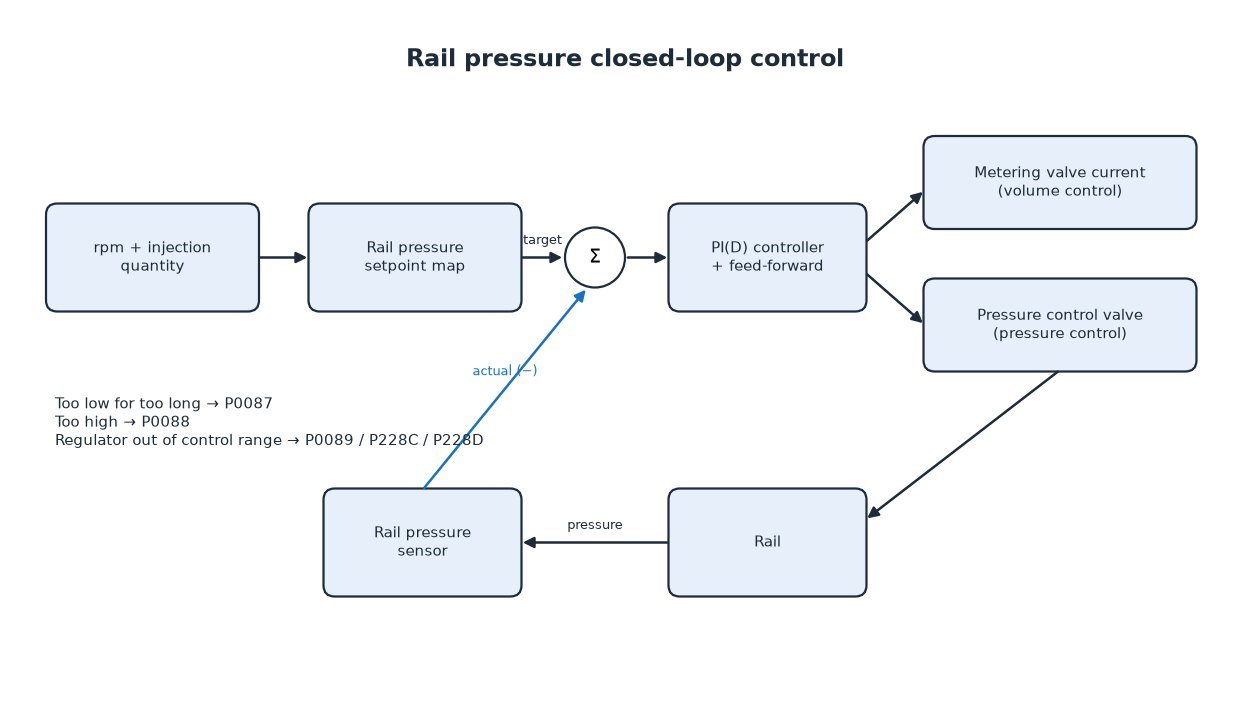
The ECU calculates a target rail pressure, mainly from engine speed and requested injection quantity, with corrections for coolant and fuel temperature, altitude and operating mode (for example cold start or regeneration). It then compares the target with the measured value and drives one or two actuators in closed loop.
Inlet metering valve
The inlet metering valve, often called MPROP, IMV, ZME or SCV depending on the manufacturer, sits on the pump inlet. It controls how much fuel is allowed into the high-pressure pumping elements. Less fuel in means less fuel pumped into the rail, so pressure falls; more fuel in means pressure rises. The ECU drives it with a current-controlled PWM signal.
Pressure control valve
Many systems also have a pressure control valve, often called DRV or PCV, on the rail or the pump outlet. It spills high-pressure fuel back to the return line. It can lower rail pressure very quickly, for example when the driver lifts off the throttle, and on some systems it is used to warm the fuel in cold conditions.
Systems with both valves are called dual-actuator systems. The ECU decides which valve is in control in each operating range, and in some ranges it uses both. Single-actuator systems rely only on inlet metering and let the injectors’ internal leakage bring pressure down.
Pressure limiting valve
Most rails also carry a mechanical pressure limiting or relief valve. It is a safety device that opens if pressure exceeds the system limit. Some designs then hold a reduced limp-home pressure so the vehicle can still be driven.
Common faults and how to approach them
The generic fault codes are a good starting point: P0087 (rail pressure too low), P0088 (rail pressure too high), P0093 (large fuel leak detected) and P0190 to P0193 (rail pressure sensor circuit and plausibility).
A systematic approach saves a lot of parts:
- Read target and actual pressure together. Watch them during cranking, idle, a snap throttle and a load test. A fault that only appears under load points to supply problems; one that appears at idle points to leakage or control.
- Check the metering valve command. If the ECU is already asking for maximum fuel and pressure is still low, the problem is not the control strategy. It is a lack of supply or too much leakage.
- Verify the low-pressure side first. A blocked filter, air ingress, a weak lift pump, waxed fuel in winter or a pinched line will starve the high-pressure pump.
- Test injector return flow. Excessive back-leak from one or more injectors bleeds pressure from the rail. A back-leak test or a rail pressure hold test helps separate injector leakage from pump weakness.
- Look for contamination. When a high-pressure pump wears internally, metal particles can travel through the rail and injectors. Replacing only the pump without cleaning or replacing the downstream parts often leads to a repeat failure.
- Do not ignore the sensor. A drifting rail sensor can make the ECU regulate to the wrong pressure. Compare it with a known-good sensor or a test-rig gauge to confirm.
A crank-no-start is a classic case. The ECU will not fire the injectors until the rail reaches a minimum pressure, so a weak lift pump, air in the lines or a leaking relief valve can stop the engine from starting even though every electrical part seems fine.

Related fault codes (DTCs)
Generic OBD-II (SAE J2012) codes related to common rail pressure control, the high-pressure pump metering valve and the rail pressure sensor. "Regulator 1" can mean the metering valve or the pressure control valve depending on the system, so check the manufacturer's definition.
| Code | Meaning | Typical causes |
|---|---|---|
| P0001 | Fuel Volume Regulator Control Circuit/Open | Open circuit to the HP pump inlet metering valve (MPROP/IMV/SCV), unplugged connector, failed valve |
| P0002 | Fuel Volume Regulator Control Circuit Range/Performance | Metering valve sticking (contaminated fuel, wear), high-resistance wiring |
| P0003 | Fuel Volume Regulator Control Circuit Low | Control circuit shorted to ground, failed metering valve |
| P0004 | Fuel Volume Regulator Control Circuit High | Control circuit shorted to voltage, failed metering valve |
| P0087 | Fuel Rail/System Pressure – Too Low | Clogged fuel filter, weak lift pump, air in fuel, sticking metering valve, high injector back-leakage, leaking pressure control valve, worn HP pump |
| P0088 | Fuel Rail/System Pressure – Too High | Pressure control valve stuck closed, metering valve stuck open, faulty rail pressure sensor, blocked return |
| P0089 | Fuel Pressure Regulator 1 Performance | Regulator (pressure control or metering valve) not achieving commanded pressure, contamination, wiring |
| P0090 | Fuel Pressure Regulator 1 Control Circuit | Open/short in the regulator circuit, failed regulator |
| P0091 | Fuel Pressure Regulator 1 Control Circuit Low | Regulator circuit shorted to ground, failed regulator |
| P0092 | Fuel Pressure Regulator 1 Control Circuit High | Regulator circuit shorted to voltage, failed regulator |
| P0093 | Fuel System Leak Detected – Large Leak | External high-pressure leak (pipe, union, rail), injector stuck open, pressure limiting valve opening |
| P0094 | Fuel System Leak Detected – Small Leak | Small external leak, excessive injector return flow, leaking pressure control/limiting valve |
| P0190 | Fuel Rail Pressure Sensor "A" Circuit | Rail pressure sensor or wiring fault, 5 V reference problem |
| P0191 | Fuel Rail Pressure Sensor "A" Circuit Range/Performance | Sensor drift or implausible reading (offset with engine off), connector corrosion |
| P0192 | Fuel Rail Pressure Sensor "A" Circuit Low | Signal open or shorted to ground, failed sensor |
| P0193 | Fuel Rail Pressure Sensor "A" Circuit High | Signal shorted to voltage, open ground, failed sensor |
| P0194 | Fuel Rail Pressure Sensor "A" Circuit Intermittent/Erratic | Loose connector, chafed wiring, failing sensor |
| P0251 | Injection Pump Fuel Metering Control "A" Malfunction (Cam/Rotor/Injector) | Fuel metering actuator or its circuit on the injection pump |
| P0252 | Injection Pump Fuel Metering Control "A" Range/Performance | Metering actuator not reaching commanded position: sticking, contamination, wiring |
| P0627 | Fuel Pump "A" Control Circuit/Open | Open circuit to the (electric) fuel pump control, relay or pump module fault |
| P0628 | Fuel Pump "A" Control Circuit Low | Pump control circuit shorted to ground, failed pump or relay |
| P0629 | Fuel Pump "A" Control Circuit High | Pump control circuit shorted to voltage, failed pump control module |
| P228C | Fuel Pressure Regulator 1 Exceeded Control Limits – Pressure Too Low | Pressure stays below target with regulator at its limit: supply restriction, worn HP pump, injector back-leak, leaking regulator |
| P228D | Fuel Pressure Regulator 1 Exceeded Control Limits – Pressure Too High | Pressure stays above target: regulator sticking, blocked return, faulty rail pressure sensor |
Trucks, tractors and machinery
The same principles apply to heavy-duty and agricultural diesels. Many truck, tractor and construction engines use Bosch, Denso or Delphi common rail systems with larger pumps and rails, while some heavy-duty engines use unit injectors or unit pumps instead of a shared rail. On machines that work long hours at high load, fuel quality and water separation matter even more for pump and injector life.
What this means for tuning
Rail pressure maps are part of every diesel calibration. A careful tune looks at the whole picture: injection quantity, injection timing, rail pressure target, the pressure limits and the smoke and torque limiters. Adding fuel without checking that the pump can keep up leads to rail pressure deviation, which the ECU will flag or answer with limp mode. Raising rail pressure targets beyond what the pump and injectors are designed for adds stress to expensive parts and is not a shortcut to power.
After any calibration change, log target versus actual rail pressure and the metering valve command at full load. If the actual pressure follows the target with margin left on the actuator, the hardware is coping. If the actuator is at its limit, the file is asking too much of that fuel system.
Key takeaway
Rail pressure is built by the pump, stored in the rail, measured by a single sensor and controlled by the ECU through metering and pressure control valves. When a pressure fault appears, compare target, actual and actuator command first, then work from the low-pressure side up to the injectors. That order finds most faults faster than swapping parts.
Need a diesel calibration that respects your fuel system’s limits? Order your tuning file from ECUFileMarket.
One Response