
Before you blame a coil, an injector or the ECU for a misfire, a rough idle or a lack of power, it is worth asking a basic question: does every cylinder actually seal? Compression, relative compression and leak-down tests answer that question. This guide explains what each test measures, how to run it properly and how to read the results on cars, trucks, tractors and motorcycles.
Why engine sealing matters
An engine makes power by trapping air (and fuel) above the piston, compressing it and burning it. If air escapes past the valves, the piston rings or the head gasket, that cylinder produces less pressure and less torque. The ECU sees the result indirectly: crankshaft speed drops slightly on that cylinder’s power stroke, which can be flagged as a misfire on petrol engines or as a cylinder balance deviation on diesels.
That is also why sealing should be checked before any performance calibration. A tuned map asks more of every cylinder, and an engine with a burnt valve or tired rings will show it as misfires, smoke, heavy blow-by or oil being pushed into the intake.
Test 1: cranking compression
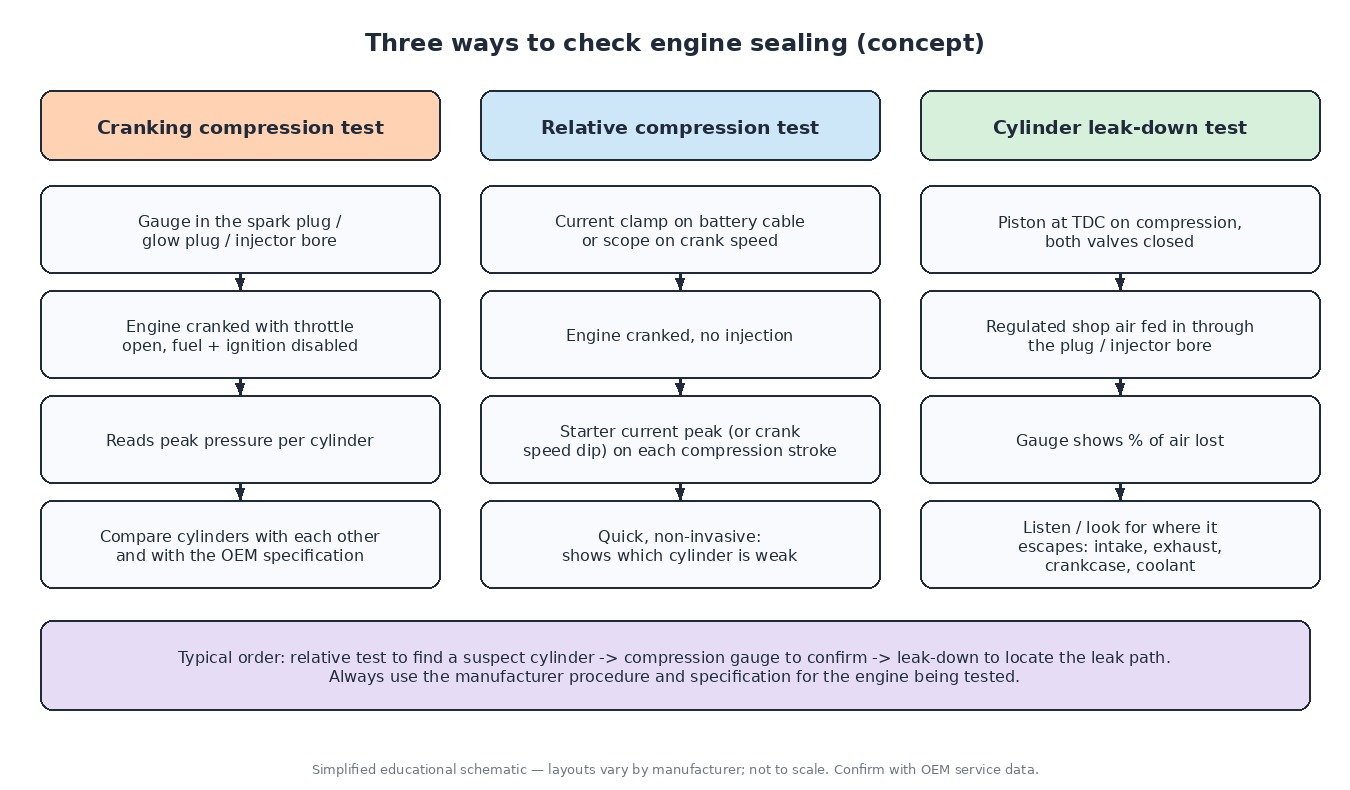
The classic test uses a pressure gauge screwed into the spark plug hole (petrol) or into the glow plug or injector bore with a suitable adapter (diesel). The engine is cranked by the starter and the gauge records the peak pressure for that cylinder.
Doing it properly
- Warm engine, healthy battery. Cranking speed has a big influence on the reading. A weak battery or slow starter gives low numbers on every cylinder.
- Disable fuel and ignition. Unplug injectors or the fuel pump supply and the coils, as the service procedure describes, and clear any stored codes afterwards.
- Remove all plugs and open the throttle on petrol engines so every cylinder fills the same way and the starter turns freely.
- Crank until the needle stops rising, usually a few compression strokes, and use the same number of strokes on every cylinder.
- Use the right gauge. Diesel compression pressures are much higher than petrol ones, so the gauge range and the adapters must match the engine.
Reading the result
Compare each cylinder with the manufacturer’s specification and, just as importantly, with the other cylinders. The service data gives the minimum value and the maximum allowed difference between cylinders. One low cylinder points to a local problem (valve, rings, gasket). Two low cylinders next to each other often suggest a head gasket leak between them. All cylinders low together can mean worn engine, slow cranking or incorrect valve timing after a belt or chain has jumped.
On petrol engines a wet test can help: add a small amount of engine oil to the weak cylinder and retest. If the reading rises clearly, the oil is temporarily sealing the rings, so the rings or bore are the likely cause. If it stays low, the valves or gasket are more likely. Avoid the wet test on diesels unless the manufacturer allows it, because liquid in a high-compression cylinder can cause damage.
Test 2: relative compression
A relative compression test compares cylinders without removing anything. While the engine cranks with injection disabled, a current clamp on the battery cable records starter current. Every time a piston comes up on compression, the starter has to work harder and the current rises. A cylinder that leaks makes a lower peak. Some scan tools and engine ECUs do the same job using crankshaft speed: the crank slows down slightly before each compression top dead centre, and a weak cylinder causes a smaller slowdown.
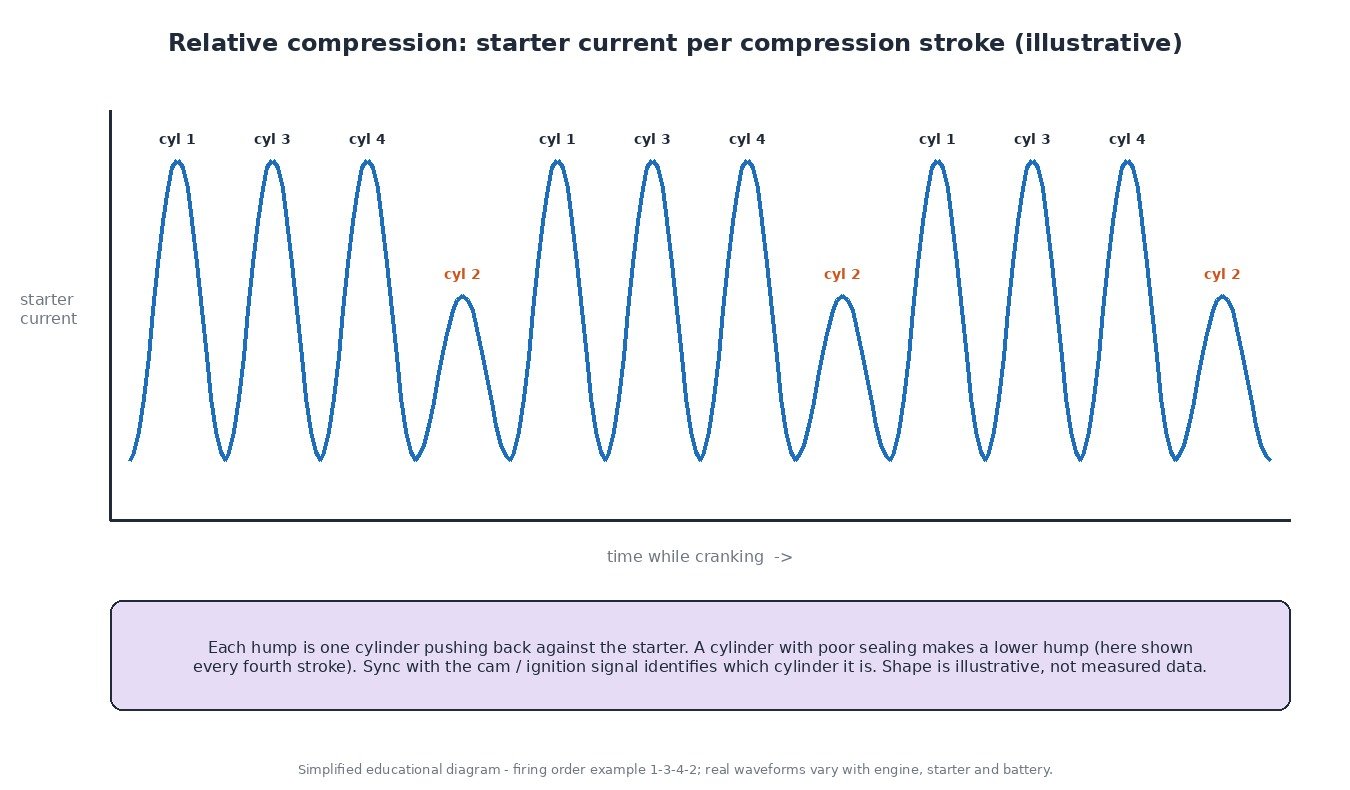
The test does not give pressure values, only a comparison. Syncing the trace with a cam sensor or ignition signal tells you which hump belongs to which cylinder. It is a fast first check on engines where plugs or injectors are hard to reach.
Test 3: cylinder leak-down
A leak-down tester feeds regulated shop air into a cylinder with the piston at top dead centre on the compression stroke, when both valves are closed. Two gauges show the supply pressure and the pressure held in the cylinder, and the difference is shown as a leakage percentage. The real value of this test is that you can find where the air goes.
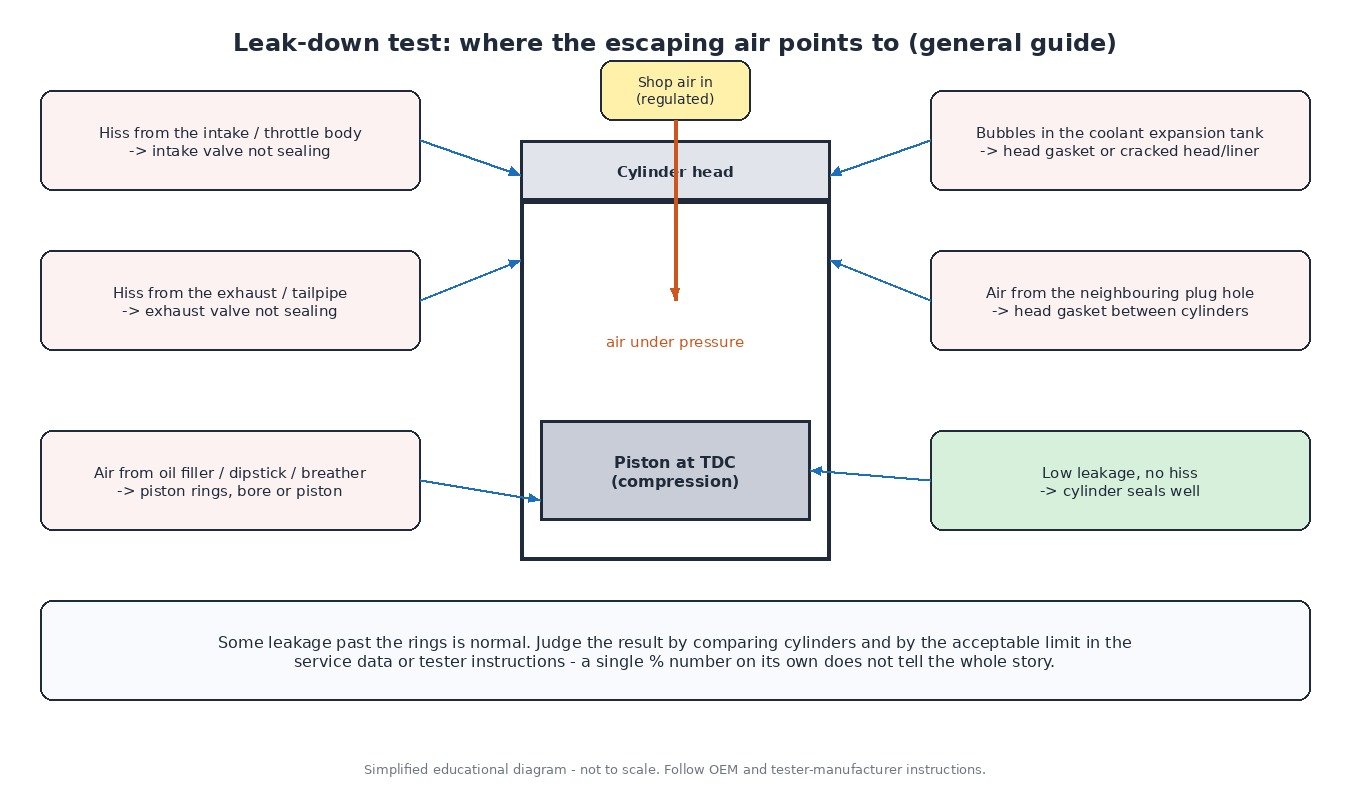
- Hiss at the intake or throttle body: intake valve not sealing.
- Hiss at the exhaust: exhaust valve not sealing.
- Air at the oil filler, dipstick tube or crankcase breather: rings, bore or piston.
- Bubbles in the coolant expansion tank: head gasket, cracked head or liner.
- Air from the next cylinder’s plug hole: head gasket leak between cylinders.
Hold the crankshaft securely: air pressure on a piston that is slightly off top dead centre can turn the engine suddenly. Some leakage past the rings is normal, so compare cylinders and follow the limits given by the service data or the tester’s maker.
Vehicle-specific notes
Cars and vans
Coil-on-plug petrol engines make compression testing easy. On direct-injection diesels, removing injectors to fit an adapter can be risky if they are seized, so a relative compression test or a scan-tool cylinder test is often the better first step.
Trucks and agricultural machines
Heavy-duty diesels usually need injector-bore adapters and high-range gauges. Many engine ECUs and service tools offer cylinder cut-out or crank-speed based tests, which help separate an injector problem from a mechanical one before the engine is opened.
Motorcycles and small engines
Many singles and twins use automatic decompression on the camshaft to make starting easier, which lowers cranking readings. Manufacturers state the expected value for that design, so compare with the correct data. Tight valve clearances are a common cause of low compression on shim-adjusted bike engines, because a valve that cannot close fully leaks.
A simple diagnostic order
- Read fault codes, freeze frame and misfire counters or cylinder balance values.
- Check ignition and fuelling on the suspect cylinder first; they are the more common causes.
- Run a relative compression test to confirm or rule out a mechanical problem.
- Measure cranking compression on the suspect cylinders.
- Use leak-down to locate the leak before deciding on valve work, a head gasket or an engine rebuild.
Related fault codes (DTCs)
Low compression does not set a code of its own. It shows up through misfire and balance monitoring. These generic codes are often linked to sealing problems:
| Code | Meaning | Typical causes |
|---|---|---|
| P0300 | Random/Multiple Cylinder Misfire Detected | Ignition or fuelling faults, vacuum leaks, low compression on one or more cylinders (worn rings, burnt or tight valves, head gasket), incorrect valve timing |
| P0301–P0308 | Cylinder 1–8 Misfire Detected | Coil, plug or injector fault on that cylinder; if those check out, poor sealing on that cylinder: burnt/bent valve, tight valve clearance, broken ring, head gasket leak |
| P0316 | Misfire Detected on Startup (First 1000 Revolutions) | Cold-start fuelling or ignition faults, coolant entering a cylinder through a leaking head gasket, low compression that improves once the engine warms up |
| P0016 | Crankshaft Position – Camshaft Position Correlation (Bank 1 Sensor A) | Stretched timing chain, jumped belt, worn guides or tensioner, cam phaser or oil-control faults; a jumped belt/chain can also reduce compression on all cylinders |
| P0263 | Cylinder 1 Contribution/Balance | Diesel: injector delivery or leak-off fault on cylinder 1, wiring, or a mechanical problem such as low compression making that cylinder contribute less |
| P0266 / P0269 / P0272 | Cylinder 2 / 3 / 4 Contribution/Balance | Same as P0263 for cylinders 2, 3 and 4: injector fault, wiring, or low compression / poor sealing on the named cylinder |
Conclusion
Compression, relative compression and leak-down tests tell you whether the engine is mechanically healthy before you change parts or calibration. Make them part of your routine for any persistent misfire, balance fault or power complaint, and definitely before tuning a used engine.
Engine checked and ready for a calibration? Get professionally prepared tuning files for cars, trucks, tractors and bikes from the ecufilemarket.com file service.