
You stop at a red light, the rev counter drops to zero, and a fraction of a second after you lift off the brake the engine is running again. Automatic start-stop looks simple from the driver’s seat, but behind it sits a reinforced starting system, a battery built for constant cycling, a sensor that watches every amp, and a control unit checking a long list of conditions before it allows each stop. This guide explains how the system works and why it so often stops working.
What start-stop is for
An idling engine burns fuel and produces emissions while the vehicle is going nowhere. Start-stop switches the engine off during standstill, typically in city traffic, and restarts it automatically when the driver wants to move.
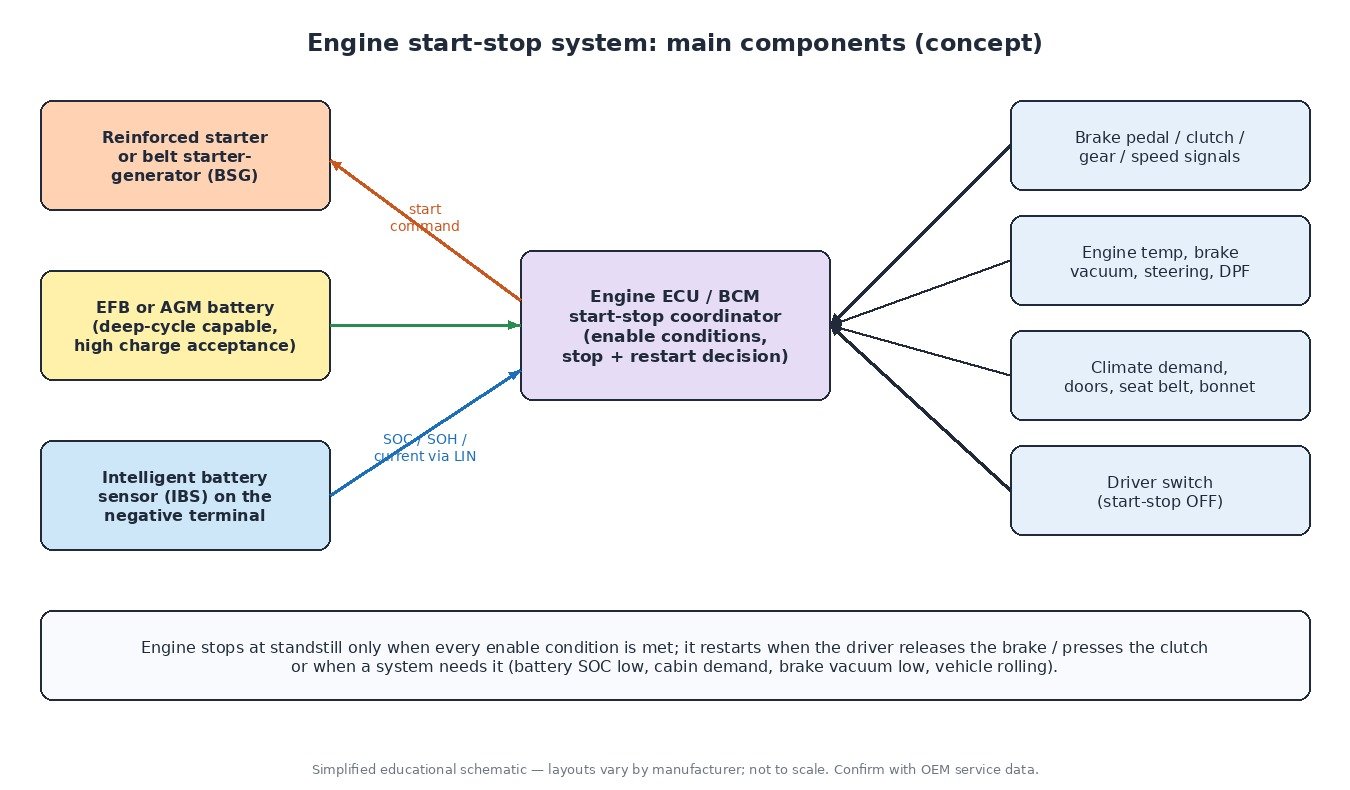
The hardware: starter, battery and sensor
Reinforced starter or belt starter-generator
A conventional starter is designed for a few starts per journey. A start-stop vehicle may restart dozens of times on a single trip, so it uses an enhanced starter with stronger brushes, bearings and pinion engagement parts designed for a far higher number of cycles. The alternative is a belt starter-generator (BSG): an electric machine in place of the alternator that charges the battery during driving and spins the crankshaft through the auxiliary belt for restarts. Belt restarts are quieter, and on 48 V mild hybrids the same machine also recovers braking energy.
EFB and AGM batteries
During every stop the battery alone supplies all consumers, then delivers the restart current. A standard flooded battery would age quickly under these deep, frequent cycles. Start-stop vehicles therefore use an EFB (enhanced flooded battery) or an AGM (absorbent glass mat) battery. Both tolerate cycling much better than a standard battery, and AGM is usually fitted where demands are highest, for example with regenerative braking. A replacement should be the same technology the vehicle was designed for, or a type the manufacturer explicitly approves.
Intelligent battery sensor (IBS)
Clamped onto the negative terminal, the IBS measures battery current through a precision shunt together with voltage and temperature. From these values it estimates state of charge (SOC), state of health (SOH) and how well the battery would support a restart, and reports them to the energy management system, usually over a LIN bus. Our smart charging system guide explains how the same data controls alternator output.
Enable conditions: when the engine may stop
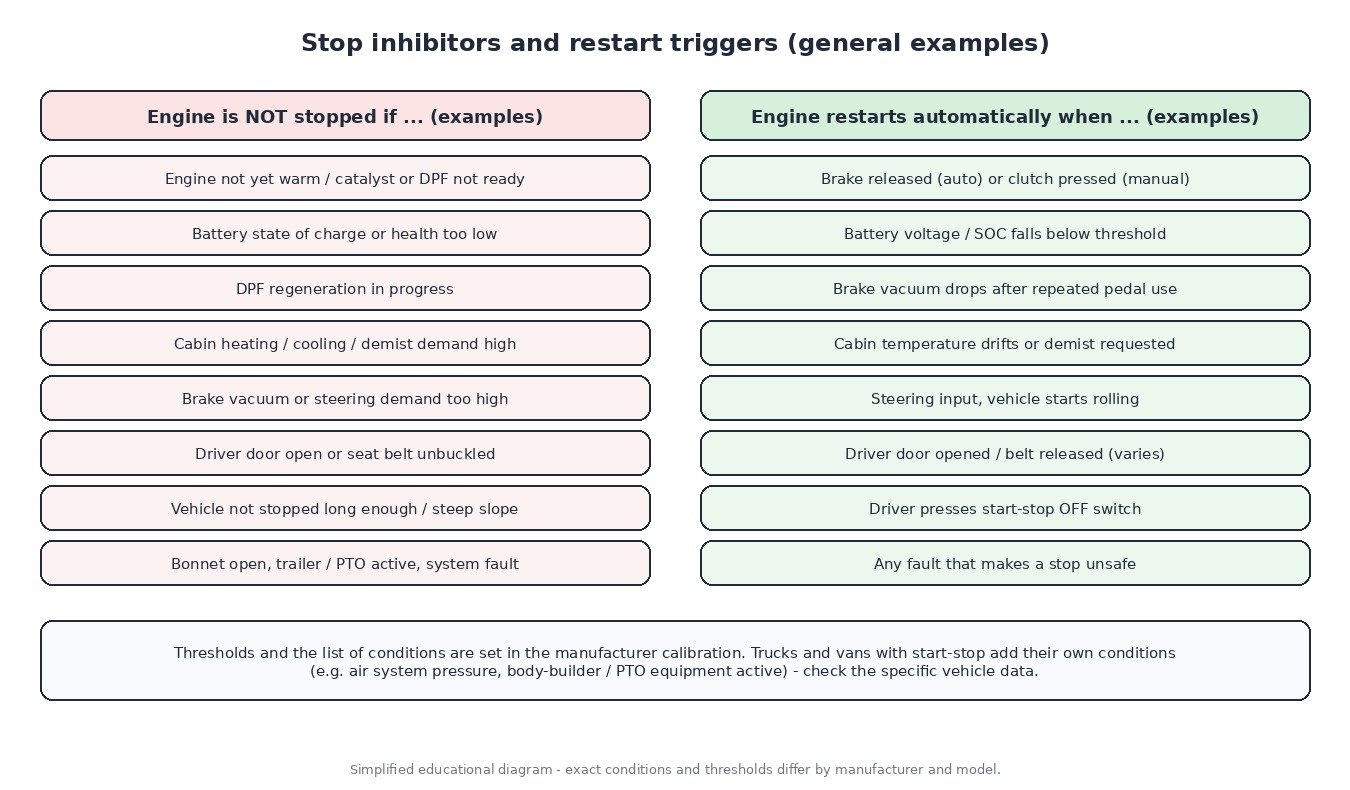
The engine ECU, body control module (BCM) or a dedicated energy management function only allows a stop when all conditions are met. They vary by manufacturer, but typical examples are:
- engine and exhaust aftertreatment warm enough, and no DPF regeneration in progress;
- battery SOC and health above their thresholds;
- cabin heating, cooling or demisting demand within limits;
- enough brake vacuum or booster assistance, and no large steering input;
- driver door closed, seat belt fastened, bonnet closed;
- vehicle fully stopped (some systems stop the engine shortly before standstill), in neutral with clutch released on a manual, or brake held on an automatic.
Restart triggers
A restart is requested by the driver (releasing the brake, pressing the clutch, selecting a gear) or by the vehicle itself. The system restarts on its own if battery voltage or SOC drops too far, brake vacuum falls after repeated pedal applications, the cabin temperature drifts, the vehicle starts rolling or a fault appears. On many cars opening the driver’s door or unbuckling the belt prevents an automatic restart and requires a normal key or button start instead, as a safety measure.
Why start-stop stops working
- Battery aging. As capacity falls, the IBS reports lower health and the system inhibits stops to protect the next start. Often this is the only symptom of a weak battery.
- Battery not registered or coded after replacement. Many vehicles need a new battery registered with a scan tool. Without it the energy management still assumes the old, aged battery, keeps start-stop disabled and may apply the wrong charging strategy. If the capacity or technology changed, it must be coded too.
- IBS faults. A loose clamp, corroded terminal, damaged LIN wire or failed sensor removes the data the system needs.
- Short trips and high loads. Cold weather, heavy climate use and short journeys keep SOC low, so the system rarely gets permission to stop.
- Switches and sensors. Faulty bonnet, door, belt, clutch or neutral switches, or a brake booster pressure sensor, will block the function.
Diagnostics tips
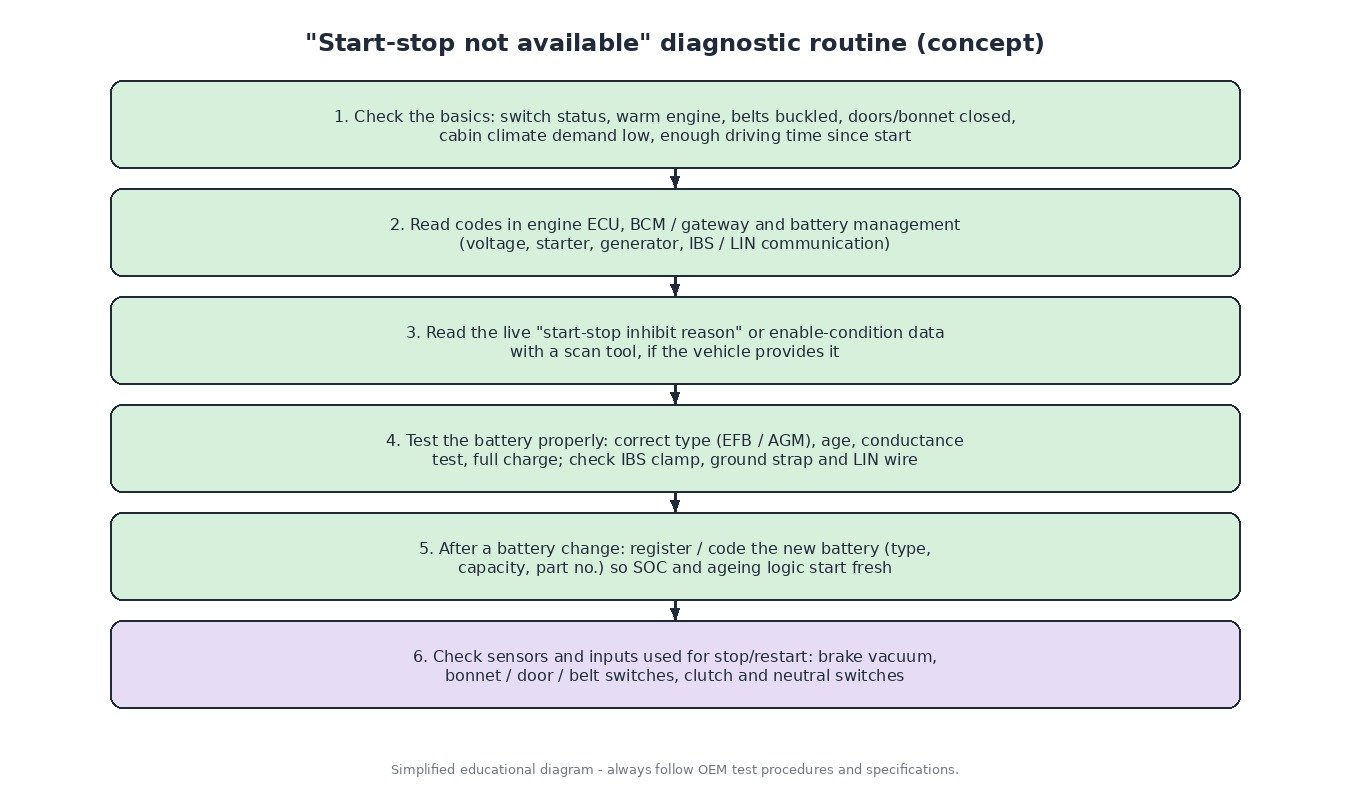
- Confirm the basics: system switched on, engine warm, belts buckled, doors and bonnet closed, low climate demand.
- Read codes in the engine ECU, BCM or gateway and energy management, including voltage, starter, generator and LIN communication codes.
- Many scan tools show the current “start-stop inhibit reason” in live data. It usually tells you exactly which condition is missing.
- Test the battery with a suitable tester for EFB/AGM, fully charged. Check the IBS clamp, the ground strap and the LIN connection.
- After a battery change, register the battery and code its type and capacity where required.
- When charging or supporting the battery, follow the manufacturer’s instructions; many specify connecting the negative lead to a body ground point so the IBS sees the charge current.
Vans and trucks
Vans use the same technology as cars. On heavy trucks automatic start-stop at traffic lights is less common; many instead use idle shutdown timers that stop the engine after a set idling time, and add conditions such as air system pressure or active PTO equipment.
Related fault codes (DTCs)
Generic OBD-II/EOBD codes (SAE J2012). Start-stop inhibit reasons are usually stored as manufacturer-specific codes or live data, so confirm with service information.
| Code | Meaning | Typical causes |
|---|---|---|
| P0560 | System Voltage | Battery supply to the ECU out of the expected range or implausible: weak or discharged battery, poor battery terminal or ground connections, charging system fault |
| P0561 | System Voltage Unstable | Loose or corroded terminals, intermittent ground strap, failing alternator/regulator, high-resistance connections that make voltage fluctuate during cranking or restarts |
| P0562 | System Voltage Low | Aged or sulphated battery, wrong battery type, parasitic drain, charging not keeping up (belt, alternator, regulator), voltage drop on B+ or ground cables; start-stop is usually inhibited |
| P0563 | System Voltage High | Regulator fault or alternator overcharging, poor sensing ground, incorrect external charger or jump-start equipment |
| P0512 | Starter Request Circuit | Fault in the start request signal from the ignition switch / start button or other control unit: switch, wiring, connector or input fault |
| P0615 | Starter Relay Circuit | Open circuit in the starter relay control wiring, failed relay, blown fuse, connector fault |
| P0616 | Starter Relay Circuit Low | Relay control circuit shorted to ground or relay coil fault |
| P0617 | Starter Relay Circuit High | Relay control circuit shorted to supply, relay stuck, wiring fault |
| P0620 | Generator Control Circuit | Fault in the ECU-to-alternator (generator) control line: wiring, connector, regulator fault; smart charging and start-stop may be disabled |
| P0621 | Generator Lamp/L-Terminal Control Circuit | Faulty L-terminal wiring, charge warning lamp circuit fault, regulator fault |
| P0622 | Generator Field/F-Terminal Control Circuit | Field control circuit open or shorted, worn brushes or regulator fault, wiring or connector problems |
Closing
Start-stop depends on a healthy, correctly registered battery and a working IBS before anything else. Check those first, then read the inhibit reason, and most “start-stop not available” complaints are solved quickly.
Need a custom engineered ECU or TCU file built from your original read? Upload your file at ECUFileMarket.