
The mass of air that enters a cylinder is not fixed by throttle angle or boost alone. Temperature changes density: colder air packs more oxygen into the same volume, hotter air packs less. The sensor that tells the engine control unit (ECU) that story is the intake air temperature (IAT) sensor — usually an NTC thermistor in the intake duct, inside a MAF housing, or combined with a pressure sensor after the intercooler as a TMAP. This article explains how IAT works, how the ECU uses it for density correction and protection, and what goes wrong when the reading is false.
Why air density matters
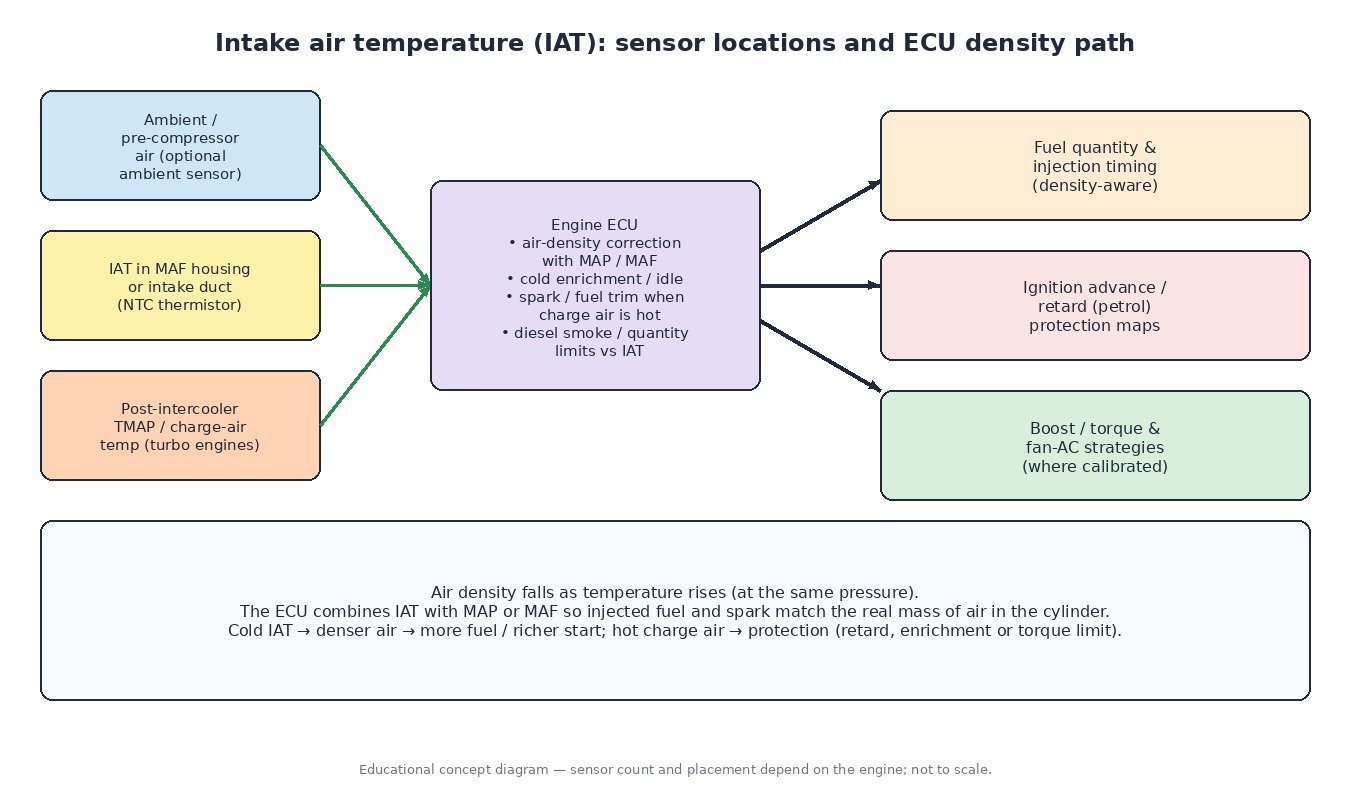
Fuel injection and ignition timing are built around air mass. On a speed-density system the ECU estimates mass from manifold pressure (MAP), engine speed and IAT. On a MAF system the hot-wire or hot-film element already measures mass flow, but IAT still appears in corrections, cold start and charge-air protection. If the ECU believes the air is colder than it really is, it treats the charge as denser and can add fuel; if it believes the air is hotter, it may pull spark, enrich for cooling or cut diesel quantity. That is why a stuck or shorted IAT circuit shows up as driveability and smoke problems, not only as a temperature gauge complaint.
Sensor hardware and where it sits
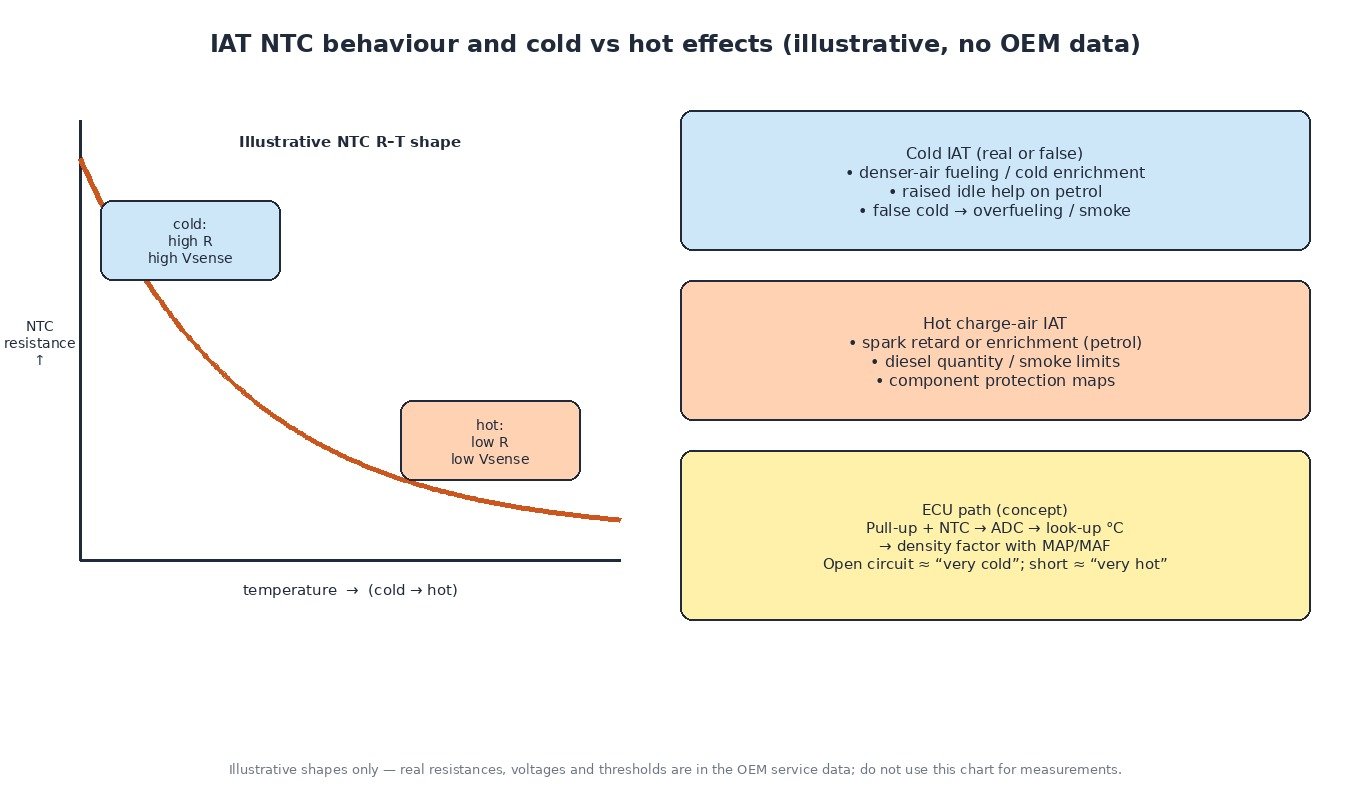
- NTC thermistor: resistance falls as temperature rises. Inside the ECU a pull-up resistor and the sensor form a voltage divider; the ADC reading is converted through a look-up table into degrees.
- Two-wire standalone IAT: a probe in the intake hose or airbox, common on many petrol and diesel engines.
- Integrated in the MAF: the temperature element shares the MAF housing; contamination of the housing can affect both signals.
- Post-intercooler TMAP: on turbo engines a combined temperature and pressure sensor after the cooler reports charge-air temperature closer to what the cylinders actually see.
Pre-throttle or MAF locations track filter-box air; post-intercooler locations track compressor heat and cooler effectiveness. Trucks may also use a separate ambient sensor for climate and derate strategies.
How the ECU uses IAT
- Density correction with MAP or MAF so injected fuel matches the real oxygen mass.
- Cold enrichment and idle help on petrol engines when intake air (and walls) are cold.
- Spark retard or enrichment when charge air is hot, to protect against knock and component heat.
- Diesel smoke and quantity limits that tighten when IAT or charge-air temperature is high.
- Fan / AC strategies on some calibrations, alongside coolant temperature.
Open-circuit NTC wiring often looks like an extremely cold reading; a short to ground often looks extremely hot. Many ECUs then substitute a default value and set a circuit code, which can leave the engine rich, lean or limited depending on which substitute they chose.
Turbo charge-air temperature vs ambient IAT
Compressor outlet air is hotter than ambient; the intercooler brings it down before the throttle or manifold. A MAF or pre-compressor sensor does not match a post-intercooler TMAP. For protection and smoke control on boosted engines, charge-air temperature after the cooler is the more relevant figure. A clogged or heat-soaked intercooler shows as a persistently high post-cooler reading under load while ambient IAT looks normal — a qualitative sign of lost cooling effectiveness, not a substitute for OEM tests.
Diagnostics that separate sensor from reality
- Cold soak comparison: with the engine cold and key on, IAT should sit close to ambient (and to a second known reference if you have one).
- Heat-soak after shutdown: underhood air can rise after a hot stop; watch whether the reading recovers with airflow on the next drive.
- Live data vs symptoms: false cold IAT → overfueling, black smoke on diesels, rich trims on petrol; false hot IAT → power limit, retard, hesitation.
- Resistance and wiring: check the NTC against the service chart at known temperatures, then verify reference, ground and signal integrity for opens and shorts.
- MAF housing contamination: oil mist or debris on an integrated IAT/MAF can skew both channels; clean only as the manufacturer allows.
- Plausibility: compare pre-compressor IAT with post-intercooler TMAP under load; large, unexpected gaps point to sensor, wiring or cooler issues rather than “just a map.”
Cars, vans, trucks, ag machines and bikes
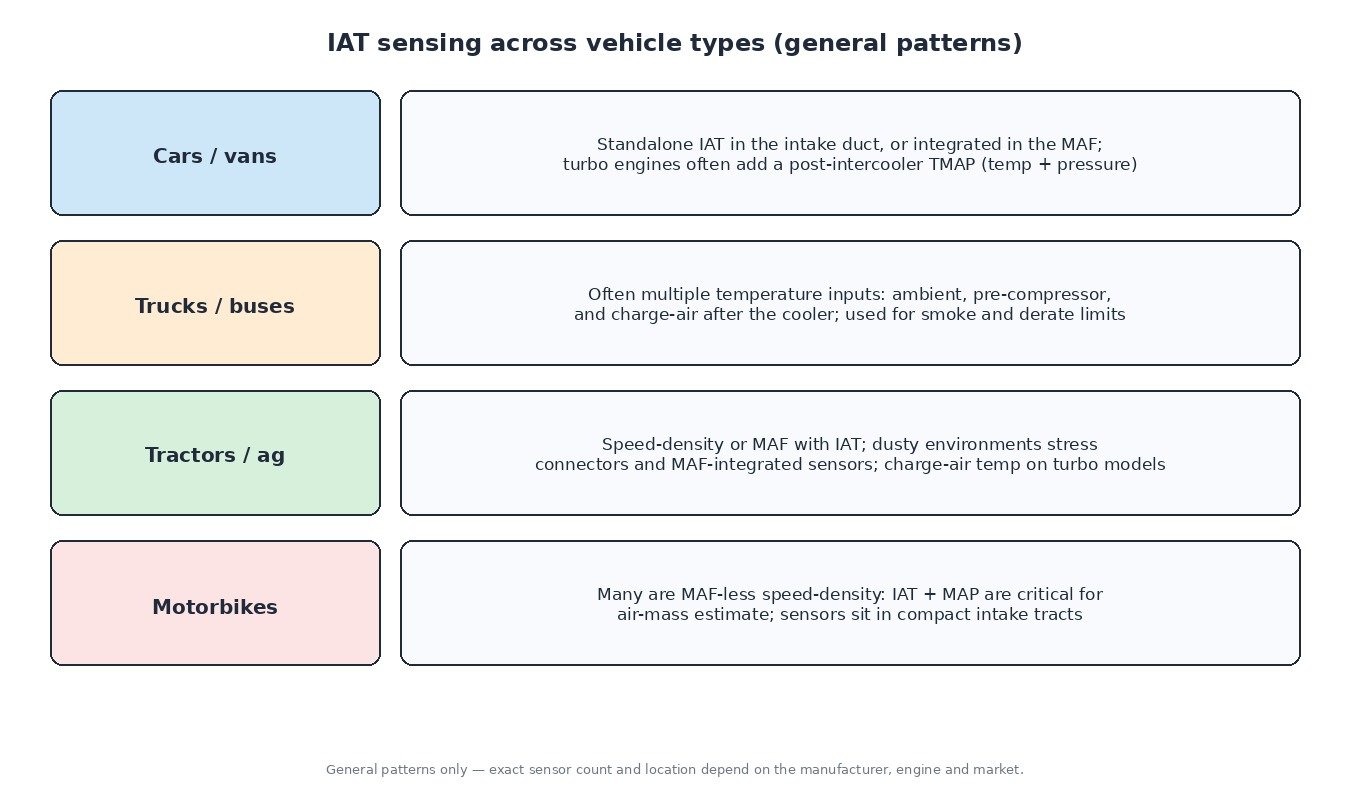
Cars and vans typically use a MAF-integrated or duct-mounted IAT, plus a TMAP after the cooler on turbo models. Heavy trucks often run ambient, intake and charge-air inputs because smoke limits and derates matter. Agricultural engines face dusty connectors and MAF housings; turbo tractors still rely on post-cooler temperature. Many motorcycles are MAF-less speed-density designs: IAT and MAP carry the air-mass estimate, so a bad IAT hits fuelling quickly.
Tuning implications
Leave IAT sensor scaling alone unless you are repairing a known hardware mismatch. Hot IAT and charge-air protection maps matter on boosted engines; disabling them to chase peak power is how pistons and turbines get hurt. A false cold IAT in the field produces overfueling and smoke that will be blamed on the file if the sensor and wiring were never checked. On ECUFileMarket, engineered files are delivered through the site upload flow; checksum correction, when needed, is a separate paid option — it is not included in file prices.
Related fault codes (DTCs)
Generic OBD-II codes per SAE J2012. Manufacturer wording varies; some brands add their own IAT and TMAP codes.
| Code | Meaning | Typical causes |
|---|---|---|
| P0110 | Intake Air Temperature Sensor 1 Circuit | General IAT circuit fault: open, short, failed sensor or connector |
| P0111 | Intake Air Temperature Sensor 1 Circuit Range/Performance | Implausible reading vs ambient/ECT, intermittent signal, contaminated MAF-integrated sensor |
| P0112 | Intake Air Temperature Sensor 1 Circuit Low | Signal shorted to ground or failed sensor (often reads very hot) |
| P0113 | Intake Air Temperature Sensor 1 Circuit High | Open circuit, poor connector or failed sensor (often reads very cold) |
| P0114 | Intake Air Temperature Sensor 1 Circuit Intermittent | Loose pin, chafed harness, heat-related intermittent open/short |
| P0070 | Ambient Air Temperature Sensor Circuit | Fault in the ambient (outside air) temperature circuit where fitted |
| P0071 | Ambient Air Temperature Sensor Range/Performance | Implausible ambient reading vs IAT/ECT after soak |
| P0072 | Ambient Air Temperature Sensor Circuit Low | Ambient sensor or wiring shorted low |
| P0073 | Ambient Air Temperature Sensor Circuit High | Ambient sensor open or shorted high |
| P0127 | Intake Air Temperature Too High | Genuine hot charge air, heat-soaked sensor, failed intercooler airflow, or skewed high reading |
| P0101 | Mass or Volume Air Flow Sensor Circuit Range/Performance | MAF plausibility fault; can accompany a contaminated MAF housing that also holds the IAT element |
| P0238 | Turbocharger/Supercharger Boost Sensor “A” Circuit High | Boost/TMAP pressure circuit high; check shared TMAP connectors when diagnosing charge-air temperature issues |
Closing
IAT is a small sensor with a large effect on density correction, cold running and hot-charge protection. Verify the live reading against reality before chasing fuel maps or boost targets.
Need an engineered tuning file for a car, van, truck, tractor or bike? Upload your original ECU read at ECUFileMarket.